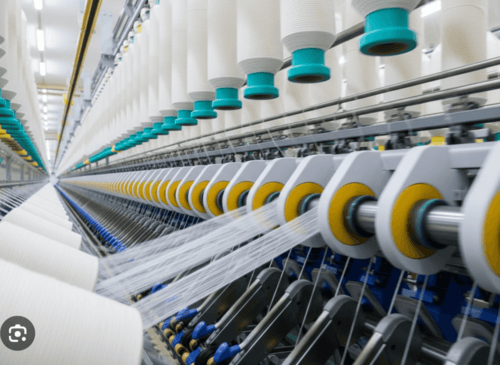
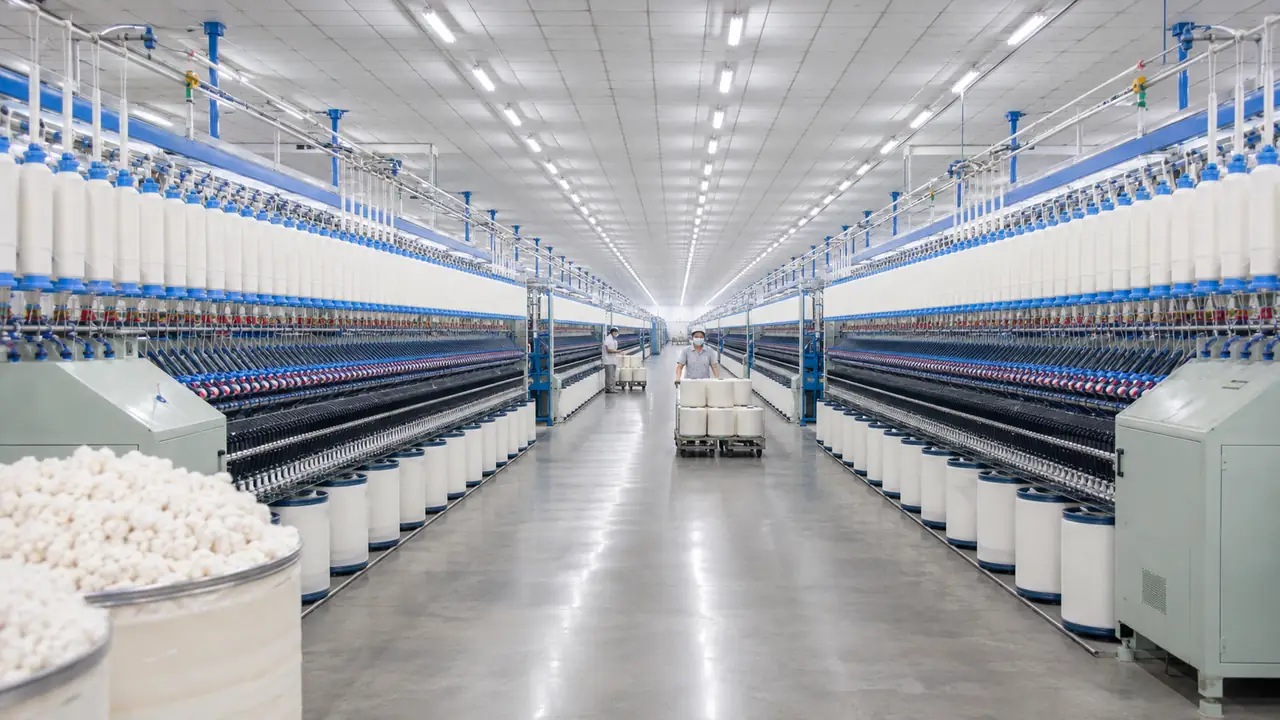
A cotton spinning mill does much more than simply twist fibres into yarn. Before twist is inserted, the mill has to manage variation between cotton bales, open compacted fibre, remove unwanted material without excessive fibre damage, individualise and orient the fibres, improve mass regularity and finally reduce the strand to the required yarn count.
For a carded ring-spun cotton yarn, the basic production route is:
Bale laydown → Blow room opening, blending and cleaning → Carding → Drawing → Roving → Ring spinning → Winding and clearing
For a combed ring-spun cotton yarn, additional preparation is inserted after carding:
Bale laydown → Blow room → Carding → Drawing/lap preparation → Combing → Finisher drawing → Roving → Ring spinning → Winding
The exact mill arrangement can vary with raw material, yarn specification, machinery and spinning technology. Rotor and air-jet spinning, for example, do not follow exactly the same route as ring spinning.
The important operating principle is this:
Every spinning stage should have a defined input, function, measurable output and release condition. A downstream machine should not be expected to permanently correct uncontrolled upstream material.
That distinction makes the process much easier to understand—and much more useful for production troubleshooting.
1. Cotton Bale Selection and Laydown: Control Variation Before Processing Starts
The spinning process effectively starts with the cotton bales selected for a particular yarn programme.
Cotton bales are not identical. Properties such as fibre length, strength, Micronaire, colour and other quality characteristics can vary between bales. A spinning mill therefore builds a laydown, combining selected bales so that variation is distributed through production rather than allowing one unusual bale to dominate a short section of yarn. CottonWorks describes bale laydown as an important preparation step before opening and blending.
What the laydown must achieve
Input: Selected cotton bales
Main purpose: Create a controlled and repeatable raw-material mix.
Important checks:
- bale and lot identification;
- relevant fibre-test data;
- consistency within and between laydowns;
- contamination risk;
- traceability to the yarn lot.
Output: A planned cotton mix ready for gradual opening.
A practical mistake is to look only at the average fibre result. Two laydowns can show similar averages while having different distributions or bale-to-bale variation. TextileInfoHub’s existing spinning-efficiency guide therefore recommends controlling variation within and between laydowns, not only the mean value.
This is the first example of a principle that applies throughout spinning:
Variation must be controlled at its source, not merely averaged at the end.
2. Blow Room: Open, Blend and Clean Without Unnecessary Fibre Damage
Cotton arrives in a dense bale. A card cannot efficiently process that material in its compacted condition.
The blow room therefore progressively converts compressed cotton into smaller, more open tufts while simultaneously blending the material and removing suitable trash and contamination. Modern systems may combine bale opening, coarse cleaning, fine cleaning, blending, contamination detection and controlled feed to carding.
The four main jobs of the blow room
Opening: Separate large compressed fibre masses into progressively smaller tufts.
Blending: Mix material from different bales so that fibre-property variation is distributed.
Cleaning: Remove appropriate trash and foreign matter from the opened fibre mass.
Uniform feeding: Deliver a reasonably consistent fibre mass to the card.
The word cleaning can create a misleading objective. The best blow-room result is not necessarily the line that removes the greatest possible quantity of material.
CottonWorks specifically warns that overworking cotton during opening and cleaning can cause fibre breakage, while inadequate opening can reduce cleaning and carding effectiveness.
The operational target is therefore a balance:
Remove unwanted material while preserving useful fibre and preparing sufficiently small, uniform tufts for carding.
What to monitor
Useful mill controls can include:
- raw-material identity and lot;
- waste by defined waste stream;
- visible contamination;
- cleaning performance;
- feed consistency;
- evidence of excessive fibre damage;
- card performance after a blow-room change.
Universal cleaner settings or waste percentages should not be copied from another mill. The correct balance depends on cotton characteristics, machinery, yarn route and finished-product requirement.
3. Carding: Convert Open Fibre into a Controlled Sliver
Carding is the stage at which the loose cotton mass first becomes a continuous textile strand called sliver.
Wire-covered rotating surfaces act on the opened cotton to separate and individualise fibres. Carding also removes remaining small trash and many neps, improves fibre orientation and condenses the resulting thin web into a sliver that can be coiled into a can.
Input
Opened, blended and cleaned cotton from the blow room.
Main functions
- further fibre opening and individualisation;
- removal of selected residual impurities;
- reduction of neps;
- improvement of fibre orientation;
- formation of a continuous sliver.
Output
Card sliver in cans.
This is a critical transition. Blow-room material is still a loose fibre mass; card output is a continuous linear product whose mass variation can be measured and traced into subsequent processes.
Why carding quality travels downstream
If card sliver contains excessive variation, neps or poor fibre preparation, drawing can redistribute some variation but cannot make every upstream problem disappear.
The useful question is therefore not:
“Is the card running?”
It is:
“Is the card delivering sliver that allows the next drafting stage to remain stable while meeting the final yarn requirement?”
Typical verification may include sliver linear density, mass variation, nep trends, waste and relevant fibre-test results.
Machine settings, flats, wire condition, suction and operating parameters require machine-specific expertise and should be validated according to the fibre and installed equipment rather than treated as universal values.
4. Drawing: Improve Evenness, Blending and Fibre Orientation
Card slivers are fed to a draw frame in multiple ends. These slivers are combined and passed through drafting rollers operating at different peripheral speeds.
The process doubles and drafts the material: several incoming slivers are combined while the total strand is attenuated to the required delivered linear density. This improves blending, fibre alignment and mass regularity.
Input
Several carded or previously drawn slivers.
Main functions
- doubling;
- drafting;
- blending;
- improved fibre parallelisation;
- improved sliver regularity.
Output
Drawn sliver.
Modern draw frames may use autolevelling to control delivered sliver variation. Current spinning-system offerings continue to position draw frames as a dedicated preparation stage between carding and later spinning processes.
A useful troubleshooting distinction
Drawing can average random variation, but it should not be treated as permission to ignore a systematic carding or raw-material problem.
If a recurring defect enters every feed sliver, combining several defective slivers does not automatically remove the root cause.
When yarn quality changes, trace the evidence backward:
Yarn → roving → draw sliver → card sliver → blow room → laydown
That is usually more informative than immediately changing the final spinning-machine setting.
5. Combing: An Optional Quality Route, Not a Mandatory Stage
Combing is added when the product justifies a more selective fibre preparation route.
Before combing, drawn slivers are normally prepared into a lap suitable for the comber. During combing, short fibres, remaining neps and small trash particles are removed while fibre parallelisation is improved. The removed material is commonly referred to as comber noil.
What combing changes
Compared with a comparable carded route, combing can produce a fibre assembly with:
- a longer effective fibre population;
- fewer neps;
- less residual trash;
- better fibre orientation;
- smoother and more uniform yarn potential;
- improved suitability for finer yarn requirements.
These benefits come with additional processing and fibre removal, so combed is not automatically the economically correct route for every yarn.
A particularly useful purchasing and QC point is that the word “combed” does not completely specify yarn quality.
CottonWorks notes that combed-yarn quality depends partly on the input fibre and the extent of combing. Therefore, comparing two yarns solely by the percentage of noil removed can be misleading unless the incoming material and processing conditions are comparable.
That makes combing a quality-versus-realisation decision, not simply an extra cleaning operation.
Carded vs Combed Cotton Yarn Route
| Factor | Carded route | Combed route |
|---|---|---|
| Short fibres and neps | More remain | More selectively removed |
| Fibre orientation | Lower | Higher |
| Yarn surface | Generally hairier | Generally smoother |
| Yarn evenness potential | Lower | Higher |
| Fine-count capability | More limited | Better suited |
| Processing requirement | Fewer stages | Additional preparation and combing |
| Material removal | Lower | Higher because of noil |
These are route-level tendencies, not guaranteed specifications. Final yarn performance still depends on cotton quality, machinery, settings, yarn count and process control.
6. Finisher Drawing: Stabilise the Combed Sliver Before Roving
After combing, further drawing is commonly used to improve the uniformity of the combed sliver and prepare it for the next operation. CottonWorks notes that one or two additional drawing processes may follow combing depending on the route.
The principle remains the same:
combine, draft, orient and equalise the fibre strand without introducing unnecessary variation.
The exact number of passages is mill- and route-specific and should not be treated as a universal rule.
7. Roving: Prepare a Fine, Cohesive Feed for Ring Spinning
A draw-frame sliver is still too heavy and too weakly cohesive for conventional ring spinning.
The roving or speed-frame process therefore drafts the sliver to a much lower linear density and inserts a small amount of twist so that the strand has sufficient integrity for winding, handling and feeding to the ring frame. The roving is wound onto a bobbin.
Input
Finisher-drawn carded or combed sliver.
Main functions
- reduce linear density;
- provide controlled attenuation;
- add enough cohesion for handling;
- build a suitable bobbin package.
Output
Roving bobbin.
An important process distinction is that roving is associated with the ring-spinning route. CottonWorks specifically identifies roving as a preparation stage used for ring spinning.
This matters when comparing mill flows because rotor and air-jet systems can accept sliver directly.
What should be controlled
Typical considerations include:
- roving linear density;
- mass regularity;
- twist/cohesion;
- bobbin build;
- broken ends;
- unwinding behaviour at the ring frame.
The objective is not maximum roving twist. Too little cohesion creates handling problems, while unnecessary twist can make drafting at the ring frame more difficult. The appropriate value therefore has to be validated for the material and machine combination.
8. Ring Spinning: Final Draft, Twist and Yarn Formation
The ring frame converts roving into the final yarn.
Roving enters a roller drafting system, where its linear density is reduced to the required yarn count. After leaving the front drafting rollers, twist is inserted into the fibre strand and the yarn is wound onto a rotating bobbin through the ring-and-traveller mechanism.
Input
Roving.
Main functions
- final drafting;
- final yarn-count formation;
- twist insertion;
- yarn formation;
- winding onto the ring bobbin or cop.
Output
Ring-spun yarn on relatively small spinning packages.
Ring spinning remains an important system where yarn structure, count range and product characteristics justify its process route. Current integrated ring-spinning systems still include blow room, carding, drawing, roving, ring spinning and subsequent winding as separate operations.
Quality indicators to watch
Depending on the mill and end use, useful measurements may include:
- yarn count and count variation;
- twist;
- mass unevenness;
- imperfections;
- hairiness;
- tensile properties;
- end-break behaviour;
- waste;
- lot-to-lot consistency.
TextileInfoHub’s existing spinning guide stresses an important diagnostic rule: increased end breaks or deteriorating yarn quality should not automatically be blamed on one fibre value. Preparation quality, components, machine condition, settings, suction and other variables can produce similar symptoms.
9. Winding and Yarn Clearing: Make a Usable Final Package
The small packages produced by ring spinning are generally not the final packages supplied to weaving or knitting.
During winding, yarn from ring bobbins is transferred to a larger cone or cheese. Electronic clearing can detect selected yarn faults and remove them before the yarn is rewound. Joining or splicing restores yarn continuity, and waxing may be used for suitable knitting yarn applications.
Winding therefore performs three jobs
Package formation: Build a larger package suitable for transport and downstream unwinding.
Quality control: Detect and remove selected yarn faults according to the clearing policy.
Joining: Connect yarn ends with a controlled knot or splice system.
This is why winding should not be regarded as merely “putting yarn onto a cone.”
The winding department can reveal problems created much earlier in spinning. Excessive clearer cuts, poor splice quality or abnormal package behaviour may point back to yarn formation, roving, preparation or raw material.
A technically sound winding KPI should therefore distinguish between:
- genuine yarn faults;
- unnecessary clearer cuts;
- joining quality;
- package defects;
- accepted final output.
How Rotor and Air-Jet Spinning Change the Process Flow
The sequence above primarily describes ring-spun cotton yarn.
Rotor and air-jet systems change the later part of the process.
Ring route
Draw sliver → Roving → Ring spinning → Separate winding
Rotor route
Draw sliver → Rotor spinning → Final package
Rotor spinning accepts sliver rather than roving and forms a usable package on the spinning machine, eliminating the separate roving and conventional post-ring winding operations.
Air-jet route
Air-jet spinning also uses sliver as its input and produces a wound yarn package, so the traditional ring-spinning roving stage and separate ring-bobbin rewinding stage are not required.
This is why a diagram labelled simply “cotton spinning process” can be misleading unless the spinning technology is identified.
Quality Control Through the Entire Cotton Spinning Process
The best process control is not to test only the finished yarn.
A spinning mill should be able to follow important material changes from the bale through intermediate products and into the yarn.
Raw material
Check: Fibre-property distribution, laydown identity, contamination and lot consistency.
Question: Did the raw-material population change?
Blow room
Check: Waste streams, cleaning behaviour, blending consistency and evidence of fibre damage.
Question: Are we removing unwanted material without sacrificing excessive useful fibre?
Carding
Check: Sliver linear density and variation, neps, waste and fibre preparation.
Question: Is card sliver stable enough for drafting?
Drawing
Check: Delivered sliver regularity, autoleveller data where applicable and machine-to-machine consistency.
Question: Is drawing actually reducing variation, or merely carrying a systematic upstream problem forward?
Combing
Check: Noil, sliver quality, neps and lot consistency.
Question: Is the additional fibre removal producing the quality improvement for which the process was selected?
Roving
Check: Linear density, regularity, cohesion/twist and bobbin build.
Question: Can the roving unwind and draft consistently at the ring frame?
Ring spinning
Check: Count, unevenness, imperfections, hairiness, tensile properties, end breaks and waste.
Question: Is the spinning frame converting prepared fibre into acceptable yarn at the intended production condition?
Winding
Check: Clearer cuts, splice quality, package build and accepted yarn.
Question: Are cuts exposing real upstream faults or creating unnecessary waste?
This cross-stage approach is more useful than diagnosing every yarn problem at the machine where it is finally detected. TextileInfoHub’s current spinning-efficiency guidance similarly recommends tracing changes through raw material, sliver, roving and yarn before identifying root cause.
Yarn Realisation: Measure Material Conversion with a Clear Boundary
One of the most important commercial indicators in a spinning mill is yarn realisation.
A basic calculation is:
Yarn realisation (%) = Accepted yarn output ÷ Raw-material input × 100
TextileInfoHub’s broader manufacturing guide also stresses that the result is meaningful only when the measurement boundary is defined—for example, treatment of work in process, recoverable waste, saleable by-products and moisture basis.
Worked example
Assume for illustration:
- Raw cotton charged to the defined process period = 10,000 kg
- Accepted yarn produced on the same declared basis = 8,700 kg
Then:
Yarn realisation = 8,700 ÷ 10,000 × 100 = 87%
The 87% is only a worked assumption, not a benchmark or recommended target.
Two mills cannot validly compare realisation unless both are using the same material and accounting boundary.
This becomes especially important when comparing carded and combed routes because combing intentionally removes additional fibre as noil in exchange for a different fibre population and yarn-quality potential.
Five Common Misunderstandings About Cotton Spinning
1. “Blow room cleaning should remove as much material as possible.”
Not necessarily. Excessive mechanical action can damage useful fibre. Opening and cleaning must balance trash removal against fibre preservation.
2. “Carding and combing are alternatives.”
No. Cotton intended for a combed ring-spun route is carded first; combing is an additional operation after carding and suitable preparation.
3. “Combed yarn is always the correct quality choice.”
No. Combing provides particular fibre and yarn benefits but adds processing and removes material. The route should be justified by yarn count, product requirement and economics.
4. “Every cotton spinning system requires roving.”
No. Roving is required in the conventional ring-spinning route, while rotor and air-jet systems can process sliver directly.
5. “Winding only changes the package size.”
No. Winding can also perform yarn clearing and joining, making it both a package-forming and a quality-control operation.
The Most Useful Way to Understand a Spinning Mill
Instead of memorising machine names, follow four changes in the material.
Stage 1 — Control the fibre population
Bale selection → opening → blending → cleaning
The objective is to create a controlled fibre mix while removing appropriate unwanted material.
Stage 2 — Create and improve the fibre strand
Carding → drawing → combing where required → drawing
The objective shifts to fibre individualisation, orientation, blending and mass regularity.
Stage 3 — Build the yarn structure
Roving → ring spinning
The strand becomes progressively finer until final yarn count and twist are produced.
Stage 4 — Prepare yarn for the next process
Winding → clearing → package formation
The yarn becomes a controlled package suitable for weaving, knitting or another downstream operation.
This four-stage view is more useful operationally than treating spinning as an isolated list of machines.
Final Takeaway
The complete cotton spinning process is a progressive conversion of a variable mass of staple fibres into a controlled yarn.
The sequence is important, but the interface between processes is even more important.
A stable ring frame cannot fully compensate for an unstable laydown. A draw frame cannot permanently repair every carding problem. A winding clearer can remove selected yarn faults, but it cannot recover the fibre, energy and machine time already consumed in creating those faults.
For production and quality teams, the practical approach is therefore:
- define the intended yarn and spinning route;
- control raw-material variation;
- establish measurable output requirements at every preparation stage;
- trace abnormalities through sliver, roving and yarn rather than changing the final machine first;
- measure accepted output and waste using fixed definitions; and
- validate machine settings against the actual cotton, equipment and product instead of copying generic values.
For a deeper look at how staple length, short-fibre distribution and Micronaire affect drafting, yarn quality and spinning efficiency, continue with TextileInfoHub’s dedicated spinning-efficiency guide.
Frequently Asked Questions
What is the cotton spinning process in order?
For conventional carded ring spinning, the basic sequence is bale laydown, blow room, carding, drawing, roving, ring spinning and winding. A combed route adds lap preparation, combing and further drawing before roving.
What is the purpose of the blow room?
The blow room progressively opens compacted cotton, blends fibre from different bales and removes suitable trash and contamination before carding.
What does a carding machine produce?
A carding machine converts opened fibre into a continuous strand called card sliver while further individualising fibres and removing selected residual trash and neps.
Why is drawing required after carding?
Drawing combines several slivers and drafts them through rollers to improve blending, fibre orientation and mass regularity before later spinning operations.
What is the difference between carded and combed cotton yarn?
Combing adds an extra preparation stage that removes additional short fibres, neps and residual trash and improves fibre alignment. This can support smoother, more even and finer yarns, but requires additional processing and fibre removal.
Is roving required for every spinning system?
No. Roving is a preparation stage for conventional ring spinning. Rotor and air-jet spinning can use sliver directly.
What is the final process after ring spinning?
Ring-spun yarn normally passes through winding, where small ring bobbins are rewound into larger packages and yarn clearing and joining can also be carried out.