A soft flow dyeing machine should not be selected from its advertised liquor ratio alone.
A machine may claim an extremely low liquor ratio but still perform poorly with bulky fabrics, partial loads, difficult elastane blends or dark reactive shades. The correct machine must circulate fabric smoothly, maintain level dyeing, reproduce laboratory recipes and deliver acceptable water, steam, electricity and processing-time figures over the complete dyeing cycle.
Quick answer: For most modern knitted-fabric dye houses, shortlist high-temperature soft flow machines that can demonstrate low-tension fabric transport, adjustable nozzle conditions, variable loading, controlled chemical dosing and a low liquor ratio on your actual fabrics. Require full-cycle consumption figures in litres, kilograms of steam and kilowatt-hours per kilogram of fabric—not just the initial bath ratio.
Soft Flow Dyeing Machine Specifications at a Glance
| Parameter | What to ask the supplier | Why it matters |
|---|---|---|
| Machine type | Hydraulic soft flow, overflow, air-assisted or airflow | Determines fabric transport and application range |
| Batch capacity | Minimum and maximum load for each fabric type | Nominal capacity may not be achievable with bulky fabrics |
| Liquor ratio | Guaranteed ratio at the proposed load and fabric | Influences bath volume, heating and chemical use |
| Total water | Litres/kg for a complete agreed recipe | More meaningful than initial liquor ratio |
| Fabric speed | Proven range on delicate and heavy fabrics | Excessive speed can increase abrasion and tension |
| Nozzle | Diameter, pressure and automatic adjustment range | Controls fabric movement and penetration |
| Main pump | Flow, head, VFD control and operating power | Affects circulation, leveling and electricity |
| Heating and cooling | Rate under your actual utility conditions | Influences batch time and productivity |
| Dosing | Dye, salt, alkali and auxiliary dosing method | Affects reproducibility and unlevel-dyeing risk |
| Automation | Recipe control, alarms, reports and ERP interface | Reduces operator variation |
| Construction | Wetted material, pressure rating and certification | Determines safety and equipment life |
| Local support | Engineer availability and spare-parts lead time | Controls production downtime |
What Is a Soft Flow Dyeing Machine?
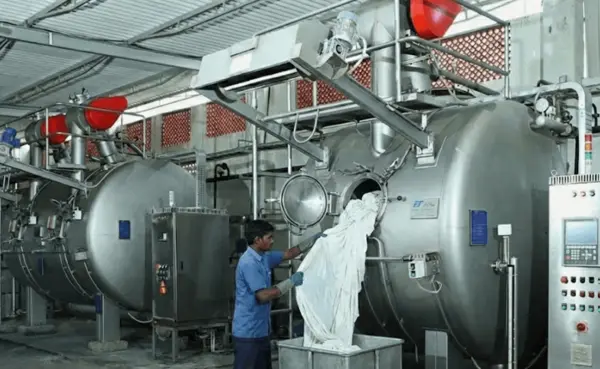
A soft flow dyeing machine is a batch-dyeing machine in which fabric is normally processed in rope form and circulated continuously through a controlled flow of dye liquor.
The fabric is transported by a combination of a lifting reel or winch and liquor flowing through a nozzle. Compared with an aggressive jet arrangement, a correctly configured soft flow system aims to move the material under lower tension and with less surface abrasion.
The machine commonly includes:
- Pressurized dyeing vessel
- Fabric-storage chamber
- Lifting reel
- Nozzle system
- Main circulation pump
- Heat exchanger
- Internal plaiter
- Dye and chemical preparation tanks
- Dosing system
- Filters
- Temperature and pressure sensors
- Programmable controller
- Loading and unloading arrangement
High-temperature, high-pressure models can process polyester and its blends at elevated temperature. The same machine may also be used for cotton, viscose, modal, polyamide and elastane blends when the hydraulic system and recipe are correctly configured.
How a Soft Flow Dyeing Machine Works
1. Fabric loading
The fabric is sewn into an endless rope and loaded into the machine. Each rope must have an appropriate length and weight for its chamber.
Incorrect rope length can cause poor circulation, excessive crowding, entanglement or repeated stopping.
2. Bath preparation
Water is filled to the required level and the dyeing bath is prepared. The initial volume depends on the machine design, fabric absorption, batch load and planned liquor ratio.
3. Fabric circulation
The lifting reel guides the fabric toward the nozzle. Controlled liquor flow assists the rope through the nozzle and returns it to the storage chamber.
The plaiter should distribute the fabric uniformly inside the chamber rather than allowing it to pile in one location.
4. Heating and chemical dosing
The bath passes through a heat exchanger while dyes, salt, alkali, acid and auxiliaries are added according to the programmed recipe.
Correct dosing rate is essential. Fast or poorly mixed alkali addition can produce unlevel reactive dyeing even when the machine circulation is satisfactory.
5. Dyeing, washing and cooling
The machine maintains the required temperature, circulation and dosing profile. After fixation, the fabric passes through rinsing, washing, neutralization or reduction clearing, depending on the fibre and dye class.
6. Unloading
The dyed rope is discharged for opening, hydro-extraction, drying or further processing.
A well-designed unloading system should minimize operator effort, tension and fabric damage.
Soft Flow vs Jet, Overflow and Airflow Dyeing
Machine terminology varies between manufacturers. Two machines described as “soft flow” may use different transport principles.
| System | Main fabric-transport method | Typical advantage | Main point to verify |
| Soft flow | Reel plus controlled liquor flow | Lower-tension rope processing | Nozzle pressure and crease control |
| Jet dyeing | Higher-energy liquor jet | Fast circulation and broad application | Surface abrasion and rope tension |
| Overflow dyeing | Overflow liquor with reel assistance | Gentle movement for sensitive fabrics | Bath volume and productivity |
| Airflow or air-assisted | Air or air-water mixture | Potential for lower bath volume | Fabric suitability and power demand |
| Beam dyeing | Stationary fabric on a beam | Avoids rope marks | Penetration and batch flexibility |
These categories overlap. Do not rely on the machine name alone. Ask the supplier to explain:
- What actually transports the fabric?
- How much force comes from the reel?
- How much comes from the liquor or air stream?
- What nozzle pressure is used?
- Can the nozzle condition change automatically?
- What happens at partial load?
- How is the fabric laid inside the chamber?
Liquor Ratio: The Most Misunderstood Specification
Liquor ratio is the relationship between fabric weight and dye-bath volume.
For example, a 500 kg batch operating at a 1:5 liquor ratio has an initial working bath of approximately:
500 kg × 5 litres/kg = 2,500 litres
This does not mean the complete process consumes only 2,500 litres. Additional water may be used for:
- Preparation
- Dye and chemical tanks
- Rinsing
- Soaping
- Neutralization
- Reduction clearing
- Machine cleaning
- Filter cleaning
- Cooling or seal systems
Therefore, request two different figures:
- Operating liquor ratio
- Total fresh water consumption for the complete recipe, in litres/kg
The second number is more useful for comparing operating cost and effluent load.
Do not accept one liquor-ratio claim for every situation
The achievable ratio can change with:
- Fabric GSM
- Fabric absorption
- Bulk and construction
- Fibre type
- Batch loading
- Shade depth
- Number of washing steps
- Chamber geometry
- Process route
A supplier advertising “starting from 1:3.5” is not necessarily guaranteeing that ratio for your cotton fleece, viscose jersey or dark reactive shade.
How to Select Machine Capacity
Nominal capacity is not enough to size a soft flow dyeing machine.
A chamber advertised for 250 kg may accept that weight of compact single jersey but a lower weight of bulky fleece or terry fabric.
Ask for maximum and minimum loading figures for each product group.
Information the supplier needs
Prepare a production-mix table containing:
- Fibre composition
- Fabric construction
- GSM
- Fabric width
- Tubular or open-width condition
- Elastane percentage
- Average lot size
- Minimum lot size
- Maximum lot size
- Light, medium and dark shade percentages
- Required daily production
- Number of working hours
- Expected style changes
Daily production calculation
A basic production estimate is:
Daily output = average batch load × completed batches per day
For example:
- Nominal machine capacity: 500 kg
- Average loading: 85%
- Average completed cycles: 3.2 per day
Estimated output:
500 × 0.85 × 3.2 = 1,360 kg/day
This estimate should then be adjusted for:
- Recipe variation
- Cleaning time
- Preventive maintenance
- Style changes
- Unplanned stoppages
- Reprocessing
- Utility interruptions
Do not calculate capacity using the supplier’s shortest polyester cycle if most of your production is dark reactive cotton.
Fabric Suitability
Cotton knits
For cotton single jersey, interlock and rib, evaluate:
- Crease formation
- Rope opening after dyeing
- Pilling
- Surface hairiness
- Levelness
- Alkali dosing
- Washing efficiency
Cotton-elastane and polyester-elastane
Stretch fabrics require controlled tension and stable fabric circulation.
Test:
- Width loss
- Spirality
- Elastane damage
- Permanent creases
- Rope marks
- Running stability at reduced nozzle pressure
Viscose and modal
Wet-strength sensitivity makes viscose and modal vulnerable to abrasion, stretching and creasing.
The supplier should demonstrate these fabrics without relying on excessive fabric speed or nozzle pressure.
Polyester and synthetic blends
For polyester dyeing, confirm:
- Maximum operating temperature
- Pressure rating
- Heating and cooling performance
- High-temperature drain option
- Oligomer-management procedure
- Reduction-clearing capability
- Reproducibility between laboratory and production
Fleece, terry and pile fabrics
These materials occupy more chamber volume than their weight suggests.
Evaluate:
- Actual loading capacity
- Pile preservation
- Chamber crowding
- Rope entanglement
- Plaiter performance
- Unloading behavior
Woven fabrics
Some woven fabrics can be processed successfully in rope form, but crease-sensitive articles should be tested carefully. Open-width or beam dyeing may be more appropriate where rope marks are unacceptable.
Nozzle and Fabric-Speed Selection
The highest possible fabric speed is not automatically the best.
High speed may shorten turnover time but can also increase:
- Surface abrasion
- Pilling
- Rope tension
- Entanglement
- Edge curling
- Crease formation
- Seam failure
Ask for:
- Minimum and maximum fabric speed
- Reel-speed control
- Nozzle diameter options
- Nozzle-pressure range
- Automatic pressure control
- Fabric-seam detection
- Rope-stoppage detection
- Synchronization between reel and pump
- Demonstrated results on your lowest-GSM and most delicate articles
The correct setting is the lowest mechanical action that still provides stable circulation and level dyeing.
Pump and Hydraulic System
The main circulation pump is one of the largest electrical loads in a hydraulic dyeing machine.
Its performance must be evaluated by flow, head, efficiency and control range—not motor size alone.
Important questions include:
- Is the pump controlled by a variable-frequency drive?
- Can flow be reduced safely for delicate fabrics?
- Does efficiency fall sharply at partial load?
- Is liquor flow measured or only inferred from motor frequency?
- How accessible are the pump, filter and mechanical seal?
- What is the expected seal life?
- Is a spare seal or pump assembly available locally?
- Can the machine continue operating if an electronic flowmeter fails?
Request electrical consumption in kWh/kg for a complete agreed recipe.
Heating, Cooling and Heat Recovery
Heating and cooling rates depend on the machine and the dye house utilities.
A quoted heating rate is meaningful only when the supplier also states:
- Starting and final temperature
- Batch load
- Liquor volume
- Steam pressure
- Steam quality
- Cooling-water inlet temperature
- Cooling-water pressure
- Heat-exchanger condition
- Whether dosing occurs during the measurement
Heat recovery can reduce steam demand, but its benefit depends on the temperature difference and the availability of simultaneous hot-effluent and cold-water demand.
Ask the supplier to provide a heat and mass balance for the proposed recipe.
Chemical Dosing and Recipe Reproducibility
Low-liquor-ratio dyeing increases the importance of dosing accuracy because a small dosing error produces a larger concentration change.
The machine should provide controlled addition for:
- Dyestuff
- Salt
- Alkali
- Acid
- Reducing agent
- Oxidizing agent
- Soaping agents
- Other auxiliaries
Evaluate:
- Tank volumes
- Mixing arrangement
- Dosing-pump range
- Minimum accurate dose
- Linear and progressive dosing
- Direct versus indirect addition
- Tank rinsing
- Transfer losses
- Automatic level measurement
- Recipe interlocks
The production controller should record actual temperature, dosing and machine events—not only the programmed curve.
Automation and Data
Useful automation features include:
- Recipe management
- Operator permissions
- Automatic filling and draining
- Heating and cooling control
- Flow and pressure monitoring
- Fabric-stoppage alarms
- Seam detection
- Automatic dosing
- Batch reports
- Alarm history
- Utility metering
- Remote support
- ERP or MES integration
- Recipe-change audit trail
Automation does not correct an unsuitable mechanical design, but it can reduce batch-to-batch variation and make problems easier to investigate.
Construction, Safety and Maintenance
A high-temperature dyeing machine is a pressure vessel. Confirm compliance with the regulations applicable in the installation country.
The technical offer should identify:
- Stainless-steel grade for wetted parts
- Vessel design pressure and temperature
- Pressure-vessel certification
- Safety-valve arrangement
- Door interlocks
- Emergency-stop system
- Over-temperature protection
- Pressure and level sensors
- Weld inspection
- Insulation
- Electrical-panel protection
- Pneumatic component specifications
Also inspect maintenance access around:
- Main pump
- Mechanical seal
- Heat exchanger
- Nozzle
- Filter
- Plaiter
- Reel bearings
- Valves
- Sensors
- Dosing pumps
A machine that saves water but remains stopped for want of a seal, sensor or controller is not a low-cost machine.
Supplier Trial and Acceptance Test
Require the supplier to process your fabrics before final selection.
Recommended trial fabrics
Include at least:
- Lightweight cotton-elastane jersey
- Dark reactive cotton shade
- Viscose or modal knit
- Polyester-elastane fabric
- Bulky fleece or terry article
- Your most crease-sensitive product
- Your highest-reprocessing article
Record these results
| Performance measure | Required unit |
| Initial liquor ratio | litres/kg |
| Total fresh water | litres/kg |
| Steam | kg steam/kg fabric |
| Electricity | kWh/kg fabric |
| Total process time | minutes/batch |
| Average batch load | kg |
| Right-first-time rate | percentage |
| Shade difference | agreed ΔE method |
| Reprocessing | percentage |
| Width and GSM change | percentage |
| Fabric damage | agreed inspection grade |
| Unloading time | minutes |
| Chemical consumption | kg/kg or cost/kg |
The supplier and buyer should agree on how each value is measured before the trial begins.
ROI Calculation
Do not calculate payback from liquor ratio alone.
Use:
Annual net saving = water saving + steam saving + electricity saving + chemical saving + effluent-treatment saving + increased output + reduced reprocessing − additional maintenance and finance cost
Then:
Payback period = incremental investment ÷ annual net saving
For a fair comparison, calculate every utility per kilogram of saleable fabric.
Include:
- Borewell or municipal water cost
- Water-treatment cost
- Boiler fuel and efficiency
- Electricity tariff
- Effluent and ZLD treatment
- Salt and alkali
- Dyes and auxiliaries
- Reprocessing
- Downtime
- Labour
- Spare parts
- Software and annual support
- Finance cost
- Residual value
A low-cost machine with poor shade reproducibility can have a higher lifetime cost than a more expensive machine with reliable right-first-time production.
Manufacturers and Models to Investigate
The following are examples for technical investigation, not a ranking or endorsement.
Thies iMaster H₂O
Thies describes the iMaster H₂O as a short-liquor-ratio machine available in single- or multiple-chamber configurations, with chamber sizes from 100 to 300 kg depending on configuration.
Official information: Thies iMaster H₂O.
Fong’s and THEN
Fong’s offers several hydraulic, overflow and airflow configurations. The range includes ECO-8, SOFTWIN and THEN SMARTFLOW TSF.
The SMARTFLOW TSF manufacturer page states a starting liquor ratio of 1:3.3. Treat this as a starting condition and require confirmation for your fabric, batch and recipe.
Official information: Fong’s ECO-8, Fong’s SOFTWIN and THEN SMARTFLOW TSF.
Brazzoli
Brazzoli’s Eco-aero is an air-assisted alternative designed for woven and knitted fabrics. Its literature describes fabric transport using controlled airflow and an air-water mixture.
Official information: Brazzoli Eco-aero.
Tonyss Engineering
Tonyss manufactures soft flow machines in India. Its Ecotech+ range is offered in multiple chamber configurations and the manufacturer publishes liquor-ratio and full-cycle water-consumption examples.
These figures should be verified through a controlled trial using the buyer’s recipes and fabrics.
Official information: Tonyss Ecotech+.
Soft Flow Dyeing Machine RFQ Checklist
Include the following in every request for quotation:
Production information
- Fibre and fabric mix
- GSM range
- Average batch size
- Minimum batch size
- Maximum batch size
- Daily production target
- Shade distribution
- Tubular or open-width input
- Elastane percentage
- Number of working shifts
Machine information
- Machine principle
- Number of chambers
- Capacity per chamber
- Minimum loading
- Nozzle sizes
- Fabric-speed range
- Main pump data
- Installed motor power
- Heat-exchanger area
- Heating and cooling guarantees
- Dosing tanks and pumps
- High-temperature drain
- Sampling arrangement
- Automatic filter
- Fabric seam and stoppage detection
- Controller and software
- Utility meters
- ERP/MES connection
- Pressure-vessel certification
Commercial information
- Base-machine price
- Optional equipment
- Taxes and freight
- Installation
- Commissioning
- Training
- Civil and utility requirements
- Warranty
- Preventive-maintenance schedule
- Recommended spare parts
- Local service engineer
- Spare-part delivery time
- Annual software or support fees
- Trial and acceptance conditions
Frequently Asked Questions
What liquor ratio should a modern soft flow machine achieve?
Many current machines advertise starting ratios between approximately 1:3 and 1:6. The achievable value depends on machine design, fabric, loading and recipe.
Compare guaranteed performance on your production mix rather than selecting an arbitrary universal number.
Which fabrics are suitable for soft flow dyeing?
Soft flow machines are commonly used for cotton knits, polyester, viscose, modal, polyamide and elastane blends. Suitability depends on fabric construction and machine settings.
Bulky, delicate and crease-sensitive fabrics require production trials.
Does a lower liquor ratio always save money?
A lower bath volume can reduce the liquid that must be heated and treated. However, savings can be lost through poor washing, reprocessing, excessive pump power or reduced loading.
Compare full-cycle consumption and right-first-time performance.
What is the difference between soft flow and airflow dyeing?
Soft flow machines primarily use controlled liquor flow and a reel to transport the fabric. Airflow systems use air or an air-water mixture as a major transport medium.
Manufacturer terminology varies, so ask for a clear explanation of the transport principle.
How much does a soft flow dyeing machine cost?
Price depends on capacity, number of chambers, pressure rating, automation, dosing, utility metering, accessories, country of manufacture and local service.
Compare complete installed cost, not only the machine’s ex-factory price.
Should I buy an imported or Indian machine?
The decision should be based on proven fabric quality, utility consumption, construction, automation, service response and total lifetime cost.
A technically advanced machine without local service can be a poor investment. A locally supported machine should still pass the same controlled trial and acceptance standards.
Final Recommendation
Choose a soft flow dyeing machine by testing four things together:
- Fabric quality
- Reproducibility
- Complete-cycle utility consumption
- Reliable daily output
Do not select a machine because it has the lowest advertised liquor ratio, highest fabric speed or lowest purchase price.
Give every shortlisted supplier the same fabric set and recipes. Measure water, steam, electricity, processing time, shade accuracy and fabric condition. Put the accepted performance figures into the purchase contract.
That is the safest way to convert a dyeing-machine investment into lower cost, stable quality and dependable production.
Read our Technology guide section for information regarding textile machines.
Last reviewed: July 2026.