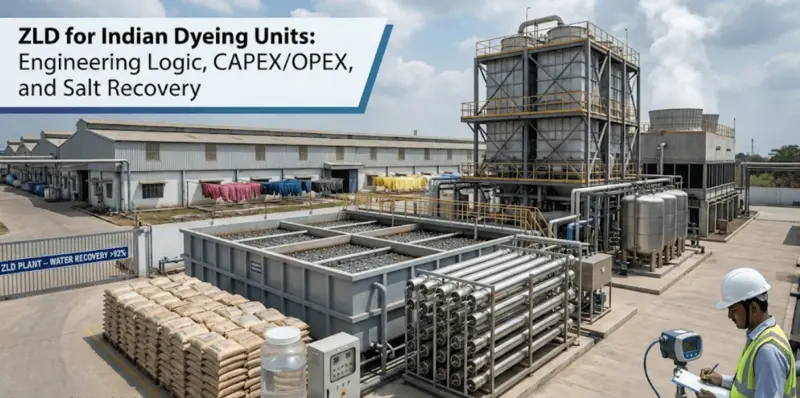
India has national treated-effluent standards for the textile sector, but those standards do not make Zero Liquid Discharge (ZLD) a single universal requirement for every mill. The notification says reuse options should be exhausted before discharge and allows CPCB or State Pollution Control Board authorities to impose more stringent conditions. It also allows ZLD to be mandated for large-scale units in environmentally sensitive or critically polluted areas.
The controlling requirement for a particular unit is therefore its current consent, authorization, location-specific directions, CETP conditions and other applicable law. Obtain written advice from the relevant Pollution Control Board or a qualified environmental professional.
A textile ZLD project is not just a membrane or evaporator purchase. It is a site-specific water, wastewater, solids, utility and compliance system. A bankable decision starts with the legal boundary and representative wastewater data, then compares complete treatment trains against defined outlets and guarantees.
1. Establish the Legal and Project Boundary
Record the unit location, products, production capacity, water sources, wastewater streams, CETP membership, discharge or reuse route, current consent conditions and applicable directions. Separate what is legally required from what is a buyer objective or an internal water-risk goal.
- Identify every consent, authorization, board direction and CETP agreement that controls the site.
- Define which production lines and wastewater streams are inside the project boundary.
- State the required water-reuse points and every permitted liquid and solid outlet.
- Record the design flow, operating days, production mix and expected variability.
2. Characterize Wastewater Before Selecting Equipment
Use a representative sampling plan across products, recipes, shifts and seasons. Record flow and the analytes required by the consent, process design and intended reuse. Identify segregation opportunities before combining streams. A single composite sample is not a bankable design basis.
The data package should identify sampling location, date and production condition; laboratory method; minimum, average and peak values; daily load as well as concentration; and the frequency of exceptional streams such as bath dumps, cleaning solutions or regeneration waste. Ask the process engineer to define the feed envelope covered by the guarantee.
3. Define the Water and Solids Outlets
Specify where recovered water will be reused, the required quality at each use point, how concentrate will be managed and which authorized route will receive sludge or recovered solids. Include storage, handling, transport and final disposition.
Do not book “salt recovery” as revenue until composition, consistency, contaminant limits, usability, buyer acceptance and legal disposition have been demonstrated. Every liquid and solid stream must have a traceable, lawful outlet.
4. Compare Complete Treatment Trains
Ask bidders to state the design basis, exclusions, pretreatment, biological treatment, clarification or filtration, membrane stages, evaporation or crystallization where applicable, redundancy, cleaning, utilities, instrumentation, automation, civil works, storage, operator needs and guarantees.
Compare guaranteed output quality and the annual water-and-solids mass balance—not equipment names alone. Confirm how the system behaves at minimum, normal and peak load and what happens during maintenance, membrane cleaning, plant trips and off-specification feed.
5. Build a Transparent CAPEX and OPEX Model
Use one boundary and one operating basis for every bid. A practical annualized comparison is:
Annualized ZLD cost per kL = (annualized capital cost + power + steam or fuel + chemicals + membranes and consumables + labour + maintenance + laboratory and monitoring + sludge or salt handling and authorized disposal + finance + contingency) ÷ annual treated volume
Create low, base and high cases from current vendor quotations, actual electricity and fuel tariffs, feed-water analyses, pilot data, disposal contracts and realistic operating days. State whether taxes, financing, land, civil work, standby capacity and production losses are included. Do not compare ₹/kL figures that use different boundaries.
6. Test Guarantees and Sensitivity
Request a process guarantee tied to a defined feed envelope. Model the effect of flow, dissolved and suspended load, recovery, downtime, energy price, membrane and consumable life, evaporation duty and disposal price. Independently verify the mass balance and the final legal outlet for every liquid and solid stream.
Keep the ZLD business case separate from the company’s greenhouse-gas inventory. Water and effluent projects can affect energy and emissions, but those effects need their own measured boundary; see the guide to measuring Scope 1, 2 and 3 emissions.
Questions to Put in Every ZLD Request for Quotation
- Which feed-quality range and flow range are guaranteed?
- Which recovered-water qualities and reuse points are guaranteed?
- What is excluded from the supply, civil, utility and automation scope?
- What are the guaranteed annual consumptions and availability conditions?
- How will every reject, cleaning stream, sludge and recovered solid be handled?
- Which measurements, acceptance tests, remedies and performance-security terms apply?
Sources and Review
- CPCB/MoEF textile-sector effluent standards, accessed 16 August 2026.
- CPCB charter for water recycling and pollution prevention in the textile sector, accessed 16 August 2026.
- Tamil Nadu Pollution Control Board proceedings, including B.P. No. 46 dated 24 July 2024 for textile CETPs with ZLD; accessed 16 August 2026.
State and consent conditions can be stricter and can change. The final design and every numerical example require review by an environmental-consent specialist and a competent ZLD process engineer.