Choosing the wrong reactive-dyeing method creates costs long before a fastness failure reaches the laboratory. A route that is ideal for a 20,000-metre woven order may be inefficient for 300 kg of knitted fabric. A salt-saving process may still perform poorly if padding pick-up, fabric temperature or washing-off is unstable.
Reactive dyeing of cotton is best understood as three process families:
- Exhaust or batch dyeing
- Semi-continuous dyeing, principally Cold Pad Batch (CPB)
- Continuous padding and rapid-fixation processes
Processes such as pad-steam, pad-dry-pad-steam, pad-dry-thermofix and Econtrol belong within this wider framework. They should not be treated as interchangeable recipes. The right route depends on the textile form, dye chemistry, lot length, machinery, wash-off capacity and required level of reproducibility.
Process safety note: The values in a dye supplier’s current technical data sheet, laboratory trial and mill standard operating procedure take precedence over generic guidance. Dye concentration, electrolyte, alkali, pH, temperature, dwell and washing conditions must be validated for the selected dyes, substrate and machine.
Quick comparison of reactive dyeing methods for cotton
Exhaust or batch
- How colour is applied and fixed: The textile and liquor are circulated together. Dye is first adsorbed and diffused, then alkali initiates fixation.
- Strongest fit: Knits in rope form, yarn packages, garments and short or frequently changing lots.
- Main advantage: Flexible loading and shade changes.
- Main constraint: A longer wet cycle; electrolyte and wash-off demand can be high.
Cold Pad Batch
- How colour is applied and fixed: Dye and alkali are padded in open width. The wet roll is covered, rotated and held for ambient-temperature fixation before washing.
- Strongest fit: Woven cotton and suitable open-width cellulosic fabrics in medium or long lots.
- Main advantage: Usually no added electrolyte and little fixation heat.
- Main constraint: Delayed shade result, batching space and strict control of pick-up, temperature and moisture.
Continuous
- How colour is applied and fixed: Fabric is padded in open width and fixed rapidly by steam, controlled drying or a dedicated continuous process, followed by washing.
- Strongest fit: Long repeat runs of woven or stable open-width fabrics.
- Main advantage: High throughput and immediate process feedback.
- Main constraint: Higher capital requirement, start-end losses and tight width-wise process control.
This classification follows the application structure described in the Handbook of Textile and Industrial Dyeing: reactive dyes may be applied by exhaust and padding methods, while padding includes several semi-continuous and continuous sequences. The publisher’s book record and chapter list are available on ScienceDirect.
What all reactive dyeing methods must control
Reactive dyes are water-soluble anionic colourants designed to form a covalent bond with cellulose. That bond gives reactive-dyed cotton its characteristic resistance to washing, but the process contains a built-in competition: the reactive group can react with cellulose, or it can be hydrolysed by water under alkaline conditions.
Every successful route therefore manages four linked stages.
1. Adsorption and diffusion
Before fixation, dye must reach the fibre surface and diffuse into accessible regions of the cellulose. This stage is largely reversible. In conventional exhaust dyeing, electrolyte is commonly used to reduce the electrostatic barrier between negatively charged cellulose and anionic dye, thereby promoting uptake.
Padding processes work differently. A low volume of concentrated liquor is mechanically applied to the fabric, so electrolyte may not be required. The critical variables shift from bath exhaustion to wet pick-up, penetration and uniformity across the fabric width.
2. Alkali activation
Alkali increases the nucleophilicity of cellulose and activates fixation. Once alkali is introduced, migration becomes more limited and the rate of both dye-fibre reaction and hydrolysis increases. Alkali selection and addition should therefore follow the reactive group, dye combination, temperature and application route – not a universal grams-per-litre figure.
3. Fixation versus hydrolysis
The objective is not maximum exhaustion alone. It is maximum useful fixation with acceptable levelness. A bath can show strong dye uptake while still leaving substantial hydrolysed or non-covalently held colour on the fibre. Dye compatibility, dosing profile, temperature, pH and time determine how much adsorbed dye becomes fixed.
4. Rinsing, neutralisation and washing-off
Hydrolysed and otherwise unfixed dye must be removed. If it remains on the surface, wet rubbing and washing fastness can deteriorate even when the shade looks correct. Washing-off conditions should be selected from the dye supplier’s data and verified through the relevant buyer test method; “always boil” is not an adequate operating rule for every modern dye system.
Method 1: Exhaust reactive dyeing
Exhaust dyeing is a batch process. The textile is treated in a finite bath while the liquor, the goods, or both are moved to produce exchange between dye solution and fibre. Common equipment includes soft-flow, overflow, jet and airflow machines for fabric; package machines for yarn; and other batch machines selected for the material form.
Typical process logic
- Load uniformly prepared cotton and establish stable liquor circulation.
- Add dissolved and filtered dye under controlled conditions.
- Build adsorption and migration using the electrolyte and temperature profile specified for the dye system.
- Add alkali progressively or according to the validated dosing curve.
- Hold for fixation while controlling pH, temperature, circulation and fabric movement.
- Drain, rinse, neutralise where required, wash off unfixed dye and complete final rinsing.
This sequence separates the neutral adsorption or migration phase from the alkaline fixation phase. The handbooks emphasise that rapid uptake and rapid fixation can create unlevelness unless the machine provides effective liquor-goods interchange.
Where exhaust dyeing is strongest
- Cotton knits that must run in rope form
- Towel processing on Soft flow
- High twist structred fabric in soft flow
- Hosiery, garments and made-up articles
- Yarn packages and other non-open-width forms
- Short lots or a production plan with frequent shade changes
- Articles that need time for penetration and migration
Critical controls
Pretreatment uniformity
- Why it matters: Waxes, size, residual alkali or peroxide can cause resist areas and dye damage.
- Verify: Absorbency, fabric pH and residual peroxide using the mill’s approved tests.
Load and liquor circulation
- Why it matters: Dead zones and poor turnover produce patchiness.
- Verify: Actual load, pump or nozzle condition, fabric speed and turnover time.
Dye dissolution and compatibility
- Why it matters: Undissolved or incompatible dyes can spot or separate in shade.
- Verify: Supplier dissolution limits, filtration and compatibility trials.
Electrolyte and alkali dosing
- Why it matters: A sudden strike or fixation front reduces levelness.
- Verify: Addition sequence, dosing time, conductivity trend and pH profile.
Temperature profile
- Why it matters: Reactivity and migration change with temperature.
- Verify: Actual liquor temperature and calibrated controller response.
Wash-off endpoint
- Why it matters: Surface dye reduces wet fastness.
- Verify: Final rinse clarity plus validated washing and rubbing-fastness results.
Advantages
- Flexible across product forms and lot sizes
- Practical for knitted structures and yarn packages
- Shade correction is sometimes possible before the process is completed
- Existing batch machinery can handle a wide article range
Limitations
- More machine time is tied up in filling, dosing, fixation, cooling and washing
- Conventional recipes can introduce substantial electrolyte mass
- Bath-to-bath reproducibility depends on dosing, water quality, loading and circulation discipline
- Low liquor ratio alone does not guarantee low total water use if rinsing and wash-off are inefficient
For machinery selection, see the Soft Flow Dyeing Machine Buying Guide.
Method 2: Cold Pad Batch reactive dyeing
Cold Pad Batch is a semi-continuous process. Fabric is impregnated in open width with reactive dye and alkali, squeezed to a controlled wet pick-up, wound into a roll, protected against moisture loss, rotated and held for fixation at a controlled ambient temperature. The roll is then washed, soaped as required, rinsed and neutralised.
The process normally avoids added electrolyte because the dye is applied from a concentrated, low-liquor padding system. It also avoids a heated fixation bath. Those advantages do not make CPB automatically superior: the quality burden moves to the padder, dosing system, batching environment and wash range.
Typical process logic
- Confirm uniform absorbency, width and temperature of the prepared fabric.
- Prepare dye and alkali streams according to their stability requirements.
- Meter and mix them close to the pad trough when short liquor stability makes this necessary.
- Pad the fabric at a validated, uniform wet pick-up.
- Wind a straight, evenly packed roll without selvedge displacement or pressure bands.
- Seal the roll against drying, rotate it and maintain the specified batching temperature and time.
- Wash promptly and effectively to remove alkali and unfixed dye.
Where CPB is strongest
- Woven cotton in open width, including shirting, sheeting and many home-textile constructions
- CPB process is most recommended for delicate wovens and fabrics like voil, cambric, for regenerated fibers (Tencel, Modal &Lyocell)
- Medium and long solid-shade orders where ambient fixation fits production planning
- Mills seeking to reduce added electrolyte and fixation heat
- Articles that can be wound and rotated without pressure, crease or moire defects
CPB is not categorically unsuitable for knits. Open-width knitted cotton can be processed when fabric handling, tension, edge control, batching and washing equipment are designed for it. A 2026 peer-reviewed comparison, for example, evaluated CPB on 100% cotton single jersey; its results are specific to that substrate, dye set and experimental process and should not be treated as a universal performance guarantee. Read the study in Discover Chemistry.
Critical controls
Fabric absorbency and temperature
- Failure if unstable: Side-centre or start-end shade variation.
- Check: Map absorbency and temperature across the incoming width.
- Check: Color and Alkali temprature should not be more than 20 deg.
Nip pressure and wet pick-up
- Failure if unstable: Uneven depth across the width.
- Check: Gravimetric wet pick-up at defined positions and intervals.
Pad-liquor stability
- Failure if unstable: Tailing or changing shade as dye hydrolyses in the trough.
- Check: Control liquor age, volume, temperature, recirculation and replenishment.
Dye-alkali mixing
- Failure if unstable: Premature reaction before the liquor reaches the fibre.
- Check: Validate metering accuracy and mixer response.
Roll build and rotation
- Failure if unstable: Moire, pressure bands, selvedge marks or drying.
- Check: Inspect alignment, cover integrity and rotation.
Batching temperature and time
- Failure if unstable: Under-fixation in cold conditions or excess hydrolysis in warm conditions.
- Check: Record actual roll and room conditions, not only set points.
Wash-off capacity
- Failure if unstable: Poor wet rubbing or back-staining.
- Check: Match washing-range speed and liquor exchange to shade depth.
Advantages
- Usually eliminates added salt from the application stage
- Requires little thermal energy for fixation
- Uses relatively simple application and batching equipment
- Can provide high dye utilisation with suitable reactive dyes and disciplined control
Limitations
- The bulk shade cannot be assessed immediately after padding
- Fabric apperance is not good in compact plain weaves
- Batching ties up floor space and working inventory
- Temperature changes alter required dwell and fixation behaviour
- Pad-trough tailing, width-wise pick-up variation and roll defects can affect long lengths
- A strong washing range is still necessary; salt-free application does not mean effluent-free production
Method 3: Continuous reactive dyeing
Continuous dyeing combines open-width padding, rapid fixation and washing in a linked range. It is best considered a platform containing several sequences rather than one recipe.
One-bath pad-steam
Dye and fixation chemicals are applied in one padding stage, followed by rapid steaming and washing. The short route offers high productivity, but pad-liquor stability, temperature, penetration and steam conditions must remain tightly controlled.
Pad-dry-pad-steam
The fabric is first padded with dye and dried under conditions that minimise migration. Alkali is then applied in a second pad, followed by steaming and washing. Separating dye application from the alkali stage can improve liquor stability, but the process adds equipment and more control points.
Pad-dry-thermofix or pad-dry-cure
Selected reactive dyes and auxiliary systems can be fixed through a high-temperature dry process. This is not a universal route for “pigment-heavy shades,” and it should not be specified from a generic temperature range. Dye reactivity, fixation chemistry, moisture, urea or alternative auxiliary requirements, fabric sensitivity and wash-off must be validated as one system.
Econtrol
Econtrol is a specific continuous reactive-dye process rather than another name for pad-dry-pad-steam. In Monforts’ current description, reactive dye is fixed during one-pass drying in a controlled hot-flue climate at 120-130 degrees C, 25-30% moisture by volume and 2-3 minutes dwell. The supplier states that the route uses no salt or urea and does not require a separate steamer. These are equipment- and process-specific vendor claims, not generic settings for other ranges. See the current Monforts process description.
Where continuous routes are strongest
- Long, repeatable open-width orders
- Mills with stable preparation, padding, drying, steaming and washing capability
- Products requiring strong length-wise and width-wise reproducibility at high throughput
- Production programmes that can absorb startup, colour-change and end-of-lot losses
Critical controls
- Uniform pretreatment and residual moisture entering the padder
- Predryer and dryer temp. plays an important role to avoid CSV and Length wise tailing
- Dyestuff selection is also very important for good quality dyeing
- Padder crown, nip pressure, trough circulation and wet pick-up across width
- Dye and chemical feed concentration versus line speed
- Migration control during predrying
- Steam quality, air exclusion, dwell and condensate control in steaming routes
- Hot-flue temperature and humidity in controlled-drying routes
- Line synchronisation, tension and fabric guiding
- Wash-range liquor exchange, counter-current flow and speed
Advantages
- High production rate with less intermediate handling
- Strong potential for repeatability when the line is stable
- Immediate feedback after fixation and washing
- Lower labour per metre on suitable long runs
Limitations
- High capital and maintenance requirement
- Startup and shutdown fabric can be significant for short lots
- A small width-wise error can continue through a long order
- Laboratory-to-bulk correlation must account for padding, drying, steam and washing conditions
How to select the right method
Rope-form cotton knit with varied shades or shorter lots
- Starting point: Exhaust on suitable soft-flow, overflow, jet or airflow equipment.
- Why: It is flexible and compatible with rope handling.
- Confirm: Crease risk, fabric speed, liquor exchange and wash-off capacity.
Yarn packages, loose fibre or garments
- Starting point: Exhaust.
- Why: Padding is not practical for these material forms.
- Confirm: Package density, circulation, levelness and material movement.
Medium-to-long open-width woven order with limited steam demand
- Starting point: Cold Pad Batch.
- Why: It uses ambient fixation and normally no added electrolyte.
- Confirm: Pad uniformity, batching space, temperature control and washing-range capacity.
Open-width cotton knit with an appropriate low-tension line
- Starting point: A controlled CPB trial.
- Why: The route is technically possible but article- and machine-dependent.
- Confirm: Edge curl, tension, roll build, GSM, width and crease behaviour.
Long repeat order on woven cotton
- Starting point: Continuous pad-steam or pad-dry-pad-steam.
- Why: High throughput with immediate process feedback.
- Confirm: Minimum economic lot, migration, steam and wash-range stability.
Existing controlled-humidity hot-flue range with approved dyes
- Starting point: Econtrol evaluation.
- Why: One-pass fixation without separate steaming.
- Confirm: Current equipment capability, dye approval and supplier-supported trial.
Unstable preparation or inadequate washing capacity
- Starting point: Correct the bottleneck before choosing a dyeing route.
- Why: No application method can compensate for a non-uniform substrate or poor removal of unfixed dye.
- Confirm: Complete a pretreatment and wash-off capability study.
A practical decision sequence
- Define the textile form. Is it rope-form knit, open-width fabric, yarn, garment or loose fibre?
- Define the lot profile. Consider average and minimum lot length, shade-change frequency and repeat-order demand.
- Screen dye compatibility. Use the current technical data for the complete dye combination, not the generic dye class alone.
- Map installed control capability. Include dosing accuracy, circulation, pad pick-up, temperature, humidity, steam, tension and washing.
- Run a controlled laboratory and pilot trial. Match the production mechanism as closely as possible.
- Compare total cost and environmental load. Include quality loss and rework, not only dye price or machine speed.
Compare total cost, not a single utility
There is no defensible universal claim that one reactive-dyeing method always has the lowest cost per kilogram. Use a mill-specific model:
Total conversion cost per kg = dyes + auxiliaries + electrolyte + alkali + water + thermal energy + electricity + labour + machine time + washing + effluent treatment + quality loss and rework
CPB can reduce salt and fixation heat, but it adds batching inventory and delays shade feedback. Continuous processing can reduce unit processing time, but short lots may suffer disproportionately from startup and colour-change losses. Exhaust dyeing is flexible, but a long recipe and inefficient wash-off can increase both machine occupancy and utilities.
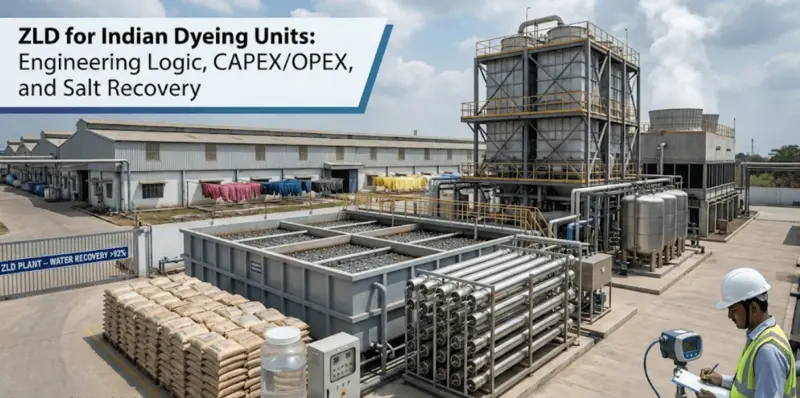
For mills operating or evaluating Zero Liquid Discharge, compare mass load per tonne of fabric, not only wastewater concentration. The Textile ZLD Cost Guide explains why salt and wash-off loads affect downstream treatment.
Troubleshooting by process symptom
Side-centre shade difference
- Most relevant routes: CPB and continuous.
- Check: Absorbency, nip loading, roller profile, moisture and temperature across the width.
- First containment: Stop release and map shade and wet pick-up across the full width.
Start-end tailing
- Most relevant routes: CPB and continuous.
- Check: Pad-liquor age, trough volume, feed concentration, hydrolysis and line speed.
- First containment: Compare beginning, middle and end samples with bath records.
Patchy or cloudy shade
- Most relevant route: Exhaust.
- Check: Pretreatment, circulation, loading, salt or alkali addition rate and dye compatibility.
- First containment: Hold further batches and verify circulation plus dosing history.
Low colour yield
- Most relevant routes: All.
- Check: Dye selection, pH, temperature, time, liquor ratio or wet pick-up, and residual peroxide.
- First containment: Reconcile actual process records with the approved standard.
Poor wet rubbing or wash fastness
- Most relevant routes: All.
- Check: Incomplete fixation, hydrolysed surface dye, overloaded washing or redeposition.
- First containment: Verify the wash-off endpoint and repeat fastness on a controlled rewash sample.
Crease, rope or pressure marks
- Most relevant routes: Exhaust and CPB.
- Check: Overloading, lubrication, fabric speed, roll build, tension and temperature transitions.
- First containment: Segregate the affected length and inspect handling records before chemical correction.
For broader defect diagnosis, use the Common Dyeing Defects and Root-Cause Guide. Testing requirements should be confirmed against buyer specifications and licensed standards; the ISO 105 colour-fastness overview can help orient the laboratory plan.
Sustainability and compliance: what the process name does not prove
A method is not automatically “GOTS compliant” or “ZDHC aligned.” Compliance depends on inputs, facility controls, wastewater performance, documentation and the applicable certification or brand programme.
- GOTS states that chemical inputs used in wet processing of GOTS goods must be assessed and approved, and wet processors must operate a functional internal or external effluent-treatment system. See the GOTS certification requirements.
- The ZDHC Wastewater Guidelines define wastewater and sludge parameters, limit values and test methods for wet-processing facilities. They do not certify a dyeing route as inherently compliant. See ZDHC Wastewater Guidelines Version 2.2.
For process improvement, track at least:
- Added electrolyte in kg per tonne of fabric
- Total water use in litres per kg, including washing
- Thermal and electrical energy per kg
- Dye fixation or total dye utilisation under the mill’s validated method
- First-pass shade acceptance and reprocess rate
- Wastewater flow and pollutant mass load, including colour, chemical oxygen demand and total dissolved solids where applicable
Low-salt dyes, cotton cationisation and non-aqueous research systems are chemistry or substrate modifications layered onto an application route. They should not be listed as a fourth primary factory method until the specific system, safety controls, chemical approval, recovery route and economics have been validated.
Final takeaway
The best reactive dyeing method is the one that controls the complete chain from prepared cotton to washed-off shade.
- Choose exhaust dyeing for flexibility, rope-form knits, yarns, garments and changing lot profiles.
- Choose Cold Pad Batch when open-width handling, controlled batching and a capable wash range make low-salt ambient fixation practical.
- Choose a continuous route when lot length and process discipline justify high-speed padding, fixation and washing.
- Evaluate Econtrol as a distinct equipment-specific continuous process, not as a synonym for pad-dry-pad-steam.
Before changing routes, compare pilot results for shade, levelness, fixation, washing and rubbing fastness, dimensional behaviour, utilities, wastewater mass load and Right-First-Time performance. A shorter recipe is valuable only when it also produces a reproducible and releasable fabric.