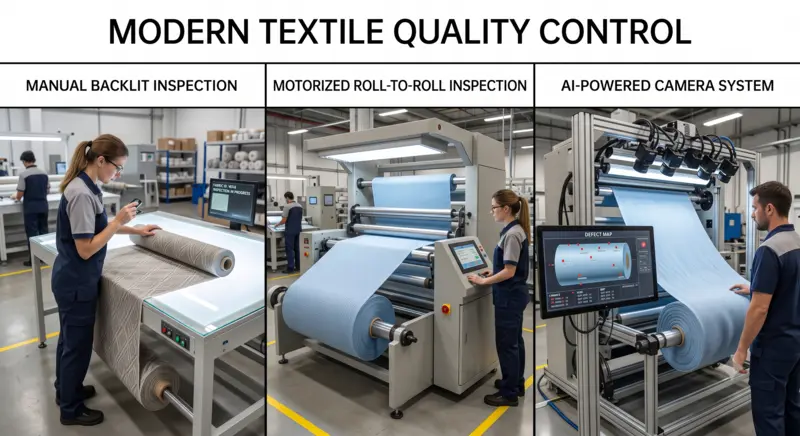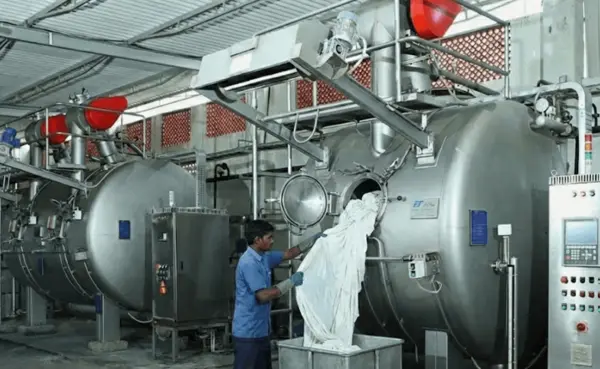

The wrong textile processing machine does not fail only when it breaks down. It can fail every day through low loading, long changeovers, excessive water or steam use, unstable fabric handling, repeated shade correction, poor data access, or slow service response.
The safest buying rule is simple: select the process route first, define the required performance second, and compare machines third. A vendor’s maximum speed, nominal batch capacity or lowest advertised liquor ratio is not enough. The purchase decision should be based on saleable output and resource use across the mill’s real product mix.
This guide covers industrial wet-processing and finishing machinery used for pretreatment, dyeing, washing, drying, heat setting, chemical application, coating and dimensional control. It does not rank brands. Instead, it shows how to create a common technical basis on which competing offers can be tested.
What counts as textile processing machinery?
Textile processing machinery is a broad group. The correct machine class depends on the textile form, construction, fibre chemistry, lot pattern and finish required.
| Process need | Common machine classes | Best suited to | Main selection risk |
|---|---|---|---|
| Batch fabric pretreatment or dyeing | Jet, soft-flow, airflow, winch and jigger systems | Frequent colour changes, variable lots, flexible production | Comparing only nominal load or headline liquor ratio |
| Yarn or fibre dyeing | Package, beam, hank and loose-fibre systems | Dyeing before fabric formation | Uneven flow, package density mismatch and weak lab-to-bulk correlation |
| Continuous pretreatment, dyeing or washing | Open-width ranges, pad-steam, pad-dry, thermosol and continuous washers | Long, repeatable runs with stable constructions | Low utilization, changeover loss and fabric-tension damage |
| Drying and heat treatment | Stenters, relaxation dryers and loop dryers | Moisture removal, width control, heat setting and curing | Comparing chamber count without process-specific evaporation duty |
| Mechanical finishing | Compactors, sanforizers, calenders, raising and sueding machines | Shrinkage, surface, lustre and handle control | Achieving one property while damaging another |
| Chemical or functional application | Padders, minimum-application units, spray systems and coaters | Softeners, resins, repellents, binders and coatings | Non-uniform add-on, chemistry loss, difficult cleaning and limited recipe range |
| Process support | Automated dispensing, colour kitchens, laboratory machines, inspection and process-data systems | Reproducibility, traceability and control | A technically capable machine that cannot exchange usable data |
Use this map only to shortlist the process route. A detailed machine selection still requires trials with representative material.
1. Write a user requirement specification before requesting quotations
A user requirement specification (URS) turns the order book and factory constraints into one document that every supplier must answer. Without it, each vendor will quote a different configuration and the price comparison will be misleading.
At minimum, the URS should define:
- Fibre types and blends, including elastane or other heat- and tension-sensitive components.
- Fabric or yarn form, construction, weight range, working width and roll or batch format.
- Current and expected lot-size distribution, not only the largest batch.
- Process routes, shade depth, required temperature range and special finishes.
- Target daily and annual saleable production by product family.
- Quality-critical outputs such as shade reproducibility, width, grams per square metre (GSM), residual moisture, shrinkage, bow/skew, handle or coating add-on.
- Available steam, thermal oil, gas, electricity, compressed air, water quality, drainage and effluent capacity.
- Building layout, floor loading, access, working height, ventilation and future expansion space.
- Required language, documentation, recipes, audit trail, data export and remote-support controls.
- Applicable local law, buyer requirements and machinery-safety review.
Do not write “suitable for all fabrics.” List the actual product families and identify the difficult articles that the supplier must prove during trials.
2. Compare stable saleable capacity, not nameplate capacity
Nameplate capacity describes what a machine can hold or how fast it can run under selected conditions. The mill earns from good-quality output after loading loss, stoppages, changeovers and reprocessing.
For a batch machine, a practical planning equation is:
Saleable kg/day = loaded kg/batch × completed batches/day × operating availability × first-pass yield
For a continuous open-width line:
Gross kg/hour = speed (m/min) × working width (m) × fabric weight (kg/m²) × 60
Saleable kg/hour = gross kg/hour × operating availability × first-pass yield
Worked illustration: at an assumed 30 m/min, 1.8 m working width and 180 g/m² fabric, gross output is about 583 kg/hour. At an assumed 75% operating availability and 96% first-pass yield, saleable output falls to about 420 kg/hour. These figures are a calculation example, not a benchmark or vendor guarantee.
Ask every supplier to calculate capacity for the same representative articles and include:
- Minimum, normal and maximum stable load or speed.
- Heat-up, cooling, filling, draining, washing and cleaning time where relevant.
- Changeover duration between light and dark shades or incompatible finishes.
- Production loss for seams, leaders, filter cleaning, recipe changes and maintenance.
- Output at the required moisture, fixation, width and quality conditions.
A large machine can be expensive when the mill’s normal lot is small. A high-speed continuous range can also be a poor investment when orders are short, construction changes are frequent or upstream delivery is irregular.
3. Put utilities and effluent on the same measurement boundary
Water, thermal energy, electricity and chemistry figures are comparable only when the boundary and production conditions are identical. A low liquor ratio in the process vessel does not, by itself, prove low total water use; preparation, additions, rinsing, washing-off and cleaning may materially change the result.
Request guaranteed or trial-measured values for each representative article:
| Metric | Useful reporting unit | Boundary to define |
|---|---|---|
| Fresh water | L/kg saleable textile | Machine inlet through final drain, including cleaning and changeover |
| Electricity | kWh/kg saleable textile | Main drives, pumps, fans, heaters, vacuum and auxiliaries included in the quoted system |
| Thermal energy | MJ/kg or kg steam/kg saleable textile | State steam pressure/quality or fuel and heating efficiency assumptions |
| Chemistry or finish | kg/kg textile, g/L or g/m² as appropriate | Include preparation loss, residual bath, filter loss and cleaning waste |
| Effluent | L/kg plus temperature and pollutant-relevant characteristics | State streams excluded, reused or sent separately |
| Exhaust | Flow, temperature and treatment requirement | Include lint, oil mist, odour and heat-recovery conditions where applicable |
The European Commission’s 2023 textile Best Available Techniques reference document covers pretreatment, dyeing, printing and finishing and is a useful official research reference for environmental-performance questions. The World Bank Group also publishes sector-specific Environmental, Health and Safety guidance for textile manufacturing. For brand programs, the ZDHC Wastewater Guidelines set a voluntary industry framework for wastewater and sludge sampling, testing and reporting at wet-processing facilities. These documents do not replace the mill’s permits, local law or buyer-specific requirements.
Treat energy-saving percentages as application-specific claims
Technology can reduce resource demand, but the saving depends on the starting machine, article, utilization, settings and measurement method. For example, Monforts states that its EcoBooster heat-recovery system can save up to 35% in energy costs for a stated eight-field stenter, fabric and operating-hour basis, and that some existing machines can be retrofitted. That is a manufacturer claim with defined assumptions—not a universal stenter result.
Ask the supplier to provide a baseline, calculation boundary, fabric condition, set temperature, exhaust volume, operating hours, fouling allowance and maintenance plan. Then include the accepted method in the purchase contract.
4. Test fabric handling and quality, not only speed
The machine must deliver the required result without creating a downstream problem. Higher nozzle pressure, overfeed, tension, nip pressure, dwell time or temperature may improve one KPI while harming surface, width, stretch, strength, handle or shade.
Create a trial matrix covering normal and difficult products:
| Machine/process | Trial outputs to agree before testing |
|---|---|
| Batch dyeing | Loading range, shade uniformity, batch-to-batch reproducibility, crease tendency, surface change, process time, washing result and drain profile |
| Continuous pretreatment or washing | Absorbency or residual removal relevant to the route, widthwise uniformity, fabric tension, crease condition, water use and line speed |
| Stenter or dryer | Width, GSM, bow/skew, residual moisture, temperature uniformity, surface condition and output at the required dwell time |
| Pad, spray or coating application | Wet pickup or add-on across width and along length, edge-to-centre variation, penetration, clean-down time and residual chemistry |
| Compaction or sanforizing | Shrinkage after the agreed test, width, GSM, handle, spirality or skew where relevant, and speed stability |
The mill and supplier should agree sampling locations, conditioning, test methods, tolerances and responsibility for disputed results before the trial. Expert review required: final acceptance criteria must be set for the mill’s substrates, customer methods and applicable licensed standards.
5. Convert trials into FAT and SAT acceptance clauses
A demonstration shows that a machine can run. A factory acceptance test (FAT) and site acceptance test (SAT) determine whether the supplied machine meets the purchase requirement.
The purchase order should define:
- The exact configuration, options, software versions, instruments and utilities included.
- Representative products, recipes and load/speed points for each acceptance run.
- Measured quality, capacity, utility, safety and reliability criteria.
- Calibrated instruments and responsibility for test material, chemicals and testing.
- Duration of sustained running—not only a short best-case sample.
- Corrective-action and retest procedure when a criterion is missed.
- Documents, source backups, spare lists, drawings, certificates and training required before final sign-off.
- Warranty start point, performance retention and any holdback linked to SAT completion.
Do not leave performance promises in sales presentations. Move agreed values into signed schedules attached to the purchase order.
6. Specify usable automation and data ownership
“Industry 4.0 ready” is not a functional specification. Define what data the mill needs and how it will be accessed.
Useful requirements may include:
- Recipe versioning and approval permissions.
- Actual-versus-setpoint histories for time, temperature, pressure, speed, tension, moisture, flow or dosing variables relevant to the process.
- Alarm and operator-action history with synchronized timestamps.
- Batch, roll and material identifiers that can be mapped to the mill’s ERP or manufacturing execution system.
- Exportable data in a documented format, with tag names, units and sampling intervals.
- Documented application programming interface or industrial interface where integration is required.
- Local operation when the internet or vendor cloud is unavailable.
- Role-based remote access, multifactor authentication where supported, session logging and a mill-controlled method to disable access.
- Ownership, retention, backup and restoration of recipes and production data.
- Software support period, security-update policy and charges for future integration.
OPC UA for Machinery provides a cross-industry framework for machine identification and other common information-model building blocks. It can be a useful interoperability option, but the presence of an OPC UA label alone does not prove that the tags and functions your mill needs are exposed. Verify the implemented profiles and data during acceptance.
For a deeper software selection framework, use the site’s textile ERP buying guide.
7. Calculate total cost of ownership with dated inputs
Total cost of ownership (TCO) should be calculated for the same analysis period and production plan for every offer.
TCO = purchase and installation + financing + utilities + consumables + labour + maintenance + planned and unplanned downtime + quality loss + effluent and exhaust treatment + software and service – residual value
Include at least these cost groups:
| Cost group | Often missed item |
|---|---|
| Purchase and installation | Foundations, piping, electrical panels, transformer capacity, ventilation, freight, duties and production lost during installation |
| Utilities | Demand charges, water treatment, steam distribution loss, compressed air and effluent treatment—not only machine electricity |
| Production | Changeovers, cleaning, minimum-load inefficiency, warm-up, sampling and ramp-up loss |
| Quality | Reprocessing, downgrade, shade correction, claims, extra testing and delayed delivery |
| Maintenance | Recommended spares, proprietary parts, lubricants, filters, calibration, travel and software support |
| Downtime | Lost contribution margin and disruption to upstream/downstream machines |
| End of life | Decommissioning, disposal, transferability of licences and residual value |
Simple payback illustration
Assume an upgrade costs ₹30 lakh more than the alternative and is expected to save ₹8 lakh per year after all added maintenance and software costs. Simple payback is:
₹30 lakh ÷ ₹8 lakh/year = 3.75 years
If only 70% of the expected saving is achieved, payback becomes about 5.36 years. If 130% is achieved, it becomes about 2.88 years. These are transparent assumptions, not market prices or promised savings. For long-lived capital, finance should also calculate discounted cash flow, tax, financing and residual-value scenarios.
8. Score service capability before negotiating the final price
Service is measurable. Replace statements such as “24/7 support available” with response and restoration commitments.
Ask each supplier:
- Where are the nearest trained electrical, mechanical and process technicians?
- What is the contracted remote-response time and on-site response time for your location?
- Which critical parts are stocked locally, and what are their current lead times?
- Which components are proprietary, single-source or subject to software activation?
- What preventive-maintenance hours and specialist visits are required each year?
- Can the mill replace drives, sensors, bearings and control hardware with documented equivalents?
- How long will controllers, human-machine interfaces and software versions be supported?
- Can the supplier provide comparable customer references processing similar material and lots?
- What training is included for operators, maintenance, process teams and administrators?
Verify reference installations directly. A logo list supplied by a vendor is not evidence of performance in your product mix.
9. Make safety and compliance a purchase gate
Machinery safety should be reviewed before layout approval, not after commissioning. ISO 11111-1:2016 covers common textile-machinery safety requirements, while ISO 11111-7:2005 covers significant hazards and safety measures for dyeing and finishing machinery when used with Part 1. ISO lists Part 7 as current but under review in 2026 and identifies two amendments. Part 1 also states that it does not address specific pressure-containment requirements.
Expert review required: consult the current official catalogues, licensed standards, local factory and electrical law, pressure-equipment rules, fire and explosion risk, chemical handling, guarding, lockout provisions, access platforms, ventilation, noise and emergency procedures for the actual installation. Do not treat a certificate or declaration as a substitute for a machine-specific risk review.
Regulatory correction: CBAM is not presently a textile-product requirement
As of 5 August 2026, the European Commission lists cement, iron and steel, aluminium, fertilisers, electricity and hydrogen as the sectors covered by the EU Carbon Border Adjustment Mechanism (CBAM). Textile products are not in that current sector list.
The EU Ecodesign for Sustainable Products Regulation is relevant to future product requirements, and the Commission’s 2025-2030 working plan prioritises textiles/apparel for preparatory work. However, a priority in a working plan is not the same as a final requirement for a particular textile machine. The mill should track product-specific rules and buyer data requests as they develop, rather than buying machinery on the claim that it is “CBAM compliant.”
10. Decide whether to retrofit or replace
Replacement is not automatically the most economical route. A retrofit may be better when the core mechanical platform, fabric handling and safety condition are sound.
| Retrofit may be preferable when | Replacement may be preferable when |
|---|---|
| The process route still fits the order book | The machine class no longer fits product or lot requirements |
| Heat recovery, metering, drives, controls or dosing can close the main gap | The vessel, chamber, frame, chain, rollers or pressure system is at end of life |
| Spare and service support remain available | Critical parts or software are obsolete and unsupported |
| The upgrade can be validated without a long production shutdown | Multiple retrofit layers create a complex, unreliable system |
| Safety gaps can be fully corrected | Safe access, guarding or pressure integrity cannot be economically resolved |
Ask for a condition audit and a separately priced retrofit scope. Compare its remaining life, warranty, downtime and residual risks with a new machine on the same TCO horizon.
11. Use a weighted supplier scorecard
Score all offers only after technical clarifications and representative trials. The following weighting is an editorial starting point; change it for the mill’s priorities.
| Criterion | Suggested weight | Evidence required |
|---|---|---|
| Process and product fit | 25% | Completed URS response and representative trials |
| Guaranteed stable performance | 20% | Capacity, quality and utility schedule with conditions |
| Lifecycle cost | 15% | Comparable TCO model with dated assumptions |
| Quality and reproducibility | 10% | FAT/SAT results and measurement method |
| Service, spares and support life | 10% | Locations, stock list, response terms and references |
| Water, energy, chemistry and effluent | 10% | Machine-boundary measurements or contractual guarantees |
| Automation, integration and data rights | 5% | Demonstrated tags, exports, security and backup |
| Safety and documentation | 5% | Risk documentation, applicable declarations, manuals and training |
A supplier should not receive technical points for a feature that is optional but absent from the priced offer. Record exclusions, open deviations and recurring fees beside the score.
12. Final RFQ checklist
Before commercial negotiation, confirm that every bidder has provided:
- A clause-by-clause URS response with deviations highlighted.
- A product-specific capacity model and stable operating window.
- Water, electricity, thermal-energy, chemistry and effluent guarantees with boundaries.
- General arrangement, load data and a complete utility schedule.
- Representative trial plan and sample report.
- FAT and SAT protocol with remedies for missed performance.
- Automation architecture, data map, remote-access method and software lifecycle.
- Safety documentation and the list of standards or legal frameworks used.
- Installation, commissioning, training and ramp-up responsibility matrix.
- Recommended two-year operating spares and critical-spares lead times.
- Warranty exclusions, service rates, software fees and escalation assumptions.
- Customer references using comparable substrates and process routes.
- Itemised price, payment milestones, delivery terms and the complete list of exclusions.
The buying decision in one sentence
Choose the textile processing machine that produces the required saleable quality across the real product mix at an accepted lifecycle cost—and make the supplier prove the critical assumptions before the purchase order is released.
If the current project is specifically a batch fabric-dyeing investment, continue with the site’s soft-flow dyeing machine buying guide. For projects where effluent treatment is the capacity constraint, review the textile ZLD CAPEX and OPEX guide. For finishing teams diagnosing width and fabric-weight performance, use the stenter GSM control guide.
Frequently asked questions
What is the most important specification when buying textile processing machinery?
There is no single universal specification. The most important requirement is proven process fit across the mill’s substrates, lot sizes and quality targets. Capacity, water, energy, chemistry, handling, automation and service should then be tested on that common basis.
Is the lowest liquor ratio always the best dyeing-machine choice?
No. Liquor ratio matters, but the machine must maintain stable circulation, fabric movement, heat and mass transfer, dosing, rinsing and quality throughout the required loading range. Compare total cycle water and energy per kilogram of saleable output, not a headline vessel ratio alone.
Can an old stenter or dyeing machine be upgraded instead of replaced?
Often, yes—if the core machine, fabric handling, structural or pressure condition, spare support and safety can meet the future requirement. Metering, drives, controls, heat recovery, insulation, dosing or exhaust treatment may be retrofit candidates. A condition and safety review should precede the business case.
Does EU CBAM apply to textile exports in 2026?
Not under the European Commission’s sector list current on 5 August 2026. CBAM presently covers selected goods in cement, iron and steel, aluminium, fertilisers, electricity and hydrogen. Textile exporters should separately track evolving EU product rules and customer requirements.