Should a textile mill buy textile ERP system, a manufacturing execution system (MES), or both?
The answer depends on where control is breaking down.
If sales orders, purchasing, inventory value, production planning, costing and finance do not reconcile, the primary gap is usually at the ERP level. If the mill has an ERP but still lacks trustworthy machine status, production progress, downtime, process parameters or shop-floor consumption, the missing layer may be MES. If both enterprise control and real-time execution matter, an integrated ERP–MES stack may be the better architecture.
The product name alone does not settle the issue. Textile software suppliers use overlapping terms such as ERP, MES, manufacturing operations management, production monitoring, advanced planning and shop-floor control. Two applications carrying the same label may operate at very different depths.
This guide compares widely evaluated ERP and MES product families using current official product documentation. It does not claim that they are the “most used” in a statistically proven order.
Important evidence note: No neutral, current global dataset was found that ranks ERP or MES installations specifically by spinning, weaving, knitting, wet-processing and integrated textile mills. Vendors may count customers, sites, machines, users or countries differently. Customer logos and “leading” claims are not comparable market-share evidence. The systems below form a practical research shortlist, not a popularity league table or endorsement.
ERP vs MES in one minute
The International Society of Automation’s ISA-95 overview describes an integration framework between enterprise functions and manufacturing control. The framework is useful for defining boundaries, although mills should consult licensed standards and qualified automation specialists for a formal implementation.
ERP: the enterprise transaction and planning layer
Usually owns:
- customers, suppliers and commercial terms;
- sales and purchase orders;
- item and material masters;
- enterprise inventory quantity and valuation;
- production orders and higher-level planning;
- standard and actual costing;
- receivables, payables, general ledger and statutory reporting; and
- approvals and enterprise audit controls.
Question it answers: What should the business buy, make, hold, deliver and account for?
MES: the production-execution layer
Usually owns or captures:
- machine and work-centre state;
- order dispatch to the shop floor;
- operation start, stop and completion;
- operator, shift and machine context;
- downtime and reason codes;
- actual production, consumption, loss and rework events;
- process and quality data close to production; and
- real-time production visibility.
Question it answers: What is happening in production now, and what actually happened to this order, batch, package or roll?
The integrated stack
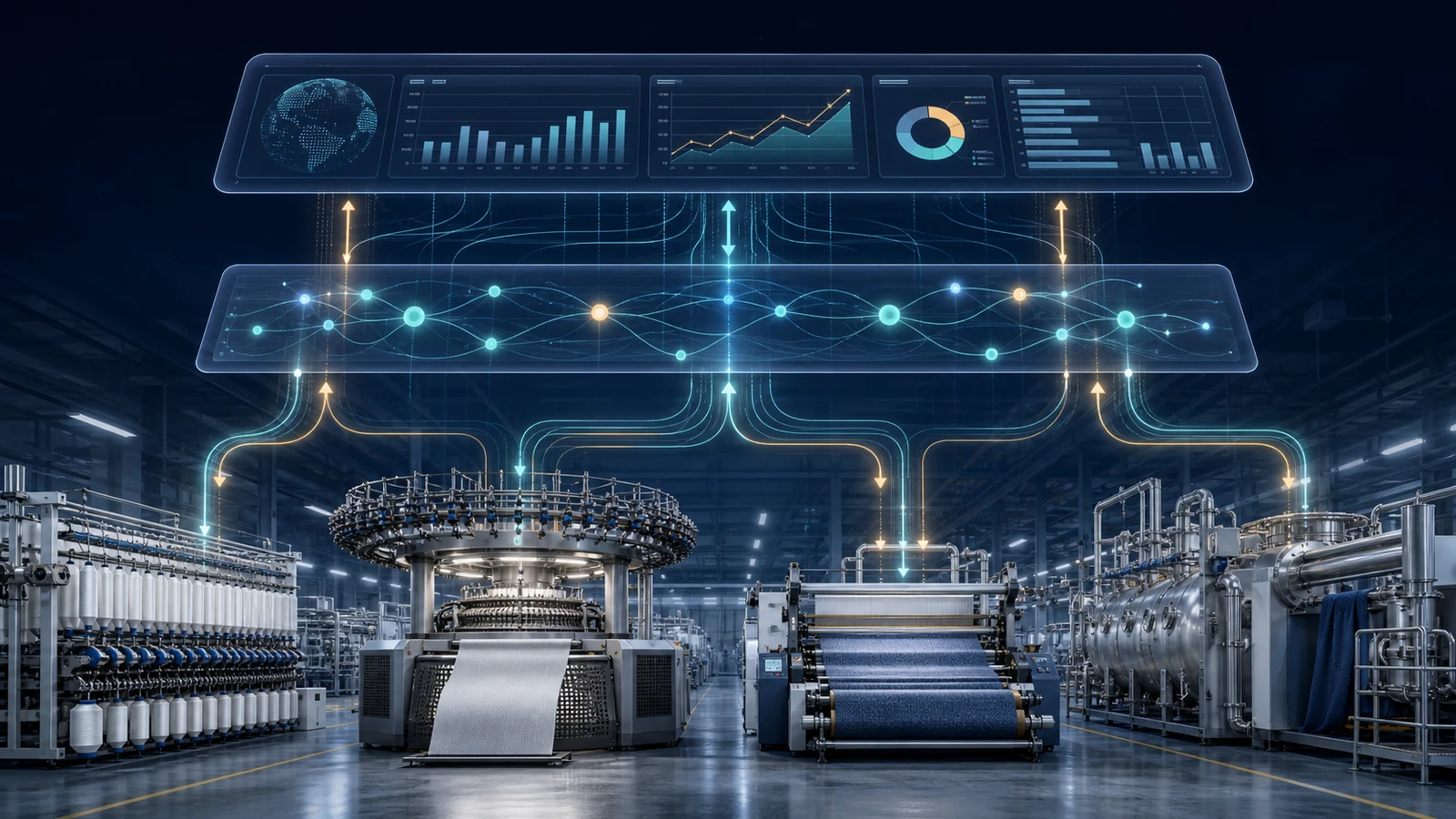
ERP sends: The approved production order, product, route or recipe reference, quantity, due date, material or lot context and relevant master data.
MES returns: Production status, actual consumption, output, loss, timestamps, machine or resource, quality status and completion events.
The critical rule: Assign one system of record for every master and transaction. Two applications should not independently “own” the same stock balance, recipe version, quality release or production completion.
NIST’s Manufacturing Extension Partnership notes that MES can feed production data into ERP and that the two systems can provide complementary planning and operational information. That is a useful principle, but the value depends on data quality, process discipline and a working interface—not on installing two products.
When one system may be enough
ERP without a separate MES
Best starting case: A smaller or less machine-connected mill whose priority is commercial, inventory, production-order, costing and finance control.
Can work when: Shop-floor transactions are few enough to enter reliably through ERP terminals, scanners or mobile screens; detailed machine data is not required; and the ERP can handle the mill’s textile objects and exceptions.
Main risk: Managers see completed bookings but not the real production state, downtime or process history behind them.
MES connected only to accounting or a basic business system
Best starting case: A focused spinning, weaving, knitting or dyeing operation whose largest immediate gap is machine-level execution and production visibility.
Can work when: The financial or commercial system remains deliberately narrow and the integration boundary is documented.
Main risk: The mill creates a high-quality production island while orders, procurement, inventory value, costing and finance continue in disconnected systems. Treat this as a controlled phase, not automatically the final architecture.
ERP and MES together
Best starting case: A machine-intensive or multi-stage mill that requires both enterprise control and detailed execution data.
Can work when: Product and order identifiers match, transaction ownership is explicit, interfaces are monitored, and both systems can be upgraded without repeatedly breaking the connection.
Main risk: Two license contracts, two implementation teams and an interface whose exceptions nobody owns.
ERP systems textile mills commonly evaluate
The following products are not ranked. Each serves a different buying logic. All capability statements are drawn from official vendor material and must be proven for the proposed version, modules, country, implementation partner and mill workflow.
Datatex NOW
Type: Textile- and apparel-specific ERP.
Vendor-documented scope: Datatex describes NOW as a modular system for textile and apparel companies, with modules covering planning, production, costing, sales, purchasing, inventory and logistics, plus extensions for finance, quality, maintenance, product data and shop-floor applications. See the official Datatex NOW product page.
Strongest reason to investigate: The mill wants one textile-first data model across fibers, yarns, fabrics, lots, production stages and commercial processes.
Best-fit candidates: Multi-stage textile manufacturers, textile-first groups and mills that want to minimize the amount of vertical textile logic built on top of a general ERP.
Prove in the demo:
- the exact spinning, weaving, knitting, dyeing or finishing route;
- units, attributes, splits, merges, grades and job work;
- local finance, tax and statutory reporting depth;
- which shop-floor functions are native NOW modules, group products or third-party integrations;
- data export, API, upgrade and customization boundaries; and
- support capacity in every operating region.
Do not assume: “Textile-specific” automatically means best finance, easiest user experience, lowest cost or strongest implementation partner.
SAP Cloud ERP / SAP S/4HANA
Type: Broad enterprise ERP with general manufacturing capabilities.
Vendor-documented scope: SAP documents bills of materials, routings, work centres, production planning, process and discrete manufacturing, master recipes, shop-floor updates and embedded quality management on its manufacturing page.
Strongest reason to investigate: The group needs enterprise-scale finance, governance, multi-entity processes and a large integration ecosystem alongside manufacturing.
Best-fit candidates: Larger or multi-company groups, especially where SAP is already the corporate platform or group reporting and controls dominate the architecture decision.
Prove in the demo:
- textile attributes and units without uncontrolled item-code expansion;
- lot, roll, shade, grade, recipe, route and job-work handling;
- the boundary between standard configuration, industry extension and custom code;
- actual integration with laboratory, planning, warehouse and textile MES applications; and
- total implementation and upgrade ownership.
Do not assume: General process-manufacturing functionality equals an out-of-the-box textile solution.
Microsoft Dynamics 365 Supply Chain Management
Type: Broad manufacturing and supply-chain ERP.
Vendor-documented scope: Microsoft documents production, inventory, warehouse, master planning, asset management, bills of materials and process-manufacturing formulas in Dynamics 365 Supply Chain Management. Its formula documentation includes versions, ingredients, co-products and by-products. Microsoft also documents integration with third-party MES, including event history and exception handling.
Strongest reason to investigate: The company wants a broad ERP that fits its Microsoft technology environment and can connect with a specialist MES.
Best-fit candidates: Mid-sized to large manufacturers prepared to configure textile logic and govern partner-built extensions.
Prove in the demo:
- variable textile units and product dimensions;
- roll, lot, package and shade traceability;
- recipe or formula behavior for actual mill routes;
- subcontracting and reprocessing;
- interface retries, duplicate prevention and reconciliation with the proposed MES; and
- ownership of every Power Platform or partner extension.
Do not assume: An available MES integration framework proves compatibility with a specific textile MES. Test the named versions and messages.
Odoo Manufacturing
Type: Modular business suite with manufacturing applications.
Vendor-documented scope: Odoo’s official manufacturing product page and documentation describe manufacturing orders, planning, bills of materials, lots or serial numbers, subcontracting, shop-floor use, quality, maintenance and related business applications.
Strongest reason to investigate: The mill wants a modular platform and has a capable implementation partner who can demonstrate the required textile workflows without creating an unmaintainable custom system.
Best-fit candidates: Smaller and mid-sized businesses with controlled scope, strong process ownership and willingness to test textile gaps carefully.
Prove in the demo:
- dual quantity, variable length or weight and unit reconciliation;
- roll and shade-lot behavior;
- process loss, grading, rework and job work;
- performance at expected transaction volumes;
- which textile features are standard, community, partner-developed or custom; and
- upgrade, support and source-code responsibility.
Do not assume: Modularity or open-source availability makes implementation simple. Partner design quality can determine long-term fit.
MES systems textile mills commonly evaluate
BMSvision textile MES family
Type: Textile-specific production monitoring and MES family.
Vendor-documented scope: BMSvision documents separate systems for production stages, including SpinMaster for spinning, WeaveMaster for weaving and KnitMaster for knitting. The pages describe real-time data collection, production monitoring, scheduling and ERP interfaces. QualiMaster adds fabric inspection and quality functions.
Strongest reason to investigate: Machine connectivity and real-time production visibility are the central gap in spinning, weaving or knitting.
Best-fit candidates: Mills with many production machines, mixed equipment ages or a need to connect operational performance and quality data with an enterprise ERP.
Prove in the demo:
- connectivity to the mill’s exact machine makes, models, controllers and generations;
- data collected automatically versus entered manually;
- order, beam, yarn lot, roll or package identity across the interface;
- offline behavior and late data synchronization;
- quality and inspection integration; and
- which system owns production planning, stock and final order completion.
Do not assume: Vendor efficiency or “leading” claims predict results in your mill. Establish the current baseline and validate benefits after adoption.
SedoMaster
Type: Textile-specific MES for dyeing and finishing.
Vendor-documented scope: Sedo Treepoint describes SedoMaster as an MES for a dyehouse or textile finishing plant, with process editing, planning, batch reporting and interfaces to ERP, recipe systems, chemical dispensing, inventory and production-planning tools.
Strongest reason to investigate: The mill needs connected batch execution, recipe/process coordination and visibility across dyeing or finishing equipment.
Best-fit candidates: Dyehouses and finishing plants, particularly where existing Sedomat controllers, Sedo Treepoint recipe tools or compatible dispensing systems are important.
Prove in the demo:
- compatibility with every machine controller and dispensing system in scope;
- approved recipe transfer and change control;
- batch split, hold, correction, reprocess and completion;
- dye and chemical actual-consumption posting;
- interface behavior when ERP or the network is unavailable; and
- reconciliation of batch output, stock and cost back in ERP.
Do not assume: Connecting machines automatically resolves laboratory-to-bulk governance, recipe ownership or inventory accuracy.
SETEX OrgaTEX
Type: Textile-specific MES and automation environment for dyeing and finishing.
Vendor-documented scope: SETEX describes OrgaTEX as an MES environment covering production monitoring, machine and process data, planning, recipes, quality, energy indicators and interfaces with ERP and colour-management systems.
Strongest reason to investigate: The mill needs a close connection between machine controls, process execution, resource data and production management in dyeing or finishing.
Best-fit candidates: Dyeing and finishing operations using SETEX controllers or evaluating a coordinated automation-and-MES retrofit.
Prove in the demo:
- connectivity and available functions for non-SETEX machines;
- controller, sensor and MES version compatibility;
- recipe and production-order ownership;
- raw versus calculated energy, water and chemical data boundaries;
- export and access to machine/process history; and
- support response for the mill’s location and production hours.
Do not assume: A shared supplier for controls and MES removes the need for interface, cybersecurity, backup and exit testing.
SAP Digital Manufacturing
Type: General cloud manufacturing operations management and MES platform.
Vendor-documented scope: SAP describes SAP Digital Manufacturing as a cloud MES/MOM platform connecting shop-floor execution with planning and logistics. SAP documentation also covers production connectivity and integration with SAP ERP.
Strongest reason to investigate: A group wants an enterprise MES in the SAP ecosystem, consistent cross-plant governance and a common corporate architecture.
Best-fit candidates: Larger manufacturers with SAP architecture capability and a willingness to design textile-specific execution flows and machine connections.
Prove in the demo:
- spinning, weaving, knitting or dyeing objects rather than a generic manufacturing example;
- process, batch, roll and quality genealogy;
- edge/offline behavior and shop-floor latency;
- machine and automation connectivity;
- licensing metric and cost at the proposed operating scale; and
- division of responsibility across SAP, the implementation partner and machine integrators.
Do not assume: Staying within one software brand eliminates textile configuration or integration work.
Practical ERP–MES combinations for textile mills
These are architecture patterns, not universal bundles. A named combination should enter the shortlist only after both suppliers confirm the proposed versions, interface scope and support ownership in writing.
1. Datatex NOW plus SETEX OrgaTEX
Architecture: Textile-specific ERP plus textile-specific dyeing and finishing MES.
Why mills may investigate it: Datatex and SETEX publicly describe an integrated ERP–MES approach within the same Textile Solutions Group, with NOW at the enterprise layer and OrgaTEX closer to production and machines.
Best fit to test: Vertically integrated mills and wet-processing operations seeking a coordinated textile data model from order and planning through machine execution.
Main proof required: A live order-to-batch-to-cost transaction. Confirm which product owns the recipe, schedule, batch, inventory, actual consumption, quality status and production completion.
Risk: “Integrated suite” can still contain separate modules, databases, releases and support teams. Request the interface catalogue and exception workflow.
2. SAP Cloud ERP plus SAP Digital Manufacturing
Architecture: Broad enterprise ERP plus same-vendor general MES/MOM.
Why mills may investigate it: Corporate governance, finance, planning and shop-floor execution can sit within one major vendor ecosystem with documented integration paths.
Best fit to test: Large, multi-site groups that already use SAP or want a common global manufacturing platform.
Main proof required: The hardest textile workflow, not a generic factory demonstration. Test lot or roll genealogy, recipes, grades, reprocessing, machine connection and reconciliation.
Risk: Same-vendor architecture does not create textile depth automatically. System integrator skill and extensions remain important.
3. Dynamics 365 plus a specialist textile MES
Architecture: Broad manufacturing ERP plus BMSvision, SedoMaster, OrgaTEX or another textile-execution system selected by process.
Why mills may investigate it: Dynamics can remain the business and inventory system while a vertical MES handles machine-intensive execution. Microsoft publishes third-party MES integration concepts and processing-event monitoring.
Best fit to test: Mid-sized and large mills comfortable with a Microsoft platform but unwilling to force all textile execution into ERP.
Main proof required: A production order sent to MES, actual material and output posted back, an interface failure recovered without duplicates, and inventory/cost reconciled.
Risk: The two vendors may each declare the problem outside their scope. Contract one owner for end-to-end integration support.
4. Odoo or another modular ERP plus a specialist textile MES
Architecture: Modular ERP for commercial, inventory and finance processes plus a process-specific MES for machine execution.
Why mills may investigate it: A focused mill may want a lighter enterprise layer without giving up textile machine connectivity.
Best fit to test: Smaller and mid-sized operations with disciplined scope, a strong local integrator and a clear reason to add MES.
Main proof required: Stable identifiers, supported APIs, order-status exchange, actual consumption/output posting, quality status, error recovery and upgrade testing.
Risk: Custom middleware can become the real core system. Budget its documentation, monitoring, security, regression testing and support.
Which shortlist fits each mill process?
Spinning mill
ERP options to investigate: Datatex NOW for textile-first scope; SAP or Dynamics for enterprise breadth; Odoo for a controlled modular implementation.
MES option to investigate: BMSvision SpinMaster where machine monitoring, production and quality visibility are the core need.
Combination logic: ERP should control orders, material and financial records. MES should capture machine and execution events. Demonstrate bale or mix context through yarn lot and package output where relevant.
Weaving mill
ERP options to investigate: The same four ERP paths, tested specifically for yarn allocation, warping, sizing, weaving, greige rolls, inspection and job processing.
MES option to investigate: BMSvision WeaveMaster, with QualiMaster where inspection and piece mapping are in scope.
Combination logic: Make order, beam, loom, yarn lot and roll identifiers flow without manual re-entry. Confirm where grading and roll splits update saleable stock.
Knitting mill
ERP options to investigate: Textile ERP or a configured general/modular ERP that can manage yarn lots, machine/gauge context, greige rolls and outside processing.
MES option to investigate: BMSvision KnitMaster for machine-connected knitting execution.
Combination logic: Test yarn issue, production quantity, roll identity, defects, downtime and the return of actual data to ERP.
Dyeing and finishing mill
ERP options to investigate: Datatex NOW, SAP, Dynamics or a carefully configured modular ERP.
MES options to investigate: SedoMaster and SETEX OrgaTEX for textile-specific batch/process execution; SAP Digital Manufacturing where the corporate architecture justifies a general MES.
Combination logic: The decisive workflow is approved recipe and order transfer through batch execution, chemical issue, quality hold, correction or reprocess, output and cost reconciliation.
Vertically integrated mill
Architecture options to investigate: Textile ERP plus process-specific MES; enterprise ERP plus multiple textile MES applications; or same-ecosystem ERP and MES where the integrator can prove textile depth.
Combination logic: Avoid one giant interface map with unclear ownership. Define enterprise masters, local production masters, shared identifiers and event flows for each department.
The integrated demo every vendor pair should pass
Give both suppliers one anonymized but difficult mill order and require them to run it together.
- ERP creates and approves the production order, route or recipe reference, quantity, due date and material context.
- MES receives the order without re-keying it.
- MES dispatches work to the correct machine or work centre.
- Production records actual material, output, time, loss, downtime and quality events.
- The operator splits or partially completes the lot, batch or roll.
- A quality hold or reprocess decision changes the production flow.
- MES returns the approved actuals and status to ERP.
- ERP updates stock, work in process, cost and order status once—without duplicates.
- The team interrupts the interface, restores it and processes queued events in the correct sequence.
- Users trace the finished output backward and the input material forward across both systems.
Reject a scripted “happy path” that avoids exceptions. The split, hold, correction, retry and reconciliation steps reveal whether the combination is genuinely integrated.
Data ownership questions that prevent expensive confusion
Before choosing a combination, assign an owner for each object.
Product and textile attributes
Recommended decision: One master system creates the item and controlled attributes; the other consumes them.
Ask: How are changes versioned, approved and synchronized?
Recipe, BOM and route
Recommended decision: Separate the commercial/standard definition from executable machine parameters where needed, but identify the approved relationship between them.
Ask: Which system can change what, and how does an obsolete version become unavailable?
Production order and schedule
Recommended decision: ERP normally owns the authorized order; MES may own detailed sequencing and dispatch.
Ask: How do quantity, date, priority or machine changes move in both directions?
Material and output transactions
Recommended decision: MES captures execution; ERP posts the enterprise stock and value transaction.
Ask: What prevents a retry from posting consumption or output twice?
Quality status
Recommended decision: Define one authoritative release status even when measurements live in MES, laboratory or quality systems.
Ask: Can held material be allocated or dispatched in ERP before authorized release?
Machine and process history
Recommended decision: MES usually retains detailed operational history; ERP receives only the events and summaries needed for planning, stock, cost and traceability.
Ask: How long is raw data retained, how is it exported, and what remains accessible after contract termination?
Compare the full cost of the architecture
An ERP-only quotation and an ERP–MES quotation are not directly comparable until scope is normalized.
For a combined stack, include:
- both software subscriptions or licenses;
- ERP and MES implementation services;
- machine data-collection hardware and network work;
- middleware, API or message-platform costs;
- master-data design and migration;
- interface development, testing and monitoring;
- non-production environments;
- cybersecurity, backup and recovery controls;
- support from both vendors plus an end-to-end integration owner;
- regression testing after either system changes; and
- data export, transition and decommissioning.
The combination is justified only when the added execution control addresses a defined operational need that ERP alone cannot meet at acceptable risk and cost. Do not count vendor-promised savings as verified benefits. Establish baselines and measurement rules before implementation.
A practical starting shortlist—not a ranking
If textile-specific enterprise depth is the priority
Investigate Datatex NOW and compare it against at least one configured general ERP using the same textile transactions.
If enterprise governance and global breadth are the priority
Investigate SAP Cloud ERP and Microsoft Dynamics 365, then prove the textile layer and implementation partner rather than assuming it.
If modularity and controlled scope are the priority
Investigate Odoo or another modular manufacturing ERP, but treat partner extensions, upgrade responsibility and performance as major selection criteria.
If spinning, weaving or knitting execution is the priority
Investigate the relevant BMSvision system and make it exchange a real order and actuals with the proposed ERP.
If dyehouse or finishing execution is the priority
Investigate SedoMaster and SETEX OrgaTEX. Compare them against installed controllers, recipe systems, dispensers, finishing lines and service needs—not brochure feature counts.
If one enterprise ecosystem is the priority
Investigate SAP Cloud ERP with SAP Digital Manufacturing, while demanding a textile-specific proof of concept.
For the full requirements, demo, total-cost and contracting method, use TextileInfoHub’s guide to choosing ERP for a textile mill.
Final verdict
ERP and MES are not substitutes at the same level.
An ERP-only solution is reasonable when enterprise transactions are the main gap and shop-floor data can be captured reliably at the required depth. A specialist MES is reasonable when machine-connected execution is the urgent gap, but it does not remove the need for controlled commercial, inventory and financial systems. A combined stack is strongest when both layers have clear jobs, common identifiers, tested interfaces and one accountable owner for failures.
For textile mills, the process route should shape the shortlist:
- Datatex NOW represents the textile-specific ERP path.
- SAP Cloud ERP and Dynamics 365 represent broad enterprise ERP paths that require textile proof.
- Odoo represents a modular ERP path whose success depends heavily on scope and partner engineering.
- BMSvision focuses on connected execution for spinning, weaving, knitting and inspection.
- SedoMaster and SETEX OrgaTEX focus on dyeing and finishing execution.
- SAP Digital Manufacturing represents a broad enterprise MES path.
None should win because it is called “most used.” The winner should be the system—or combination—that completes the mill’s hardest transaction, survives an interface failure, reconciles stock and cost, and remains maintainable after the implementation team leaves.