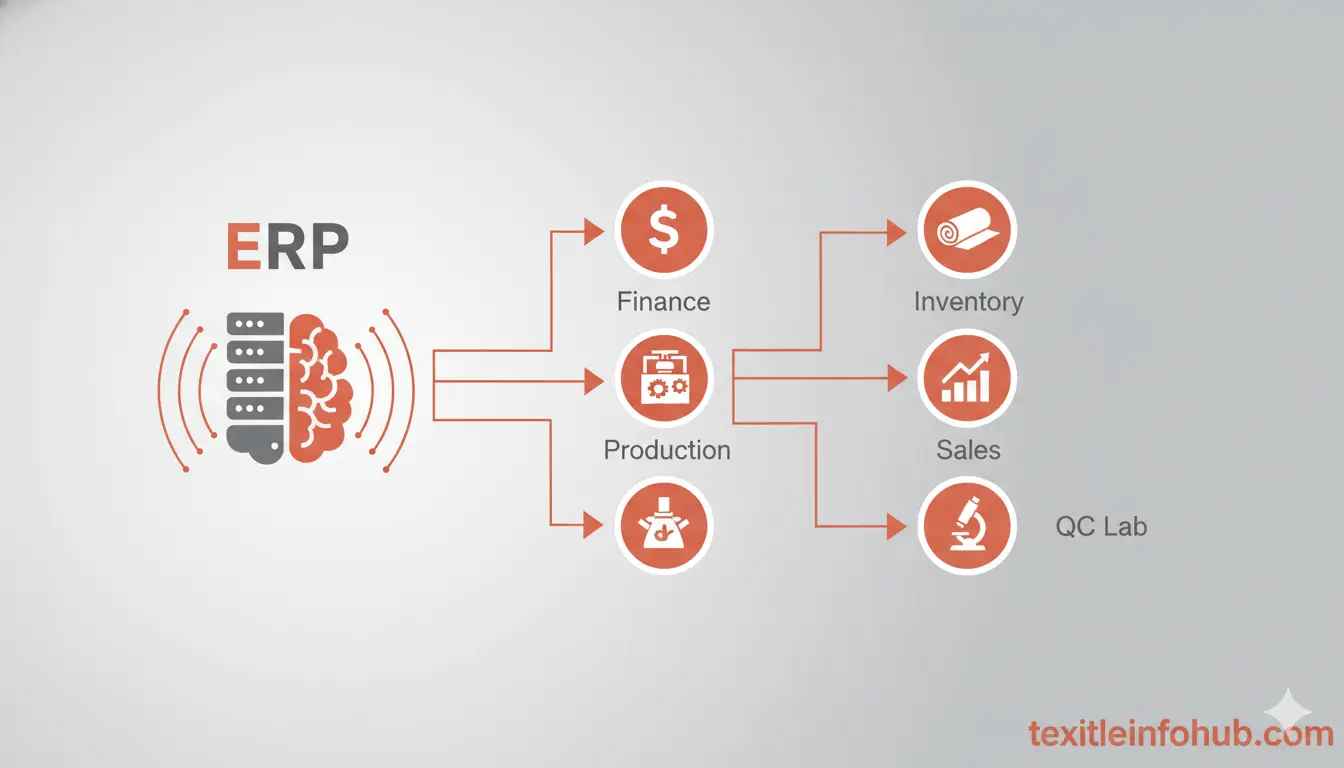
A textile mill should not choose textile ERP software by counting features or comparing brand names. It should choose the system that can control its most important order-to-cash, material-to-product and quality-to-release workflows with the least dangerous combination of gaps, customization and long-term cost.
That distinction matters. A system may handle accounting, purchasing and standard bills of materials yet still struggle with a greige roll that is split across dye lots, a yarn lot used on several machines, fabric graded after inspection, variable process loss, job work outside the mill, or a recipe revised after a lab approval.
The right ERP is therefore not automatically the largest, cheapest or most “textile-specific” product. It is the product-and-partner combination that passes your mill’s real workflows, protects traceability and costing, fits the skills of your users, integrates with essential systems, and remains supportable after go-live.
This guide provides a selection method for small, mid-sized and large mills without assuming that turnover alone defines complexity.
The short answer: Build a cross-functional team, document 10–15 must-pass workflows, set disqualifying requirements, make shortlisted vendors demonstrate those workflows with your data, compare five-year total cost, check security and exit terms, call relevant customer references, and contract against measurable acceptance criteria.
First, define what “size” means for an ERP decision
Employee count and annual sales matter for budget, but they do not fully describe ERP complexity. A single-site integrated mill can be harder to digitize than a larger trading business because production stages, attributes, quality decisions and material transformations create many more data relationships.
Profile the mill using these questions:
- How many legal entities, plants, warehouses and job-work locations must the system connect?
- Which stages are in-house: spinning, weaving, knitting, dyeing, printing, finishing, inspection, packing or garments?
- How many orders, lots, rolls, bales, packages, shades, styles or stock movements are recorded on a normal day and at peak load?
- Does production run make-to-stock, make-to-order, campaign-based, subcontracted or in a mixed model?
- Which attributes affect allocation and quality: fiber blend, yarn count, twist, shade, finish, width, grade, roll length, weight or buyer specification?
- How many existing systems and machines need to exchange data?
- What traceability, buyer, tax, sustainability or audit evidence must be retrieved, and how quickly?
- How strong are master-data discipline, network coverage, internal IT support and user readiness?
Use the answers—not a marketing label—to place the mill in one of the following operating profiles.
Small mill or focused processing unit
Typical profile: One legal entity and site, a limited number of stages, a small administrative team, few integrations and a need to replace disconnected accounting, inventory and production records.
Prioritize:
- simple sales, purchase, inventory, production and finance integration;
- lot, roll, bale or package identification at the level the business actually uses;
- job-work issue, receipt, reconciliation and billing where outsourcing is common;
- straightforward production booking and process-loss capture;
- mobile or shop-floor data entry that workers can use reliably;
- local implementation and support capacity;
- clean export of masters, transactions and attachments; and
- a phased module plan that avoids buying unused complexity.
Avoid: An enterprise-scale design that needs a large internal IT team, or a low-cost package that cannot preserve production and quality traceability.
Mid-sized or multi-stage mill
Typical profile: Several departments or sites, higher transaction volume, integrated production, formal quality control, more complex planning, multiple warehouses and a growing need for accurate product costing.
Prioritize:
- material requirements and capacity planning across departments;
- work-in-process visibility by order, lot and operation;
- recipe, bill-of-material, routing and version control;
- quality holds, inspection results, grading, rework and release authority;
- standard versus actual consumption, loss and conversion cost;
- maintenance and spare-parts coordination where operationally useful;
- application programming interfaces (APIs) for laboratory, machine, warehouse, payroll, banking or customer systems;
- role-based access, audit history and stronger approval workflows; and
- a reporting layer that reconciles operational and financial numbers.
Avoid: Adding a separate tool for every department without assigning a master system for each data object and transaction.
Large, multi-site or vertically integrated group
Typical profile: Multiple companies, plants, countries or business models; high transaction volume; complex group reporting; dedicated IT; and connections to manufacturing execution, warehouse, laboratory, planning, product, customer or supplier systems.
Prioritize:
- multi-entity, multi-site, multi-currency and applicable localization support;
- group-wide master-data governance with controlled local variation;
- scalable transaction processing and tested peak-load performance;
- segregation of duties, single sign-on, multifactor authentication, audit logs and security monitoring;
- resilient integrations and clear ownership of interface failures;
- data-retention, backup, recovery and business-continuity requirements;
- controlled extension methods that survive upgrades;
- formal release management, test environments and change governance; and
- contractual exit assistance and usable bulk data export.
Avoid: Assuming the corporate ERP must perform every shop-floor function. A governed ERP core connected to specialist production systems can be stronger than forcing one application to do everything.
ERP, MES or a combination?
ERP and a manufacturing execution system (MES) solve related but different problems.
An ERP is normally the business system of record for sales orders, purchasing, inventory value, production orders, costing, finance and enterprise controls. An MES works closer to production execution: machine status, operation progress, process parameters, operator activity and real-time shop-floor events.
The architecture should follow the mill’s problem.
One integrated ERP suite
Best fit: A mill that wants one primary platform and whose workflows can be handled through standard configuration.
Advantage: Fewer interfaces and clearer ownership of shared data.
Risk: A broad suite may be shallow in a critical textile process. Prove depth through the demo rather than accepting a module name.
Textile-specific ERP
Best fit: A textile-first company whose competitive and operational complexity lies in textile attributes, transformations, planning, traceability and costing.
Advantage: More industry terminology and workflows may be available without extensive custom development.
Risk: Finance, local compliance, integration, user experience or global support may not be equally strong. Verify each area independently.
General manufacturing ERP configured for textiles
Best fit: A group that values strong enterprise finance, controls, ecosystem and integration, and can govern textile configuration or extensions.
Advantage: Broad manufacturing and corporate capabilities.
Risk: The implementation partner may promise to “customize later” instead of proving textile workflows now.
ERP core plus specialist systems
Best fit: A mill with demanding production execution, advanced planning, laboratory, warehouse or product-lifecycle needs that one ERP cannot satisfy well.
Advantage: Each major job can use a deeper application.
Risk: Interfaces create failure points. Define which system owns the item, recipe, lot, quality status, inventory, order, cost and machine record.
Current vendor documentation shows why categories alone are not enough. General manufacturing platforms describe support for planning, bills of materials or formulas, production, quality and integration. Textile-focused vendors describe purpose-built textile workflows. Modular suites describe manufacturing, traceability, quality and maintenance modules. These are vendor claims—not proof of fit. Only an end-to-end test using your transactions can show whether the configuration works for your mill.
The 12 capabilities a textile mill should test
Do not turn this list into a tick-box questionnaire. Convert every relevant capability into a transaction that the vendor must complete in the system.
1. Product and attribute master
Check: Can the system define products without creating an unmanageable number of item codes? Test the attributes that drive ordering, planning, stock allocation, quality and price.
Evidence: Create representative fiber, yarn, greige and finished-fabric items. Change one controlled attribute and show its effect downstream.
2. Multiple units and variable quantity
Check: Can purchasing, production, stock and sales use the required combinations of kilograms, metres, pieces, rolls, packages or cones while preserving the correct base quantity and conversion logic?
Evidence: Receive, split, process, inspect and dispatch a real example. Reconcile physical quantity and financial value at every step.
3. Lot, roll, bale and package traceability
Check: Can users trace backward from a finished roll or shipment and forward from an input lot, including splits, merges, regrades, returns and subcontracted operations?
Evidence: Run a mock quality containment. Identify affected stock, work in process, dispatched material and source inputs. The GS1 Global Traceability Standard provides a useful neutral framework based on identifying, capturing and sharing traceability data; the mill must still define the textile objects and events it needs.
4. Recipe, BOM, routing and version control
Check: Can the system distinguish planned and actual material, process and resource use? Can it manage approved revisions with effective dates and an audit history?
Evidence: Change a recipe or route after approval, then show which orders use the old and new versions.
5. Production planning and capacity
Check: Can planning consider material availability, machine or work-centre capacity, sequence constraints, subcontracting and committed delivery dates?
Evidence: Insert an urgent order, remove a constrained machine and show the impact on material, schedule and promised date.
6. Work in process and process loss
Check: Can the system show quantity and value at each stage, including normal loss, abnormal loss, scrap, seconds, rework, co-products or by-products where relevant?
Evidence: Compare planned input with actual output through one complete route and reconcile the variance.
7. Quality control and release
Check: Can the mill define inspection points, specifications, sampling records, holds, concessions, grades, rework decisions and authorized release?
Evidence: Fail an in-process or final test. Confirm that restricted stock cannot be allocated or dispatched without an authorized decision.
8. Job work and subcontracting
Check: Can material sent outside the mill remain identifiable and financially controlled through issue, receipt, process loss, service charge, tax documentation and rejection?
Evidence: Split one order across two processors, receive partial quantities and reconcile pending material and charges.
9. Costing and margin
Check: Can the system calculate standard, estimated and actual cost at the level needed for decisions? Include raw material, conversion, utilities or machine rates where used, job work, packaging, quality loss, overhead rules and landed cost.
Evidence: Trace one order from quotation or standard cost to actual result. Make the vendor explain every variance source rather than showing only a final number.
10. Maintenance and operational integration
Check: Does maintenance belong in the ERP, a connected computerized maintenance management system, or the MES? Can production planning see relevant machine availability?
Evidence: Create a breakdown or planned-maintenance event and show the schedule, spare issue, work order and cost consequences.
11. Reporting, audit trail and approvals
Check: Can a manager move from a dashboard number to the underlying transaction? Are changes to sensitive masters, quantities, quality status, price and approvals attributable to a user and time?
Evidence: Correct a transaction through an authorized process. Show both the current result and the retained history.
12. Integration, export and recovery
Check: Are documented APIs, event messages or supported import/export methods available? Can the mill extract complete usable data and attachments? What happens when an interface or the main system is unavailable?
Evidence: Exchange a sample record, force an error, retry it without duplication, export it in bulk and restore a test backup.
Use a mill-specific demo, not the vendor’s standard presentation
Send anonymized sample data and expected results before the demonstration. Ask the vendor to complete the workflow live in the proposed product version and configuration. Record whether each step is standard, configurable, custom-built, dependent on a third party or unavailable.
Spinning-mill demo
Run: Bale receipt and testing → bale mix or blend plan → production through relevant stages → waste and realization capture → yarn lot and package creation → quality result → finished stock → dispatch.
Stress test: Change a blend component, record an off-quality lot, trace packages to inputs and reconcile planned versus actual material.
Weaving-mill demo
Run: Customer specification → yarn reservation → warping and sizing → loom allocation → greige roll production → inspection and grading → job-work processing if applicable → finished roll → dispatch.
Stress test: Substitute an approved yarn lot, split a roll, record a loom stoppage, downgrade part of the output and trace the final shipment.
Knitting-mill demo
Run: Yarn lot and issue → machine, gauge and program allocation → greige-roll production → defect record → dyeing or outside processing → finished width, mass and grade → dispatch.
Stress test: Mix approved lots under control, identify barre risk records, split output and retrieve all rolls linked to a complaint.
Wet-processing-mill demo
Run: Greige receipt → batch formation → route and recipe version → dye and chemical issue → process booking → shade or quality approval → finishing → inspection → finished lot → dispatch.
Stress test: Revise a recipe, record a machine change, reprocess part of the batch, hold it for approval and calculate the cost consequence.
Integrated-mill demo
Run: Start with a sales order and complete the full internal route across material planning, production, quality, costing, packing, dispatch and finance.
Stress test: Change demand after production has begun. Show the effect across capacity, inventory, purchasing, work in process, delivery and margin.
Set pass/fail gates before scoring vendors
A weighted score can hide a fatal gap. Apply non-negotiable gates first. A vendor should not reach commercial comparison if it cannot:
- complete every critical workflow with acceptable configuration;
- preserve the required lot, roll, bale or package traceability;
- reconcile operational quantities with inventory and finance;
- meet applicable statutory and buyer integration needs;
- demonstrate role controls, audit history, backup and recovery arrangements;
- provide complete, usable data export and reasonable exit support;
- identify the accountable implementation partner and support path; and
- provide relevant references that the mill can contact independently.
For an India-based mill, validate current GST, e-invoice, e-way-bill and other applicable tax workflows against official requirements and advice from the mill’s tax professional. The official e-invoice system explains that covered documents are reported to an Invoice Registration Portal and that registered data can flow to GST and e-way-bill systems. Applicability and technical rules can change, so do not rely on a sales presentation or an old checklist.
Expert review required: Confirm current tax, accounting, labor, privacy, export, buyer and sector-specific obligations for each operating country before issuing the request for proposal (RFP).
Score the evidence, not the sales team
After the pass/fail gates, use one scoring model for every vendor. The following is an editorial starting point; adjust the weights before receiving proposals so they cannot be changed to favor a preferred product.
| Criterion | Weight | Evidence to score |
|---|---|---|
| Textile workflow fit | 30% | Scripted demo |
| Partner and delivery fit | 15% | Named team, plan, references |
| Data and integration | 10% | API and export test |
| Security and reliability | 10% | Controls and recovery test |
| User adoption | 10% | User task trial |
| Five-year TCO and terms | 10% | Priced contract schedule |
| Scale and performance | 5% | Volume test |
| Reporting and analytics | 5% | Reconciled report trial |
| Roadmap and viability | 5% | Version-specific evidence |
Rate each criterion from 0 to 5, multiply the rating by its weight and divide the weighted total by 5 to produce a score out of 100. Keep evaluators’ initial scores independent, then discuss major differences using recorded evidence.
Do not award full points because a feature appears on a brochure. Full points should require a passed workflow, reviewed document, test result, contract commitment or relevant customer reference.
Compare five-year total cost, not license price
Use the same period, user counts, transaction assumptions, sites, interfaces and scope for every proposal.
Five-year TCO = software + implementation + data + integration + infrastructure + internal effort + training + support + upgrades + change + security + contingency
Build the comparison from vendor quotations and mill assumptions:
- software subscriptions or licenses by user, module, site, entity, transaction or consumption metric;
- implementation, configuration, project management and travel;
- custom development and the cost to test it after upgrades;
- data cleansing, migration, validation and history retention;
- integrations, API or message charges, middleware and monitoring;
- servers, devices, scanners, printers, networks and backup where applicable;
- internal project time, temporary backfill and super-user effort;
- training, training environments and new-employee onboarding;
- annual support, premium support and local partner charges;
- version upgrades, regression testing and mandatory technical changes;
- report changes, new workflows, additional entities and storage growth;
- identity, security monitoring, independent testing, backup and recovery; and
- a transparent contingency for approved unknowns—not a hidden vendor allowance.
Run at least three scenarios: expected use, lower-than-planned adoption and higher transaction or site growth. Treat savings, productivity gains and return on investment as separate benefit assumptions. Do not subtract vendor-promised benefits from TCO unless the mill has defined a baseline, owner, measurement method and realistic adoption condition.
Test security, resilience and exit before signing
ERP concentrates commercially sensitive and operational data. Security is therefore a business selection criterion, not an IT appendix.
The NIST Cybersecurity Framework 2.0 is designed for organizations of any size or sector and can help structure risk discussions. The CISA ransomware guide recommends practices including multifactor authentication and offline or cloud-to-cloud backups, with regular testing of backup availability and integrity.
Ask every finalist to provide evidence for:
- identity management, role-based access, privileged administration and multifactor authentication;
- separation of duties for purchasing, payment, inventory, quality release and master-data changes;
- encryption, audit logging, vulnerability and patch management, and security-incident notification;
- data location, subprocessors and access by vendor or partner staff;
- backup frequency, retention, restore testing and agreed recovery objectives;
- business continuity when internet, cloud service, interface or local network is unavailable;
- independent assurance reports or certifications relevant to the proposed service, including scope and validity;
- secure development and upgrade practices for custom extensions;
- bulk export of masters, open orders, stock, transactions, audit history and attachments; and
- deletion, transition help and continued access at contract end.
Expert review required: The mill’s information-security, legal and privacy advisers should review the proposed controls and contract. A certificate or questionnaire does not replace a risk assessment of the actual configuration and integrations.
Check the implementation partner as carefully as the software
ERP fit can be lost during implementation. Evaluate the people who will map, configure, migrate, test and support the mill—not only the product company.
Ask for:
- the named project manager, solution architect and textile functional leads;
- experience in the same mill type, operating model and scale;
- the portion of work assigned to subcontractors;
- responsibilities for process design, data cleaning, testing and user training;
- the method for classifying standard, configuration, extension and customization;
- escalation paths, local support hours and post-go-live staffing;
- customer references where the proposed team delivered comparable scope; and
- disclosure of any incentives to recommend third-party products.
During reference calls, ask what was promised, what went live, what required customization, what was delayed, how data quality was handled, whether the named team remained involved, how support performs during production-critical incidents and what the customer would do differently.
Contract for outcomes and acceptance
The statement of work should convert the winning demo and proposal into testable commitments. Include:
- modules, sites, companies, integrations, reports and data history in scope;
- documented exclusions and assumptions;
- process owners and responsibilities on both sides;
- milestone deliverables with objective acceptance tests;
- the approved demo scripts as user-acceptance scenarios;
- configuration and custom-development documentation;
- data-reconciliation rules and sign-off thresholds;
- performance, support, recovery and escalation commitments;
- change-control method and rate card;
- upgrade compatibility and regression-test responsibility;
- intellectual-property and source-code terms for critical custom work;
- data ownership, export format, retention, deletion and exit assistance;
- commercial renewal, price-change and termination terms; and
- warranty or defect-correction arrangements after go-live.
Expert review required: Legal counsel, tax advisers and information-security specialists should review the final contract and local compliance terms.
A lower-risk implementation sequence
Selection is only complete when the mill knows how the chosen system will be accepted and adopted.
1. Establish governance and baselines
Name the executive sponsor, project owner, process owners, data owners, security owner and super users. Record current performance definitions and data sources before claiming improvement.
2. Clean and govern master data
Assign owners for products, attributes, units, recipes, routes, work centres, machines, customers, suppliers, taxes, accounts and opening stock. Prevent duplicate or uncontrolled masters from moving into the new system.
3. Configure a working prototype
Run the selected end-to-end workflows early. Resolve process ownership and fit gaps before completing large data migrations or custom development.
4. Test roles, exceptions and integrations
Test normal work and difficult exceptions: split and merged lots, substitutions, rejection, rework, partial job-work receipts, downtime, interface failure, reversal, period close and recovery.
5. Migrate and reconcile data
Perform trial migrations. Reconcile opening balances, stock quantity and value, open sales and purchase orders, work in process, receivables, payables and relevant history to agreed control totals.
6. Train by role using mill transactions
Train operators, supervisors, planners, stores, quality, maintenance, finance and managers on their own tasks. Confirm competence through transactions, not attendance alone.
7. Rehearse cutover and fallback
Define inventory freeze, final migration, transaction ownership, communication, support coverage, decision authority and safe fallback if a critical acceptance condition fails.
8. Stabilize before expanding scope
Close defects, track adoption and reconcile data before adding optional modules, dashboards, machine connections or advanced automation.
Red flags during ERP selection
Pause or reject a proposal when:
- every requirement is answered “yes” without a live transaction;
- the vendor will demonstrate only prepared sample data;
- a critical textile workflow depends on customization that has not been designed, priced and assigned an upgrade owner;
- the system cannot handle the required lot or roll split, merge, grade, rework or job-work flow;
- operational quantity and financial value cannot be reconciled;
- data export is limited, chargeable in an unclear way or missing attachments and history;
- the implementation team is unnamed or materially different from the reference projects;
- support, recovery and escalation commitments are vague;
- “AI” is presented without a defined decision, input data, human control, accuracy test and fallback;
- commercial terms omit interfaces, environments, migration, reports, training or upgrades; or
- customer references do not match the proposed mill type, scope or product version.
Final selection checklist
Before approving the purchase, confirm:
- [ ] Mill profile and scope are documented.
- [ ] Cross-functional process and data owners are named.
- [ ] Critical workflows and disqualifying gates were agreed before proposals.
- [ ] Finalists ran the same scripted demos with mill data.
- [ ] Fit was classified as standard, configuration, extension, customization, third party or unavailable.
- [ ] Quantity, inventory value, cost and finance reconciled in the test.
- [ ] Five-year TCO uses comparable assumptions and sensitivity cases.
- [ ] Security, backup, recovery and business-continuity evidence was reviewed.
- [ ] Data export and exit were tested and included in the contract.
- [ ] Relevant customer references were contacted independently.
- [ ] The named implementation team and support model were evaluated.
- [ ] Applicable tax, privacy, labor, trade and buyer requirements were reviewed by specialists.
- [ ] Acceptance tests, change control and post-go-live support are contractual.
- [ ] A phased implementation and cutover plan is credible for the mill’s people and operations.
Conclusion
The best ERP for a textile mill is not a universal product. It is the system that can reliably execute the mill’s defining workflows, keep material and financial records aligned, support users at the point of work, and remain secure, recoverable and supportable at a defensible total cost.
Small mills should protect simplicity without sacrificing essential traceability. Mid-sized mills should demand integrated planning, work-in-process, quality and costing. Large groups should add governance, performance, security, integration and exit discipline. Every mill should insist on the same proof: its own transactions, run end to end, with results that can be reconciled and accepted.