Textile companies reduce emissions most credibly when they begin with a verified baseline, locate hotspots in their own data and test projects against engineering and GHG-accounting rules. Generic sector percentages and fixed saving claims cannot replace measurement at the facility or supply-chain boundary.
EU CBAM status — checked 16 August 2026
The EU Carbon Border Adjustment Mechanism’s definitive regime began on 1 January 2026 and currently covers cement, iron and steel, aluminium, fertilisers, electricity and hydrogen. Textiles are not one of these listed sectors.
Textile companies may still face customer GHG-data requests and other product, energy, environmental or due-diligence requirements. Check each obligation separately rather than labelling it “CBAM.”
1. Measure the Baseline
Define the organizational boundary, reporting period, base year, scopes, activity data and factor sources. Reconcile energy and fuel data and calculate a defensible baseline before ranking projects.
If the inventory is not yet controlled, first build the Scope 1, 2 and 3 baseline. Record data owners, source documents, estimation methods and uncertainty so later reductions can be tested against the same boundary.
2. Find Hotspots in Actual Data
Break emissions down by site, process, energy source, machine, product family and relevant Scope 3 category. Pair carbon data with production, quality and cost data. Generic industry rankings are a hypothesis, not a substitute for the company’s own inventory.
- Normalize energy and emissions by a clearly defined production denominator.
- Separate base load, variable load, start-up, reprocessing and idle operation.
- Check whether a hotspot is caused by the process, product mix, quality loss or data allocation.
- Record data confidence before committing capital.
3. Stabilize Operations and Remove Waste
Start with metering, leak repair, insulation, preventive maintenance, combustion and boiler control, compressed-air discipline, right-first-time processing, recipe control, optimized washing and drying, and scheduling. Quantify the before-and-after boundary and avoid claiming savings that are only modeled.
Operational projects should identify the responsible owner, baseline period, affected equipment, production and quality constraints, measurement method and verification period.
4. Evaluate Energy Changes Technically
Assess heat recovery, efficient motors and drives, lower-temperature processes, electrification, renewable electricity, fuel changes and thermal-system upgrades using load profiles, product-quality constraints, safety, maintenance, grid or fuel availability and total cost.
A renewable certificate, supplier tariff or power contract must meet the applicable Scope 2 accounting rules before the company attributes a market-based reduction. Keep contractual evidence and avoid double counting.
5. Work on Materials and Suppliers
For material changes, use product-specific or supplier-specific evidence where credible and document the functional unit, system boundary, allocation, geography and data year. Do not assume that one fibre label guarantees a lower total footprint for every product.
Include quality, durability, process yield and end-of-life assumptions. A nominally lower-impact input can lose its advantage if it increases rejects, processing demand or product replacement.
6. Verify Results and Prevent Double Counting
For each project, define the baseline, counterfactual, meter or data source, calculation method, uncertainty, owner and verification period. Report inventory reductions separately from avoided-emissions claims, renewable instruments and offsets. Recalculate the base year when the chosen framework requires it.
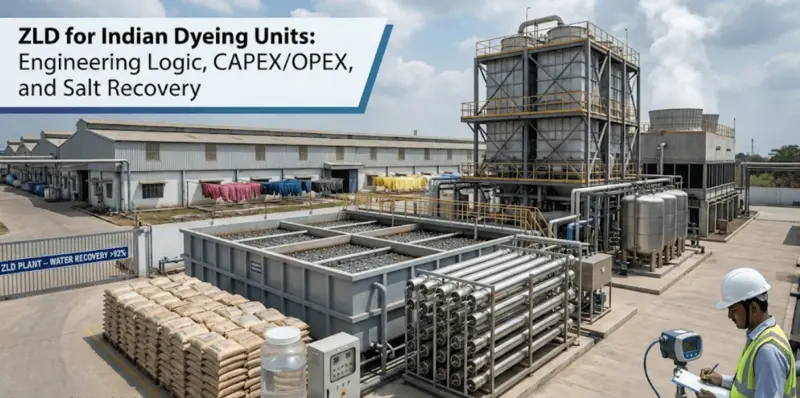
Water and effluent projects require separate environmental and carbon accounting. Use the textile ZLD compliance and cost framework to define the legal and water-system boundary, then account for its energy and other GHG effects in the inventory.
A Practical Project Register
- Project name, site, equipment and owner
- Baseline period, boundary and data source
- Engineering calculation and operational assumptions
- Expected energy, cost and GHG effect shown separately
- Capital, maintenance, quality and safety constraints
- Measurement and verification plan
- Approval, implementation status and verified result
Sources and Review
- GHG Protocol Corporate Standard, accessed 16 August 2026.
- GHG Protocol Scope 2 Guidance, accessed 16 August 2026.
- GHG Protocol Scope 3 Calculation Guidance, accessed 16 August 2026.
- European Commission — CBAM definitive regime and covered sectors, accessed 16 August 2026.
- Textile Exchange Materials Matrix, accessed 16 August 2026.
- Textile Exchange explanation of fibre and material GHG data, accessed 16 August 2026.
Every quantified saving needs a defined baseline, boundary, data period and calculation. Have engineering claims and GHG-accounting treatment reviewed before publication.