
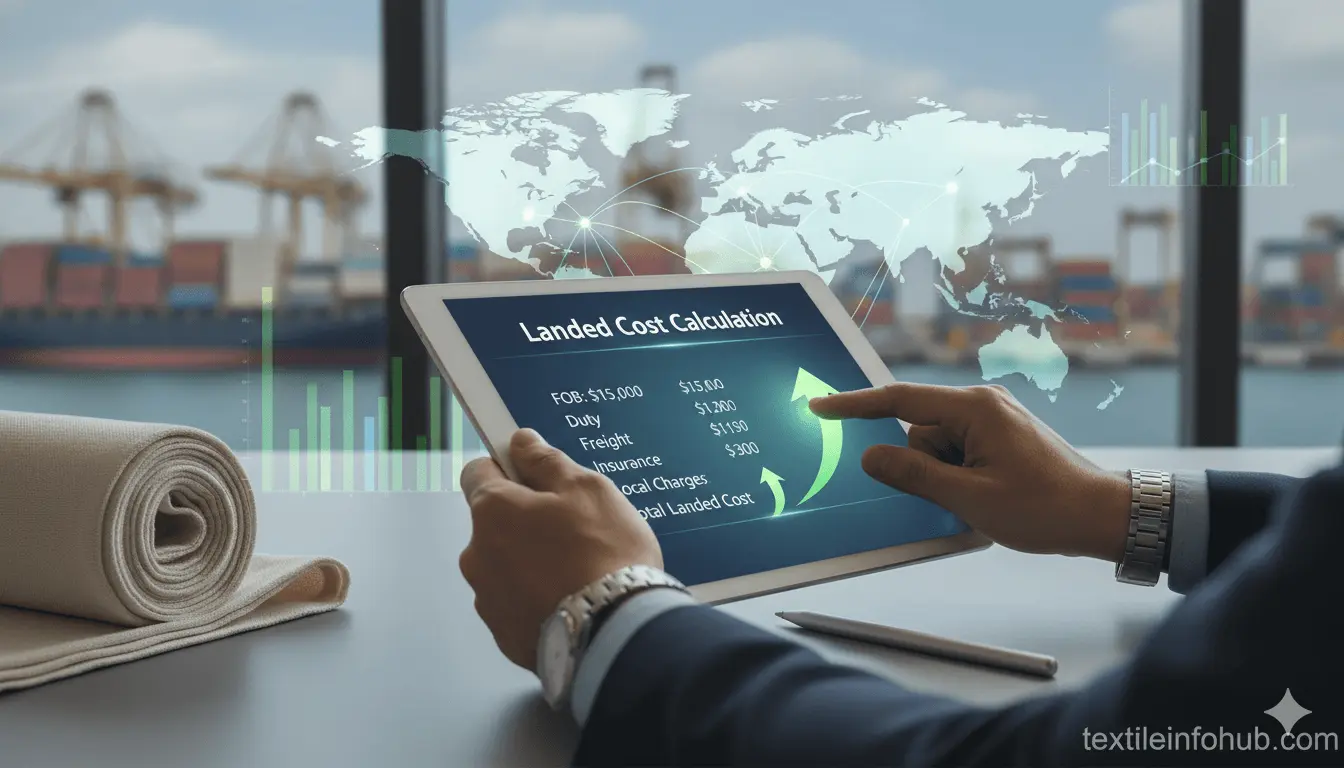
Landed cost is the importer’s total commercial cost of bringing usable goods to the required location. It is related to—but not identical to—the customs value used to assess duties and taxes.
The calculation depends on product classification, origin, transaction, Incoterm, valuation rules, current duty notifications, the customs-notified exchange rate, tax-credit eligibility and actual logistics charges. Verify these inputs for every shipment.
A. Purchase and Origin Costs
- Supplier price under the agreed Incoterm
- Packing, certification, testing and inspection charged to the buyer
- Origin haulage, terminal and documentation charges not included in the supplier price
- Buying commission or other additions where commercially applicable
Record the named place or port and the Incoterms® edition. Do not assume that a three-letter term answers who actually pays each local charge.
B. International Movement
- Main freight and carrier surcharges
- Cargo insurance or the agreed risk cost
- Transshipment and other contracted charges
- Currency-conversion and bank charges linked to the movement
C. Customs and Import Taxes
- Customs assessable value determined under the applicable law and valuation rules
- Basic customs duty and any applicable levy, cess, safeguard, anti-dumping or preferential treatment
- Social Welfare Surcharge or other applicable charge
- Import IGST and its applicable tax base
Use the confirmed HS classification, country of origin, current notification and customs-notified exchange rate. Do not infer a preferential rate from the supplier’s country alone; rules of origin and documentary conditions must be satisfied.
Import IGST can be a cash outflow without being a permanent commercial cost when the importer is eligible for input tax credit. Eligibility, timing and accounting treatment depend on the importer’s facts and require professional advice.
D. Destination and Internal Costs
- Customs broker, port or terminal, handling and documentation
- Examination, sampling, testing and compliance costs
- Demurrage and detention, or a separately disclosed risk allowance
- Inland transport, unloading and warehouse delivery
- Bank, letter-of-credit, foreign-exchange and finance cost
- Expected quality or yield loss supported by actual history, not a hidden arbitrary percentage
E. Gross Cash Cost Versus Net Commercial Cost
Show at least two totals so that management can see the cash requirement and the cost after confirmed recoveries:
Gross cash landed cost = purchase and origin + international movement + duties and taxes paid + destination and internal costs
Net commercial landed cost = gross cash landed cost − recoverable tax credits and other confirmed recoveries
State the basis of every recovery. Also state whether finance cost, inventory holding, quality loss, rejected quantity and currency risk are included in the commercial total.
FOB Is Not a Complete Landed-Cost Answer
Under Incoterms® 2020, FOB is for sea or inland-waterway transport and risk transfers when the goods are on board the nominated vessel. It is not generally the appropriate rule when containerized goods are handed to a carrier at an inland or terminal point; FCA may be more suitable.
Record the named place or port and edition, then map each real charge to the contract instead of relying on the three-letter term alone.
Build a Low, Base and High Shipment Model
Use current quotations and dated official inputs. Keep one row for each cost and these fields: line item; currency; quoted amount; quotation date; exchange-rate source and date; INR amount; included in Incoterm yes or no; customs-value treatment; recoverable yes or no; evidence reference; low, base and high case; owner; and note.
If a buyer or supplier requires an environmental assessment, include only the current quotation and the costs applicable to the transaction. The separate bluesign cost and ROI framework explains why certification and assessment costs should not be estimated from generic online figures.
Pre-Shipment Verification Checklist
- Confirmed product description and HS classification
- Country of origin and any preference or rules-of-origin evidence
- Current duty notification and applicable trade-remedy check
- Customs valuation treatment and notified exchange rate
- Incoterm, named place or port and contract charge map
- Freight, insurance, port, broker and inland quotations
- Input-tax credit and recovery treatment confirmed for the importer
- Low, base and high assumptions approved by an accountable owner
Sources and Review
- CBIC Customs Act, 1962 — Section 14 valuation, accessed 16 August 2026.
- CBIC tax-information portal for current customs law and notifications, accessed 16 August 2026.
- ICEGATE exchange-rate information and search, accessed 16 August 2026.
- ICC explanation of FOB under Incoterms® 2020, accessed 16 August 2026.
This is an educational framework, not customs or tax advice. Confirm classification, valuation, notification, origin or preference, exchange rate and input-tax treatment with qualified advisers for the shipment.