A fabric inspection machine does not create quality. It decides how early your factory finds the defects that can reduce usable yield, disturb cutting plans, create panel mismatch, trigger rework or reach the customer.
For most factories, the right choice is not simply “manual versus AI.” The real decision has three layers:
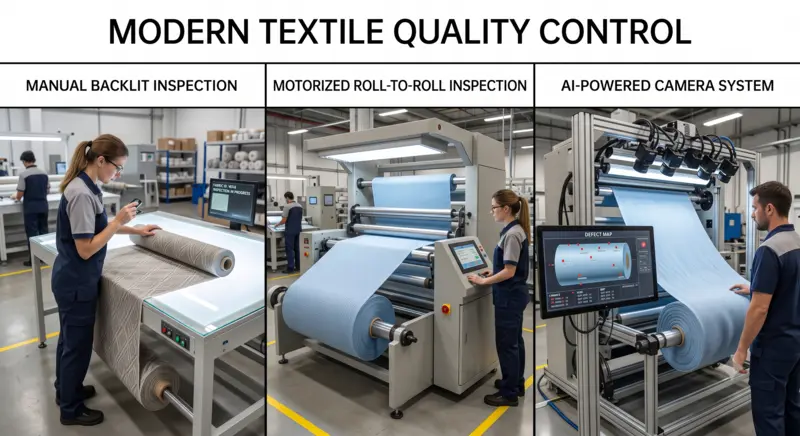
- Manual inspection is suitable when roll volume is low, styles change frequently and the factory can accept handwritten or basic digital records.
- A motorized conventional machine is usually the practical baseline when the factory needs controlled fabric movement, rewinding, length measurement, edge alignment and repeatable inspection workflow—but still wants a human to detect and grade defects.
- AI vision inspection becomes credible when inspection volume, repeated fabric families, roll-level traceability and the cost of missed defects can justify cameras, software, integration and ongoing model management.
Do not buy on maximum speed, camera count or a list of detectable defects. Ask each supplier to demonstrate the complete system on your most difficult fabrics at the speed and quality level you intend to use in production.
Quick decision table
| Factory situation | Likely starting point | Why | Main limitation |
|---|---|---|---|
| Small volume, many changing styles, sample room or occasional incoming inspection | Manual illuminated table or simple hand-fed frame | Low investment and easy adaptation to unusual fabrics | Slow, operator-dependent and weak roll-level data |
| Regular incoming or final inspection with roll rewinding and length control | Motorized conventional inspection machine | Better handling, controlled speed, tension management and repeatable roll presentation | Defect detection and grading still depend on the inspector |
| High roll volume with stable fabric families and need for defect maps | Motorized machine with digital defect logging | Improves traceability without committing immediately to full AI | Data capture may still interrupt the inspector |
| Continuous production, repeated styles, high downstream defect cost or cut-plan integration | AI vision system with human verification | Automated localization, image records, roll maps and trend analysis | Higher investment, setup effort, false alarms and fabric-specific validation |
| Printed, pile, highly reflective, very dark, transparent, open-structure or unstable stretch fabric | Trial-based selection; often hybrid inspection | These surfaces can challenge both human presentation and machine vision | Brochure performance may not transfer to the actual product |
This table is a screening tool, not a purchasing rule. Final selection must follow trials with the factory’s own substrates and agreed defect definitions.
First define what “manual,” “motorized” and “AI” mean
Manual visual inspection
A manual setup may be an illuminated inspection table, a simple frame or a hand-fed unit. The operator advances the fabric, stops at suspected defects, marks their position and records the finding.
Its strength is flexibility. An experienced inspector can change attention rapidly when moving from a plain woven to a printed fabric, a pile construction or an unfamiliar defect. The weaknesses are throughput, physical effort, record consistency and dependence on the same inspector applying the same judgement throughout the shift.
Manual inspection can remain valid for low-volume or high-mix operations. It becomes risky when roll queues grow, inspection is rushed, defect positions must be passed accurately to the cutting room, or management cannot compare supplier and batch performance.
Motorized conventional inspection
A motorized machine moves and rewinds the fabric using powered rollers. Depending on configuration, it may include variable speed, reflected and transmitted lighting, tension control, edge guiding, spreading or opening devices, a length counter, roll weighing, defect marking and barcode printing.
The word automatic in a quotation may refer only to functions such as edge alignment, tension control, stopping or roll winding. It does not necessarily mean that the machine detects defects.
Published manufacturer specifications show how widely conventional machines can differ. One current knit-fabric model lists an 82-inch roller, an 80 kg roll capacity and an inspection-speed range of 10–80 yd/min; these are manufacturer specifications, not independent performance findings. The useful lesson is to compare the complete fabric-handling envelope, not copy a headline speed from one configuration to another. See the manufacturer’s current specification page.
AI vision inspection
An AI vision system adds controlled illumination, one or more line-scan cameras, a fabric-motion encoder, image processing, defect localization or classification software, data storage and a review interface. It can be installed on an offline inspection machine or integrated into a dyeing, finishing or coating line.
Current systems may offer roll maps, defect images, defect lists, grading data and production statistics. For example, Uster’s July 2025 technical data describes reflected and transmitted illumination options, offline and inline installation, real-time image processing and report generation. These are manufacturer specifications, not proof that every fabric or defect will be detected under factory conditions.
AI does not eliminate judgement. Someone must define which defects matter, approve style settings, review uncertain detections, control false alarms and decide whether a roll is accepted, downgraded, repaired, segregated or mapped for cutting.
The seven specifications that should drive the purchase
1. Fabric form and process location
Begin with where the inspection occurs:
- greige inspection after weaving or knitting;
- intermediate inspection after dyeing, printing, coating or finishing;
- final inspection before dispatch;
- incoming inspection at a garment or converting factory; or
- defect mapping before spreading and cutting.
Then define the material presentation: roll-to-roll, roll-to-flat, flat-to-roll, folded-to-folded, open-width knit, tubular knit or another form. A machine designed for stable woven rolls may not control a curling, elastic or tubular knit correctly.
Ask whether both fabric faces must be visible in one pass. Also confirm whether the machine can inspect the fabric without creating tension marks, width distortion, creases, telescoped rolls or hard/soft winding.
2. Working width, roll diameter and roll mass
Specify:
- minimum and maximum usable fabric width;
- expected lateral movement during transport;
- maximum incoming and outgoing roll diameter;
- maximum roll mass;
- core diameter and core condition;
- roll-loading method and trolley access; and
- required floor space and service clearance.
Do not choose a working width equal to nominal fabric width. The machine must accommodate selvedges, lateral movement, edge sensors and the supplier’s stated installation tolerances.
For AI systems, camera and illumination width must cover the full inspection zone at the required resolution. A wide system running at coarse resolution is not automatically better than a narrower system matched to the product.
3. Fabric transport and tension control
Transport quality determines whether the inspector or camera sees the real fabric surface.
For stable woven fabric, the main issues may be edge alignment, wrinkle removal and roll build. For elastic knits, the buyer must examine tension ratio, overfeed or low-tension handling, edge curl, bowing and dimensional distortion. Pile, coated, delicate and technical fabrics may require special roller coverings, larger roller diameters or non-contact guidance.
During the trial, measure the fabric before and after inspection where width or length distortion is a concern. Also inspect the rewound roll for telescoping, trapped creases, edge damage and inconsistent hardness.
4. Illumination and defect visibility
No single lighting arrangement reveals every defect.
- Reflected light supports evaluation of many surface, stain, colour and structural irregularities.
- Transmitted light can make holes, open places and selected yarn or construction faults easier to see.
- Multiple lighting angles may be needed for surface relief, pile direction, coating or reflective effects.
- Colour-sensitive decisions require controlled viewing conditions and a separate colour-management procedure; a general inspection lamp should not automatically be treated as a colour-matching cabinet.
Require the supplier to state the light-source type, replacement interval, warm-up needs, control method and how illumination uniformity is checked. For camera systems, ask how the software compensates for lamp ageing, contamination and variation across the width.
5. Inspection speed versus validated detection
Maximum transport speed is not the same as effective inspection speed.
The usable speed depends on fabric construction, pattern, defect size, lighting, camera resolution, inspector workload and the consequence of a miss. A conventional machine may physically run faster than a person can inspect reliably. An AI camera may acquire images at high line speed but still require a different resolution or style setting for a difficult fabric.
Therefore, ask suppliers to quote three values:
- maximum mechanical speed;
- recommended production speed for each representative fabric family; and
- demonstrated speed at the agreed defect-detection and false-alarm performance.
The third number is the purchasing number.
6. Measurement, grading and roll-level data
A useful machine should connect defect evidence to a specific roll. Depending on factory needs, the record may include:
- supplier, order, fabric, batch, shade and roll identity;
- inspected length and width;
- defect type, position and severity;
- image or operator note;
- repair or cut-out decision;
- point total or factory grade;
- accepted, held, downgraded or rejected status; and
- export to enterprise resource planning (ERP), manufacturing execution system (MES), warehouse or cutting software.
ASTM lists D5430-26 as the active standard for visually inspecting and grading fabrics. Its public scope states that the methods may be used for roll or shipment acceptance when purchaser and seller agree. ASTM also warns that penalty results can vary when different point-assignment options are used.
Do not copy an online “standard” point threshold into the machine. The purchaser and supplier must agree on the inspection method, defect definitions, point option, sampling, acceptance rule and reporting convention. The editor should verify all mandatory details in a licensed copy of the current standard and in the applicable buyer specification.
Expert review required: Standards method, buyer-specific acceptance criteria and any pass/fail threshold.
7. Maintainability, safety and service
Inspection quality falls when lamps are dirty, rollers mark the fabric, edge sensors drift, encoders slip or cameras move out of alignment.
Request:
- preventive-maintenance tasks and intervals;
- cleaning access for lamps, lenses, boards and rollers;
- calibration or verification procedures for length, speed, width and vision components;
- critical-spares list with local lead times;
- remote and on-site support terms;
- software licence, update and cybersecurity policy;
- data backup and restoration procedure;
- operator, maintenance and administrator training; and
- guarding, emergency stops and electrical documentation applicable to the installation location.
Do not accept a promise of “remote support” without defining response time, access control, data exposure and what happens when the factory network is unavailable.
Expert review required: Electrical, mechanical and machine-safety compliance for the country and site of installation.
When AI vision is and is not the right investment
AI vision is most defensible when the factory has:
- enough roll volume to use the system consistently;
- recurring fabric families that justify stable inspection settings;
- a defined defect taxonomy;
- costly downstream consequences from missed defects;
- a need for defect images, roll maps and supplier trend data;
- people who can own model setup and verification; and
- a cutting, quality or process team prepared to act on the data.
It is less attractive when the factory runs mostly one-off developments, has poorly defined defect rules, cannot maintain controlled presentation and illumination, or lacks a process for reviewing alarms and correcting source processes.
Peer-reviewed reviews of computer-vision fabric inspection report continuing challenges around dataset availability, reproducibility, real-time deployment and transferring research performance into industrial use. That is why a published accuracy figure or a laboratory demonstration should not replace a factory trial. See the 2024 review, “Toward Automated Fabric Defect Detection”, and this review of deployment challenges.
Questions to ask an AI supplier
- Which defects can the system localize, and which can it classify?
- Are results available separately for each fabric family, colour, pattern and speed?
- How is a new style created, approved and version-controlled?
- Can the system learn from operator corrections? Who owns the resulting data and model?
- What happens with prints, mélange effects, slubs, pile, transparent fabric, reflective coatings and very dark shades?
- Does inspection cover one face or both faces?
- How are colour variation and shade bands handled, and what cannot be claimed as instrument-grade colour measurement?
- What are the false-alarm rate and missed-defect rate during a trial with the buyer’s own defect set?
- Can reports and images be exported in a usable, documented format?
- Will the system operate if the internet connection fails?
- How much storage is needed, and how long are images retained?
- Which functions require an annual licence or service contract?
Run a factory acceptance test before issuing the purchase order
A showroom demonstration proves that the machine can run the supplier’s fabric. It does not prove that it can inspect yours.
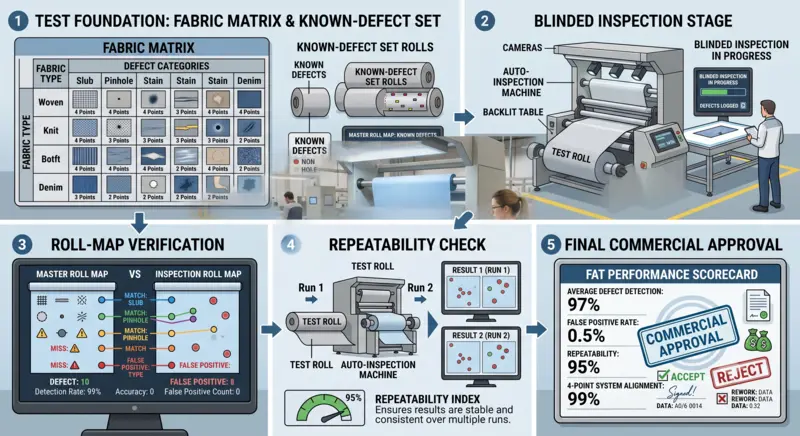
Build a test matrix using representative production materials:
- a stable plain woven;
- a stretch or open-width knit;
- the darkest regular shade;
- a printed or structured surface;
- a high-value or claim-sensitive product; and
- at least one difficult fabric the supplier has not preselected.
Include naturally occurring defects from retained rolls where possible. Record and agree the defect location and category before the scored trial. Do not add unsafe or damaging artificial defects during normal machine operation.
Recommended trial measurements
| Metric | Calculation or check | Why it matters |
|---|---|---|
| Known-defect detection rate | Known defects detected ÷ total agreed known defects × 100 | Measures misses on the agreed test set |
| False alarms | Incorrect defect calls per 1,000 inspected metres | Shows verification workload |
| Localization error | Difference between recorded and physical defect position | Determines usefulness for repair or cutting |
| Repeatability | Compare results when the same roll is reinspected under the same conditions | Reveals variation in transport, setup or recognition |
| Effective inspection rate | Accepted inspected metres ÷ total trial time | Includes stops, review and roll handling |
| Roll-build quality | Visual and dimensional check after rewinding | Prevents inspection from creating a new problem |
| Data completeness | Required fields and images successfully exported | Confirms integration value |
| Changeover time | Time to load a roll or create/approve a style | Exposes hidden production loss |
These are recommended internal procurement metrics, not universal acceptance limits. The buyer and supplier must define thresholds before testing.
Expert review required: Trial design, defect set, statistical confidence and acceptance thresholds.
Compare total cost of ownership, not machine price
Use the same time horizon for every shortlisted option.
Total cost of ownership (TCO)
TCO = installed cost + financing + training + software/licences + maintenance + spares + energy + IT/integration + planned downtime − residual value
For an AI option, compare its incremental cost and benefit against the best conventional system that would otherwise be purchased.
Annual net benefit
Annual net benefit = labour redeployed + avoided claims/rework + increased usable yield + avoided downstream inspection + planning value − annual incremental operating cost
Simple payback
Simple payback in years = incremental installed investment ÷ annual net benefit
Illustrative worked example—not a market quotation
The following values are assumptions dated 28 July 2026. Replace every input with quotations and factory records.
| Incremental AI case versus motorized inspection | Assumed annual value |
|---|---|
| Incremental installed investment | ₹40,00,000 |
| Inspector time redeployed | ₹8,00,000 |
| Avoided claims and rework | ₹10,00,000 |
| Additional usable yield or cut-plan recovery | ₹5,00,000 |
| Extra software, service, IT and maintenance cost | (₹3,00,000) |
| Annual net benefit | ₹20,00,000 |
| Illustrative simple payback | 2.0 years |
The calculation is ₹40,00,000 ÷ ₹20,00,000 = 2.0 years.
This does not predict the return from any machine. It demonstrates how to expose the assumptions. Run sensitivity cases for lower defect losses, lower labour redeployment, licence escalation, slower adoption and unplanned downtime.
Request-for-quotation checklist
Send the same specification sheet to every supplier.
Product and handling
- Fabric types, constructions and finishes
- Open-width, tubular, roll or folded presentation
- Minimum and maximum width
- Maximum roll diameter and mass
- Required tension range and stretch control
- Face/both-side inspection requirement
- Incoming and outgoing roll form
Inspection
- Reflected, transmitted and angled lighting
- Mechanical and validated inspection speeds
- Length and width measurement method
- Defect marking and repair workflow
- Grading options and configurable rules
- AI defect localization and classification scope
- Expected performance by representative fabric family
Data and integration
- Roll identification and barcode/RFID support
- Defect images and maps
- Export formats and application programming interface (API)
- ERP, MES, warehouse or cutting integration
- Data ownership, retention, backup and cybersecurity
- Offline operating capability
Commercial and support
- Base machine, options and installation
- Freight, duties, taxes and civil/electrical preparation
- Training and acceptance testing
- Warranty exclusions
- Annual licences and software updates
- Preventive-maintenance contract
- Critical spares and service response
- Upgrade path and end-of-support policy
Final verdict
Choose manual inspection when volume is low, product variety is high and simple records are acceptable.
Choose a motorized conventional machine when the factory needs controlled roll handling, length measurement, edge alignment, repeatable presentation and higher throughput, but human judgement remains practical.
Choose AI vision when missed defects and weak roll data create enough recurring loss to justify a validated camera system, software ownership and process integration.
For many mills and garment factories, the best path is staged: first standardize defect definitions and roll identification, then install reliable motorized handling and digital logging, and only then automate detection where the data shows a financial case.
The purchase order should follow a passed factory acceptance test—not the most impressive brochure.
Read our Textile Machinery section in Technology Guide Section for updates
Frequently asked questions
Is a motorized fabric inspection machine automatic?
Not necessarily. It may automate fabric movement, rewinding, edge control or measurement while a person still detects and grades defects. Ask the supplier exactly which functions are automated.
Can AI replace the fabric inspector?
AI can automate image acquisition, localization, classification and reporting, but the factory still needs people to define defects, approve settings, review uncertain calls and decide disposition. The required staffing model must be proven during the factory trial.
What inspection speed should a buyer specify?
Specify a demonstrated speed for each representative fabric family at agreed detection and false-alarm performance. Do not use maximum mechanical or camera speed as the production acceptance criterion.
Should every factory use the 4-point system?
No universal online threshold should be assumed. The inspection and acceptance method must follow the purchaser–supplier agreement, the applicable buyer specification and, where selected, a licensed copy of the current standard.
Can the same system inspect woven, knit and printed fabrics?
Some suppliers offer configurations for multiple fabric families, but transport, lighting, resolution and recognition performance can change substantially. Require separate trial results for each important construction and visual effect.