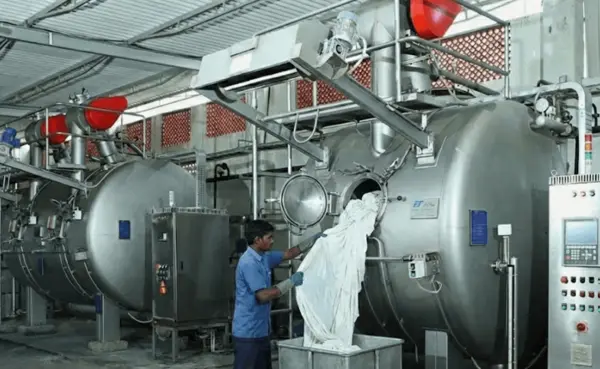
The textile dyeing landscape in 2026 is defined by a single metric: survival. With energy costs spiking and environmental regulations tightening, running legacy 1:10 Liquor Ratio (MLR) dyeing machines is financially unsustainable for any commercial mill. The transition to the new generation of Soft Flow Dyeing Machines, which routinely achieve 1:5 to 1:6 MLR, represents the fastest way to slash utility bills while protecting delicate fabrics from pilling and edge curling.
This 2026 buying guide cuts through manufacturer marketing to give plant managers and engineers the hard data needed to make the right CAPEX decision.
1. The 2026 MLR Revolution: Why 1:5 is the New Baseline
Liquor Ratio (MLR) dictates the profitability of your dyehouse. Every liter of water requires steam to heat, chemicals to condition, and energy to treat in effluent plants.
Transitioning from a conventional 1:10 MLR to a modern 1:5 MLR system reduces total water consumption by up to 50% per batch. Furthermore, because there is less liquid to heat to the standard 140°C processing temperature, steam consumption drops by nearly 60%.
The Financial Impact of MLR (Per 500kg Batch)
| Metric | Legacy 1:10 MLR | Modern 1:5 MLR | 2026 Savings |
| Water Usage | 5,000 Liters | 2,500 Liters | 50% Reduction |
| Steam Required | High | Low | ~60% Drop |
| Chemical Load | 100% | 60% | 40% Reduction |
Pro Tip: For mills targeting Zero Liquid Discharge (ZLD) plants, a 1:5 MLR machine is mandatory to keep effluent loads manageable.
2. Core Specifications: The “No-Fluff” Decision Matrix
When evaluating 2026 models, disregard subjective terms like “gentle handling” or “fast processing.” Instead, focus strictly on working pressure, fabric speed, and nozzle versatility.
The industry standard for high-tech turbo machines now pushes fabric speeds up to 800 m/min. This velocity, combined with sub-1.0 Bar nozzle pressure, is the secret to processing low-GSM (30 g/m²) elastomeric knits without tension damage.
2026 Soft Flow Specs at a Glance
- Working Temp & Pressure: Max 140°C at 3.0–3.6 Bar.
- Fabric Speed: 250 m/min (Standard) to 800 m/min (High-Tech).
- Capacities: 100 kg (Small Scale) to 2000 kg (8-tube Heavy Industrial).
- Heating/Cooling: Gradients of 5°C/min (Heat) and 3°C/min (Cool).
Top 2026 Configurations
| Machine Type | Best For | Max Capacity | Ideal MLR |
| Single-Nozzle Standard | Cost-effective Cotton knits | 600 kg | 1:6 |
| Dual-Nozzle Turbo | Spandex & Sensitive synthetics | 1000 kg | 1:5 |
| Multi-Tube Heavy Duty | High-volume Towels/Fleece | 2000 kg | 1:5 |
3. Soft Flow vs. Jet Dyeing: Selecting for Fabric Type
A common point of confusion for B2B buyers is choosing between Soft Flow and traditional Jet Dyeing machines. The decision relies entirely on the structural integrity of your target fabric.
Jet Dyeing Machines use high-pressure liquid jets to transport the fabric. While fast, the intense hydraulic pressure can cause surface abrasion, stretching, and permanent creasing on delicate materials.
Soft Flow Dyeing Machines, in contrast, transport fabric using a low-pressure overflow of liquor combined with a mechanical winch. The fabric is submerged in the dye liquor, acting as a cushion.
Best Fabrics for Soft Flow Machines:
- Low-GSM Knits: Single jersey, interlock, and rib structures.
- Elastomeric Blends: Lycra and Spandex (prevents tension-loss).
- Pile Fabrics: Terry towels, fleece, and velour (maintains surface texture).
- Delicate Synthetics: Viscose and Modal.
Rule of Thumb: If your production mix is over 40% delicate knits or stretch fabrics, a Soft Flow machine is mandatory. For heavy, stable wovens (like denim or canvas), traditional Jet dyeing remains viable.
4. Operating Costs & ROI Calculation
Capital Expenditure (CAPEX) for a 2026-spec soft flow machine is recouped through severe cuts to Operational Expenditure (OPEX). Mill owners must look beyond the sticker price and calculate the per-kg cost of dyeing.
Modern machines feature variable frequency drives (VFD) and advanced pump designs that significantly reduce energy loads.
Baselines for ROI Calculation (2026 Standards)
- Electricity Consumption: Approximately 2–3 kW per chamber (a 4-chamber/1000kg machine runs at ~8-12 kW).
- Steam Consumption: 25 kg/hour of steam at a line pressure of 5-7 kg/sq.cm.
- Batch Cycle Time: 40% faster than 2020 models due to rapid 5°C/min heating gradients. Shorter cycles mean higher daily tonnage without adding labor shifts.
5. Troubleshooting & 2026 Innovations (ZLD Compatible)
For 2026, the intersection of dyeing technology and effluent treatment is critical. The highest failure point in modern dyehouses isn’t the dyeing machine itself, but overloading the Effluent Treatment Plant (ETP).
Soft Flow machines are now the backbone of Zero Liquid Discharge (ZLD) compatibility. By operating at an ultra-low MLR of 1:5, these machines drastically reduce the volume of high-TDS (Total Dissolved Solids) wastewater sent to the ZLD evaporators. This prevents evaporator scaling and reduces ETP running costs.
Common Troubleshooting for 2026 Models:
- Fabric Entanglement: Usually caused by incorrect winch speed vs. liquor flow synchronization. Modern PLC (Programmable Logic Controller) systems auto-calibrate this balance.
- Uneven Dyeing (Channelling): Result of overloading the chamber capacity. Strictly adhere to the max kg rating (e.g., max 250kg per tube).
List of Major Soft flow Machine Manufacturers for reference
Disclaimer: This list is informational only and does not imply ranking or endorsement. It is presented in Alphabetical order. Always evaluate each soft flow model against the specifications defined in this guide.
- Apex Engineers (India)
- Brazzoli (Italy)
- COSMOTEX (Spain)
- Danitech (Italy)
- Dilmenler (Turkey)
- Exolloys Engineering Pvt. Ltd. (India)
- Fong’s National Engineering Co. Ltd. (Hong Kong/China)
- Guruson International (India)
- Krsna Engineering Works (India)
- Loris Bellini (Italy)
- SCLAVOS S.A. (Greece)
- Texfab Engineers (India) Pvt. Ltd. (India)
- Thies GmbH & Co. KG (Germany)
- TOLKAR-SMARTEX (Turkey)
- Tonello (Italy)
- Tong Geng Enterprise Co., Ltd. (Taiwan)