
There is no single public “bluesign certification cost” that applies to every textile mill. On the official manufacturer and service pages reviewed on 5 August 2026, bluesign describes the services and assessment cycle but does not publish a universal mill fee. A responsible budget therefore starts with a written scope and current quotation—not an unsourced online price range.
Terminology update — checked 16 August 2026
bluesign states that bluepass is replacing the previous consumer-facing bluesign APPROVED and bluesign PRODUCT labels. The transition began in April 2026, with consumer-facing labels scheduled to transition by 27 September 2026. Existing labels may still appear during the transition. Verify the current terminology, criteria, agreement and quotation directly with bluesign before making a commercial decision.
For a mill, the total investment can include the bluesign service fee, internal preparation, assessment support, chemical and process data work, gap-closing measures, product or article certification where required, and recurring reporting or reassessment activity. The right commercial question is not simply, “What is the fee?” It is:
This guide provides a practical framework. It does not quote on behalf of bluesign, promise approval or replace the current bluesign agreement, criteria, trademark rules or applicable law.
First Clarify What the Customer Means by “bluesign Certified”
The phrase is often used loosely in buying discussions. Before budgeting, ask the customer to name the exact facility, company, article, product or chemical status required and the deadline.
| Requirement | What it is for | What the mill should confirm |
|---|---|---|
| bluesign System Partnership Service | An ongoing relationship for manufacturers and converters covering assessment, implementation, chemical management, impact work, verification and reporting | Which legal entity, production sites and processes must be included, and what status the customer will accept |
| Impact Assessment Service | Facility-level assessment and benchmarking of areas such as energy, electricity, water and waste | Whether the buyer wants an impact assessment only or expects subsequent System Partnership |
| bluepass certification | Current bluesign certification mark for eligible consumer products, articles and chemical products | Which article or product must qualify, who owns the certification task and which testing, registration and mark-use rules apply |
On its current verification page, bluesign describes bluepass as the new certification mark replacing earlier bluesign PRODUCT and bluesign APPROVED designations. Some other official pages still display legacy terminology during the transition. Before printing packaging, hangtags, labels or sales material, obtain written confirmation of the correct claim, artwork, effective date and product-category rules.
A System Partner is not automatically entitled to describe every fabric, process or product as certified. Keep the company or facility relationship, the article or product claim, and the permission to use a mark as separate checks.
How Much Does bluesign Cost for a Textile Mill?
The only defensible external fee is the one in a current bluesign proposal for the mill’s actual scope. A quotation should clearly identify:
- Applicant legal entity and production sites
- Manufacturing processes and departments included
- Application, onboarding and initial assessment charges
- Assessor travel, accommodation and local logistics
- Annual partnership, platform or service charges
- Follow-up and reassessment charges and their planned frequency
- Chemical-inventory or data-platform requirements
- Product or article certification, testing and registration charges, if applicable
- Training or implementation support included in the price
- Additional support billed separately
- Currency, taxes, payment milestones and quotation validity
- Renewal, expansion, suspension and termination terms
Do not present a competitor’s fee, a consultant’s estimate or another factory’s invoice as a bluesign tariff. Site size, process complexity, number of locations, chemical inventory, readiness, travel, product scope and commercial terms can all change the budget.
Build a Whole-Cost Budget, Not a Fee-Only Budget
The quoted service fee may be only one part of the decision. Separate the investment into three groups so that management can see what is payable externally, what will consume internal resources and what will recur.
1. Direct external costs
- Current bluesign quotation and contracted service fees
- Assessment-related travel and logistics where not included
- Relevant taxes, duties and currency-conversion effects
- Laboratory testing, article certification or registration required by the agreed scope
- External specialist or consultant support, only if the mill chooses to use it
2. Internal readiness and gap-closing costs
- Management, EHS, laboratory, production, maintenance, purchase and commercial team time
- Chemical-inventory cleanup and collection of current safety and technical data
- Recipe, purchase, storage, dispensing, handling and traceability controls
- Trials, testing and revalidation if a chemical or process changes
- Utility metering, data collection and information-system work
- Wastewater, air-emission, waste, occupational-safety or management-system improvements
- Equipment, containment, ventilation, dosing, treatment or monitoring upgrades identified from the gap review
- Employee training, procedures, records and corrective-action work
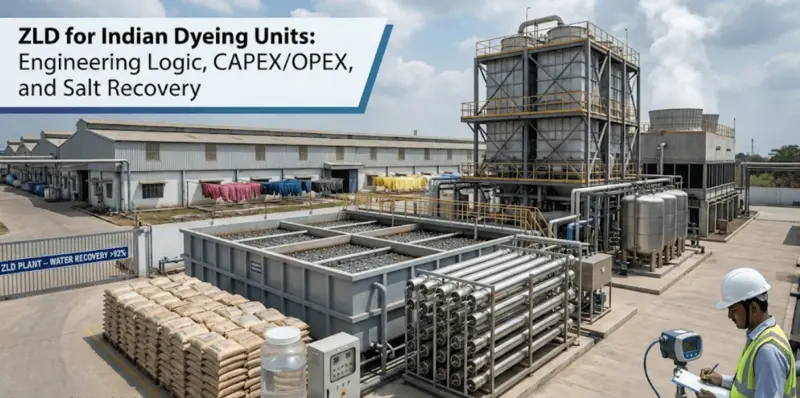
For a wet-processing mill, gap-closing capital expenditure can be more material than the scheme fee. If effluent infrastructure is part of the readiness problem, estimate it separately using the ZLD textile CAPEX and OPEX guide rather than hiding it inside a certification line item.
3. Recurring maintenance costs
- Data collection, review and reporting time
- Chemical-inventory and supplier-document updates
- Training for new staff and periodic refresher training
- Follow-up meetings, corrective actions and verification
- Monitoring, testing, product or article registration and approved claim control
- Reassessment and renewal-related costs
Confirm the current assessment and reassessment schedule in the signed agreement or current bluesign quotation.
A Practical bluesign Readiness Process
The following is a mill planning workflow based on the official service descriptions. It is not a substitute for bluesign’s current contractual process.
Step 1: Obtain the customer requirement in writing
Ask the buyer or brand to identify the required status, site, process, article or product, deadline and evidence. Clarify whether it is a tender preference, an approved-supplier condition or a condition for a specific order. A vague request for a “bluesign certificate” is not enough to approve a budget.
Step 2: Define the business scope
List the legal entity, locations, wet and dry processes, subcontracted operations, product families, major customers and chemical-use areas potentially in scope. Decide whether management is evaluating System Partnership, an impact assessment, bluepass certification for selected articles, or a combination.
Step 3: Run a readiness review
Check the current state against the official criteria and requested scope. Record each gap, owner, target date, evidence needed and estimated cost. Do not conceal legal, safety or environmental deficiencies inside a “documentation gap” category.
Step 4: Request and compare the official proposal
Map every proposal line to the whole-cost budget. Record what is included, excluded, recurring and dependent on later findings. Ask how a site or product-scope change affects cost and timing.
Step 5: Prepare controlled data
Create an owned chemical inventory and connect it to purchasing, receiving, storage, dispensing, recipes, production and disposal. Assemble utility, emission, wastewater, waste, occupational-safety, management and traceability records. Use the textile carbon-footprint guide where emissions-data boundaries need to be established.
Step 6: Complete assessment and close findings
Treat findings as operational controls, not a paperwork exercise. Validate process or chemical changes for shade, fastness, handle, strength, productivity, effluent load, worker exposure and customer approval as applicable. Assign evidence and due dates to each corrective action.
Step 7: Maintain the system and control claims
Keep data, chemical inventories, training, change control and corrective actions current. Confirm which products or articles are eligible for a certification claim and who approves artwork or commercial wording. Build the work into the mill’s management system; the ISO 9001 wet-processing guide provides a separate framework for ownership, documented controls and corrective action.
Textile Mill Readiness Checklist
Before seeking a quotation or committing to a customer deadline, check whether the mill can answer “yes” to the following:
- The precise customer requirement and in-scope site are documented.
- Management has appointed a decision-maker and a cross-functional project owner.
- Applicable permits, consents and statutory obligations have been identified and reviewed by competent local specialists.
- A current chemical inventory is linked to suppliers, products, storage locations and production use.
- Current safety and technical documents are available for relevant chemical products.
- Purchase, receiving, labelling, storage, dosing, handling, spill and disposal controls are documented and used.
- Water, energy, wastewater, air-emission and waste data have defined boundaries, units, sources and responsible owners.
- Occupational-health and safety hazards, controls, training and emergency arrangements are documented.
- Product, material, recipe and lot traceability can support the requested article or product scope.
- Internal changes are trialled, approved and recorded before routine production.
- Corrective actions have owners, deadlines and objective closure evidence.
- Finance can separate scheme fees, internal labour, capital expenditure and recurring operating cost.
If several items are missing, budget for readiness work before promising a certification date to a buyer.
How to Calculate bluesign ROI Without Inflating It
Use at least 12 months of comparable baseline data where available. Define the production volume, product mix, site boundary, currency and price basis. Record whether each benefit is measured, estimated or still hypothetical.
Annual verified cash benefit
Include only benefits that can be traced to the project, such as:
- Reduction in chemical consumption at comparable output and product mix
- Reduction in water, energy, effluent-treatment or waste-disposal cost
- Reduction in attributable rework, retesting or process failure
- Duplicate audit or testing cost actually eliminated—not merely expected to disappear
- Contribution margin from qualified incremental orders that were genuinely enabled by the required status
Use contribution margin, not total sales revenue, for new business. Do not count an existing order again merely because its buyer prefers bluesign. Separate normal process-improvement savings from savings caused by the partnership project so the same benefit is not claimed twice.
Total cost
Year 1 total cost = official fees + internal labour + readiness work + capital expenditure + trials/testing + data-system work + recurring Year 1 cost
For a multi-year case, include recurring fees, reassessment, maintenance labour, monitoring and replacement costs. Apply the finance team’s approved depreciation, tax, exchange-rate and discounting rules where material.
ROI and payback formulas
Three-year ROI (%) = (three-year measurable cash benefit − three-year total cost) ÷ three-year total cost × 100
Simple payback (months) = initial net investment ÷ average monthly verified cash benefit
If monthly benefit is zero or unverified, do not publish a payback period.
| ROI input | Baseline or evidence | Year 1 (₹) | Year 2 (₹) | Year 3 (₹) | Confidence |
|---|---|---|---|---|---|
| Official bluesign and related external costs | Current written proposal | [enter] | [enter] | [enter] | Quoted |
| Internal implementation labour | Named staff hours × approved loaded cost | [enter] | [enter] | [enter] | Estimated/verified |
| Gap-closing CAPEX and transition cost | Approved project quotations | [enter] | [enter] | [enter] | Estimated/quoted |
| Recurring monitoring and maintenance | Current run rate or approved budget | [enter] | [enter] | [enter] | Estimated/verified |
| Utility, chemical and waste cash savings | Normalised meter, purchase and disposal data | [enter] | [enter] | [enter] | Measured/estimated |
| Avoided rework, testing or duplicate audit cost | Finance-verified before/after records | [enter] | [enter] | [enter] | Measured/estimated |
| Contribution margin from qualified new orders | Signed order or probability-weighted pipeline | [enter] | [enter] | [enter] | Contracted/weighted |
State the calculation date and currency basis next to the model. Run conservative, base and upside cases instead of presenting a single optimistic result.
When Is the Business Case Strong?
| Decision signal | Strong case | Conditional case | Weak case |
|---|---|---|---|
| Customer demand | Written requirement tied to existing or credible orders | General preference or early-stage opportunity | No identified customer need |
| Scope | Sites, processes and product requirements are clear | Some buyer or product details remain open | “Get certified” is the only instruction |
| Readiness | Reliable data and manageable gaps | Material gaps need cost and timing validation | Serious legal, EHS or control weaknesses are unresolved |
| Economics | Verified savings and/or contribution margin support the case | ROI depends on several assumptions | ROI relies on an unspecified price premium or automatic orders |
| Ownership | Senior sponsor, project owner and finance review are in place | Resources compete with other projects | No accountable owner or maintenance budget |
A conditional case may justify a readiness or impact assessment before a full commitment. A weak case should not be made attractive by inventing a fee range, a sales premium or a guaranteed utility-saving percentage.
What bluesign Does Not Guarantee
Avoid these claims in board papers, buyer communication and website copy:
- Automatic legal compliance. A voluntary scheme does not replace applicable environmental, chemical, labour, safety, product or reporting law. Local specialists must identify and verify statutory requirements.
- Future-proof compliance with every regulation. Laws, restricted-substance requirements and customer standards change by market and product.
- Automatic orders or vendor approval. A customer may consider multiple commercial, quality, capacity, delivery and compliance criteria.
- A fixed resource-saving percentage. The official impact report describes aggregate progress across participating organisations; it is not a forecast for one mill.
- Automatic certification of every output. Partnership, facility assessment and product or article certification are related but distinct.
- Safe substitution without validation. A chemical change can affect process performance, quality, effluent, worker exposure and customer approval.
- Unrestricted use of the bluesign or bluepass marks. Use only the approved claim and artwork under the current rules and agreement.
Questions to Send with the Request for Quotation
- Which service and status match our customer’s written requirement?
- Which legal entities, sites, processes and subcontracted activities are included?
- Does the proposal cover System Partnership, Impact Assessment, bluepass article or product certification, or a combination?
- Which application, assessment, annual, follow-up and reassessment charges apply?
- Which travel, tax, currency and local-logistics costs are additional?
- What chemical, production, utility, EHS, management and traceability data must be supplied?
- What testing, registration or certification is required for our selected articles or products?
- Which implementation support, training and tools are included?
- How are new sites, processes, product families or chemical changes handled?
- What is the current reassessment and reporting cycle?
- Which current trademark, claim and bluepass transition rules apply?
- What are the renewal, suspension, termination and data-access conditions?
Request written answers. They form a better investment record than notes from an introductory call.
Frequently Asked Questions
Is there a fixed bluesign certification price?
No universal mill price was published on the official manufacturer and service pages reviewed on 5 August 2026. Request a current written proposal for the actual site, service and product scope. Do not rely on an online range as if it were an official tariff.
Is bluesign mandatory for textile mills?
It is not a universal legal requirement for every textile mill. It can become commercially necessary when a contract, tender, customer programme or approved-supplier rule requires a specific status. Applicable law remains separate and must be checked for the mill’s location, processes and markets.
Does becoming a System Partner guarantee more orders?
No. It may help meet a customer requirement or strengthen a qualified commercial proposal, but orders also depend on price, quality, capacity, delivery, product performance and the buyer’s sourcing decision. Include revenue in ROI only when the opportunity and contribution margin are evidenced.
What is the difference between a System Partner and a bluepass-certified product?
System Partnership is an ongoing relationship for the participating business or manufacturing operation. Bluepass is the current certification mark described by bluesign for eligible consumer products, articles and chemical products. Confirm the exact claim and scope in the current agreement; do not treat the terms as interchangeable.
Can a mill calculate ROI using the bluesign impact report?
The report can show system-wide direction and aggregate progress, but it does not predict a specific mill’s savings. Build the investment case from the mill’s normalised baseline, current quotation, gap budget and finance-verified benefits.
Final Takeaway
The most important bluesign cost is not a number copied from another website. It is the whole cost of the exact status your customer requires: official fees, internal readiness, gap closure, product work and ongoing maintenance.
Before committing, obtain the buyer requirement and current bluesign scope in writing, complete a readiness review, and calculate ROI from measured cash savings and qualified contribution margin. Proceed when the requirement is clear, the gaps are manageable and the economics remain acceptable under a conservative case.
Sources and Review
- bluepass and the label transition, accessed 16 August 2026.
- bluesign standards and criteria, accessed 16 August 2026.
- Current bluesign system documents, lists and downloads, accessed 16 August 2026.
- bluesign verification service, accessed 16 August 2026.
Commercial terms are not universal. Obtain a current written quotation and have claims about assessment, scope and label use reviewed by a person familiar with the current bluesign agreement.