
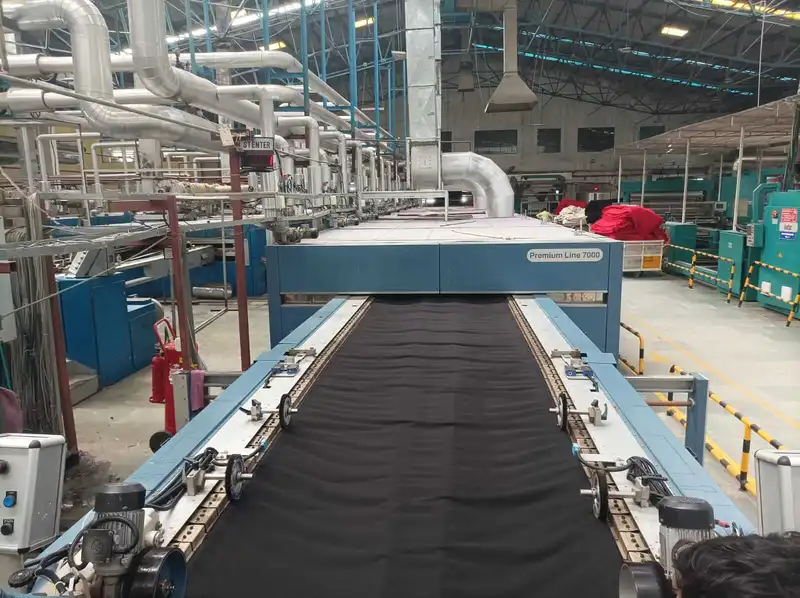
There is no greater headache for a finishing manager than a “Low GSM” report landing on the desk right before a shipment inspection. You ran the fabric, the hand-feel is perfect, the whiteness index is spot on, but the fabric is sitting at 155 GSM instead of the required 160 GSM. Do you pass it? The buyer might reject it. Do you re-process it? You’ll ruin the hand-feel and shoot your utility costs through the roof.
GSM story
GSM (Grams per Square Metre) control on the stenter is not just about stretching or shrinking fabric; it is the final frontier where profitability meets quality. Get it right, and you save yarn costs. Get it wrong, and you face the dreaded Debit Note.
In the Indian textile context, we often treat the stenter as just a drying machine. This is a mistake. The stenter is a dimensional control machine.
For a knitting mill, yarn is money. If a buyer asks for 180 GSM and you deliver 190 GSM because you couldn’t control the parameters, you have literally given away 5-6% of your raw material for free. On a 10-ton order, that is a massive loss. Conversely, if you force the GSM by over-compacting, you destroy the dimensional stability, leading to shrinkage failures after the first wash.
The challenge is balancing these three conflicting demands: Target GSM, Residual Shrinkage, and Spirality.
The Physics of Stenter Settings
To control GSM, you must stop thinking about “weight” and start thinking about loop density.
In knitted fabrics (Single Jersey, Pique, Interlock), the GSM is determined by how tightly the loops are packed together. The stenter allows us to manipulate this packing in two directions:
- Width-wise (Wales): Controlled by the chain width.
- Length-wise (Courses): Controlled by the overfeed.
1. The Overfeed Mechanism
This is your primary dial for GSM. Positive overfeed means the feed roller is running faster than the stenter chain.
- How it works: If you set Overfeed to +20%, you are feeding 1.2 metres of fabric for every 1 metre of chain movement. The fabric has nowhere to go but to bunch up (compact).
- Result: More loops per inch length-wise = Higher GSM.
- The Limit: Every fabric has a “jamming point.” If you push overfeed beyond what the structure can hold, you get bowing, ripples, or the fabric simply unpins itself.
2. The Width Setting
Width has an inverse relationship with GSM.
- The Rule: Pulling the fabric wider opens up the loops, reducing the loops per square inch.
- Result: Lower GSM.
- Practical Strategy: Operators often pull the width to meet the “required finished width,” forgetting that excessive width pulling kills the GSM. You must find the relaxed width of the fabric first.
3. Temperature and Dwell Time
While these don’t directly change loop geometry like overfeed does, they “lock” the GSM.
- Cotton/Blends: You are just drying. If you dry too fast (high temp), the fabric feels harsh. If you over-dry, you lose moisture regain weight (cotton holds ~8.5% moisture; bone-dry cotton is lighter!).
- Synthetics/Lycra: You are heat-setting. If the temperature isn’t uniform (e.g., 190°C–200°C for polyester), the Lycra won’t retract properly, and your GSM will be unstable.
The SOP for GSM Control
Here is a workflow I have implemented in floor-level SOPs for machines like Monforts, Bruckner, and Ehwha.
1. Know Your Grey Parameters Don’t fly blind. Before the lot touches the entry scray, check the grey GSM. If the grey GSM is 140 and you need 180 finished, no amount of stenter magic will save you (unless you shrink it to a child’s size). The grey GSM should typically be within 10-15% of the target depending on the process loss.
2. The “Tube Test” (For Knits) Before bulk running, take a 1-metre sample. Slit it, wet it, dry it relaxed (tumble or flat dry). Measure the dimensions.
- This gives you the Reference Width and Reference GSM.
- Rule of Thumb: Set your stenter width to roughly the Reference Width + 2 to 4 cm (to account for edge cutting/gumming).
3. Setting the Overfeed
- Start Point: For 100% Cotton Single Jersey, start with +10% to +20% overfeed.
- Lycra Fabrics: These eat overfeed. You might need +20% to +40%.
- Observation: Look at the pinning wheels. The fabric should form a small, uniform wave as it engages the pins. If it’s flat, you aren’t feeding enough. If the wave is folding over, you are feeding too much.
4. Moisture Management Use the Mahlo or Pleva moisture meter.
- Target: Exit moisture should be 6%–8% for Cotton.
- Why? Over-dried fabric (0-2% moisture) is lighter. You will get a false low GSM reading. By the time the fabric regains moisture in the warehouse, the roll weight changes, messing up your inventory.
5. The Delivery Check Do not trust the machine monitor.
- Cut a sample from the delivery side every 3-5 rolls.
- Use a calibrated GSM cutter and scale.
- Check the Edges vs. Centre: Often, the centre is sagging (higher GSM) and edges are stretched (lower GSM). If this happens, adjust your padder pressure or air nozzle flow (on the dryer) to ensure even drying and tension.
The “Grey Areas” of Finishing
Here is what the textbook won’t tell you, but a mill manager knows.
The “Cheat” Method vs. Quality Operators often use “Steam and Compaction” at the felt compactor (Tubetex/Ferraro) to fix GSM issues created at the stenter.
- Scenario: The stenter output is 145 GSM. Target is 170.
- The Fix: They run it through the compactor with high steam and slow speed to jam the fabric to get 170.
- The Trap: This GSM is temporary . The moment the customer washes the garment, it will change. GSM achieved by force is not stable. Always achieve 90-95% of your GSM on the stenter; use the compactor only for the final touch and hand-feel.
The Bowing Effect High overfeed helps GSM but creates “Bowing” (curved courses). If you are running stripes or checks, high GSM settings will destroy the pattern alignment. You might have to compromise: Accept a slightly lower GSM to keep the lines straight, or use a weft straightener aggressively (though automatic straighteners struggle with very high overfeed).
Resin Finishing If you are adding resin for anti-pilling or shrinkage control, remember that resins cross-link the fibre. This reduces the fabric’s ability to relax later. You must hit the GSM inside the stenter chamber. You won’t get much change afterwards.
Mini FAQ
Q: My GSM is correct at the edges but low in the middle. Why? A: This is usually “Bowing” caused by the fabric lagging in the center due to its own weight or uneven air pressure. Check your blower speeds—sometimes the bottom nozzles are pushing too hard. Also, check if your padder mangle is squeezing evenly; a wet center stretches more.
Q: Can I increase GSM by just running the machine slower? A: Not directly. Running slower just dries the fabric more. However, running slower does allow the fabric more time to relax if you have a relaxation zone or “tumbler” effect in the chambers. But purely for efficiency, speed should be matched to drying capacity, not used as a GSM dial.
Q: How much GSM variation is acceptable? A: Standard tolerance is usually ±5%. If the buyer asks for 180, anything from 171 to 189 might pass technically, but aim for 175–185. Consistency is key—a garment made with panels from different rolls (one 172, one 188) will look terrible after dyeing or washing (differential uptake).
Q: Does Softener affect GSM? A: Yes! Heavy silicone softeners can add 1%–2% to the weight physically, but they also lubricate the yarn, allowing loops to slide and relax more, which can actually help increase compactness (and GSM) if processed correctly.
Final Thoughts
Controlling GSM on the stenter is a balancing act between the Overfeed (Length) and Width.
- Don’t be greedy with width: If you stretch it, you lose weight.
- Don’t fake it: GSM achieved only by excessive compacting will fail in later garment stage.
- Monitor Moisture: Don’t bake the fabric bone-dry.
Tomorrow morning, go to your stenter and watch the pinning point. If the fabric looks stressed and tight entering the chamber, you are killing your GSM. Give it some slack, let it relax, and watch your quality (and rejection rates) improve.