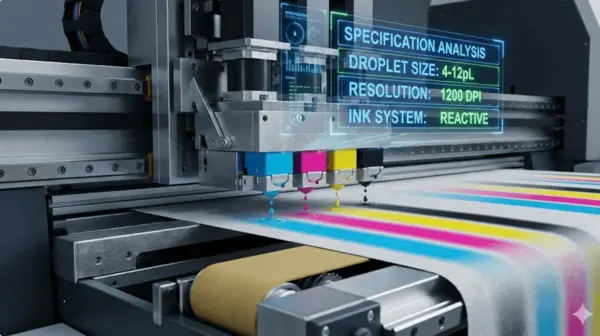
A digital textile printing quote of ₹30 per metre tells you very little unless you also know the fabric width, ink chemistry, design coverage, process route, saleable yield, production volume, and whether the price includes the fabric.
The most defensible method is to calculate cost per saleable square metre first, then convert it to a linear metre:
Printing cost per linear metre = printing cost per saleable m² × usable printed width in metres
For a usable width of 1.50 m, a cost of ₹20 per saleable m² becomes ₹30 per linear metre. At 1.80 m width, the same area cost becomes ₹36 per linear metre. This is why two “per metre” quotations cannot be compared until width and scope are identical.
There is no reliable universal rate for pigment, reactive, or sublimation digital textile printing. Ink laydown, pretreatment, fixation, washing, transfer paper, utilisation, maintenance, and reject loss vary by design and production system. The correct answer is a calculation using your own inputs.
Quick Cost Formula
Use these four steps:
- Calculate variable process cost per printed m².
- Add machine, maintenance, labour, quality, and overhead cost per printed m².
- Adjust for the percentage of output that is saleable.
- Multiply by usable width to convert to a linear metre.
The simplified formula is:
Manufacturing cost per saleable m² = total process cost per printed m² ÷ saleable yield
Manufacturing cost per linear metre = manufacturing cost per saleable m² × usable width
If a 25% gross margin is required:
Selling price = manufacturing cost ÷ (1 − 0.25)
Do not confuse margin with markup. Adding 25% to cost produces a 20% gross margin, not 25%.
First Define What the Price Includes
Before comparing rates, place every quotation into one of these scopes:
| Quote scope | Normally includes | Items that may still be excluded |
|---|---|---|
| Printing only | Artwork preparation, ink, printing, normal machine operation | Fabric, pretreatment, fixation, washing, testing, packing, freight, tax |
| Processed printing | Pretreatment, printing, fixation and required washing/drying | Fabric, special testing, packing, freight, tax |
| Printed fabric | Fabric plus the complete print route | Sampling, special finish, testing, packing, freight, tax |
| Delivered printed fabric | Printed fabric, packing and transport to the agreed point | Tax, insurance, import duty, buyer-specific testing or claims |
A low headline rate may simply have a narrower scope. Put exclusions beside the rate before deciding which supplier or process is cheaper.
Choose the Process Before Comparing Cost
Costing cannot correct a chemistry–substrate mismatch. Start with the fibre, construction, end use, and buyer performance requirement.
| Process | Typical substrate route | Main process stages to cost | Important qualification |
|---|---|---|---|
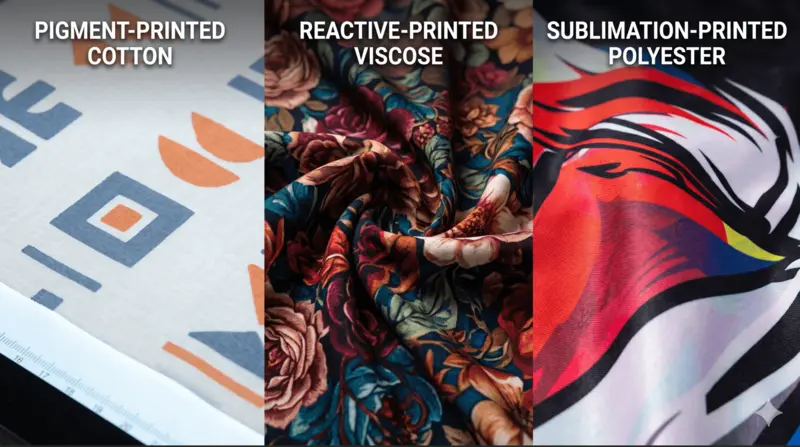
| Digital pigment | Used on multiple fibre types, depending on the ink, pretreatment and binder system | Pretreatment when required → print → dry/cure | Handle, crocking, wash performance and curing must be validated on the exact substrate and shade. |
| Reactive digital | Primarily cellulosic fibres such as cotton, viscose and lyocell | Pretreat → print → dry → steam/fix → wash-off → dry | Pretreatment add-on, steaming and wash-off strongly affect both quality and cost. |
| Transfer sublimation | Polyester fabrics qualified for the intended end use | Print transfer paper → heat transfer/calender → inspect | Paper, ink release, ghosting, migration and usable transfer width must be costed as a system. |
| Direct sublimation/disperse | Qualified polyester fabric and a compatible direct-print system | Fabric preparation if required → print → heat fixation; after-treatment depends on the system | Do not assume every polyester construction is suitable without a production trial. |
Official product information confirms that industrial textile printers may be configured for different ink families, and that transfer sublimation prints paper before heat transfer to polyester. Those manufacturer statements describe the relevant systems; they are not universal performance guarantees for every machine, ink, or fabric.
If silk, wool, or nylon is the core substrate, add acid digital printing as a separate route rather than forcing it into this three-process comparison.
The Cost Inputs That Matter
1. Usable printed width
Use the width that can actually be sold, not the nominal roll width.
Printed area = printed length × usable printed width
If a 1,000 m roll has a 1.50 m usable printed width, gross printed area is 1,500 m². If only 930 m are saleable after start-up loss, defects and trimming, saleable area is 1,395 m².
2. Ink cost
Use design-specific ink laydown from the raster image processor (RIP) when available.
Ink cost per m² = total predicted ink volume per m² × weighted ink price per mL
The weighted price must reflect the actual colour mix. Add ink used for purging, cleaning and unrecoverable start-up to the period cost, then allocate it across saleable output.
A second control is the period reconciliation:
Actual ink cost per saleable m² = ink issued or purchased for production ÷ saleable m²
The period method captures cleaning loss, rejected output and design mix. Industry guidance from SPGPrints, published by Texintel, similarly recommends comparing ink against square metres and saleable output rather than relying on one linear-metre rule of thumb.
3. Pretreatment
Include:
- Pretreatment chemical cost.
- Actual wet add-on or application rate.
- Padding, coating or spray application cost.
- Drying energy.
- Labour and cleaning.
- Waste and leftover bath disposal.
Do not use one pretreatment cost for all constructions. Fibre, grams per square metre (GSM), absorbency, weave or knit structure, shade depth, and required edge definition can change the application.
4. Fixation and after-treatment
Allocate the route actually used:
- Pigment: drying and curing, plus any system-specific pretreatment.
- Reactive: drying, steaming, wash-off, drying, wash chemicals, utilities and effluent treatment.
- Transfer sublimation: transfer paper and calender or press energy.
- Direct sublimation/disperse: heat fixation and any system-required fabric preparation or after-treatment.
Use measured electricity, gas, steam, water and chemical consumption where possible. Avoid copying utility rates from another mill because equipment efficiency, production loading, water quality and local tariffs differ.
5. Process consumables
Depending on the route, include:
- Transfer paper and protection tissue.
- Belt adhesive, belt washing and cleaning chemicals.
- Filters, wipes and approved flushing fluid.
- Pretreatment mesh, coating or padding consumables.
- Packaging used inside production.
- Laboratory consumables and strike-off fabric.
6. Machine conversion cost
Calculate the period cost of keeping the line available and productive:
Machine conversion cost per saleable m² = period machine cost ÷ saleable m²
Period machine cost may include:
- Depreciation or lease cost.
- Finance and insurance where applicable.
- Service contract.
- Preventive maintenance.
- Print-head provision based on verified replacement history.
- Spares and technical support.
- Planned and unplanned downtime.
- Climate control, compressed air and ancillary equipment.
Do not divide by advertised maximum speed. Divide by actual saleable output at the quality mode used for customer orders.
A 2024 case study in the Jordan Journal of Mechanical and Industrial Engineering modelled material, electricity, labour and overhead costs and found that cost per metre fell as production increased in the studied facility. Treat that as evidence that utilisation matters—not as a transferable price benchmark.
7. Labour, quality and overhead
Include direct and allocated costs for:
- Artwork checking and nesting.
- Colour profiling and strike-offs.
- Machine operation.
- Fabric handling.
- Laboratory and production quality control.
- Reinspection and shade segregation.
- Production planning, supervision and administration.
- Floor space and common utilities.
8. Saleable yield
Saleable yield is the most important denominator:
Saleable yield = saleable area ÷ gross printed area
Track the causes of loss separately:
- Start-up and end-of-roll waste.
- Nozzle or banding defects.
- Head strikes.
- Shade mismatch.
- Fabric defects.
- Creasing or skew.
- Transfer ghosting or migration.
- Fixation or wash-off failure.
- Sampling and approved strike-offs.
Use first-pass and final-saleable yield as separate measures. Rework may recover metres but still consumes capacity, utilities, labour and time.
Worked Example: Four Routes on the Same Basis
The following table demonstrates the calculation. It is not a market price list. Every INR input is an editorial assumption for teaching the method and must be replaced with the mill’s verified 2026 data before commercial use.
Common assumptions:
- Usable printed width: 1.50 m.
- Printing-only scope; raw fabric is excluded.
- Costs are entered per gross printed m².
- Yield is saleable output divided by gross printed output.
- Selling-price illustration uses a 25% gross margin.
- Taxes, freight and buyer-specific testing are excluded.
| Cost input (₹/gross printed m²) | Pigment | Reactive | Transfer sublimation | Direct sublimation |
|---|---|---|---|---|
| Ink | 8.00 | 13.00 | 7.00 | 9.00 |
| Pretreatment/fabric preparation | 2.00 | 3.00 | 0.00 | 2.00 |
| Fixation energy | 1.50 | 2.50 | 2.00 | 2.00 |
| Wash chemicals, water and ETP allocation | 0.00 | 6.50 | 0.00 | 0.00 |
| Transfer paper | 0.00 | 0.00 | 7.50 | 0.00 |
| Other process consumables | 0.50 | 1.00 | 0.50 | 0.50 |
| Machine and maintenance allocation | 4.00 | 4.50 | 4.00 | 4.00 |
| Labour, QC and overhead | 3.00 | 4.00 | 3.00 | 3.00 |
| Total per gross printed m² | 19.00 | 34.50 | 24.00 | 20.50 |
| Assumed saleable yield | 94% | 90% | 95% | 92% |
| Manufacturing cost per saleable m² | 20.21 | 38.33 | 25.26 | 22.28 |
| Manufacturing cost per 1.50 m linear metre | 30.32 | 57.50 | 37.89 | 33.42 |
| Illustrative selling price at 25% gross margin | 40.43 | 76.67 | 50.53 | 44.57 |
This example does not prove that pigment is always cheapest or that reactive must carry a fixed premium. It shows how different process stages and yields change a comparable result. A high-coverage pigment design, low transfer-paper price, low-utilisation printer, or difficult reactive shade can change the order.
How to Replace the Example With Mill Data
Build a rolling costing sheet using at least the last three representative production months.
Step 1: Segment the orders
Do not average unlike jobs together. Separate by:
- Ink chemistry.
- Substrate and construction.
- Usable width.
- Quality mode or pass count.
- Light, medium and heavy design coverage.
- Pretreatment route.
- Fixation and wash route.
- Short, medium and long run.
Step 2: Reconcile design prediction with actual ink
For each segment, compare:
- RIP-predicted ink per m².
- Ink issued to the line.
- Ink remaining or returned.
- Cleaning and purging.
- Gross printed area.
- Saleable area.
If actual use is consistently higher than prediction, investigate cleaning frequency, nozzle condition, profile settings, start-up loss and recordkeeping before changing the cost rate.
Step 3: Measure utilities by route
Use submeter readings or defensible equipment allocations for:
- Printer and dryer electricity.
- Curing or calender heat.
- Steam.
- Wash water.
- Drying.
- Effluent treatment.
State the tariff date beside each input.
Step 4: Allocate fixed cost using realistic output
Use actual saleable square metres, not theoretical maximum capacity. Run a sensitivity table at low, expected and high utilisation so the commercial team can see how short production months affect conversion cost.
Step 5: Validate against completed jobs
Compare the model with actual contribution from completed orders. Investigate large gaps by design coverage, width, yield, downtime, sampling and post-processing.
Process-Specific Costing Checklists
Pigment digital textile printing
- Is pretreatment included, and how is it applied?
- Does the quoted ink system rely on binder in the ink, binder in pretreatment, or both?
- What curing condition is validated for this fabric?
- What handle and rubbing requirements apply?
- Are cleaning and head-maintenance losses included?
- Is the route genuinely wash-free, or does the selected system use any wet preparation or cleaning that belongs in the allocation?
Reactive digital textile printing
- What cellulosic fibre and construction is being printed?
- What is the verified pretreatment add-on?
- Are steaming, washing, soaping, drying and effluent treatment included?
- What saleable yield is achieved by substrate and shade class?
- What buyer wash and rubbing tests apply?
- Is reprocessing counted as recovered output or as additional conversion cost?
Transfer sublimation
- Are transfer paper, protection tissue and paper waste included?
- Is usable paper width the same as usable fabric width?
- What is the validated paper–ink–fabric combination?
- Are calender warm-up, idle time and oil-heater electricity allocated?
- Are ghosting, migration, edge curl and transfer loss tracked in yield?
- Is the quote for printing paper only or for transferred fabric?
Direct sublimation/disperse
- Is the fabric prepared or coated for the selected system?
- Is the ink approved for direct printing on the specific machine?
- What fixation and any after-treatment are required?
- Does the construction pass strike-through, sharpness, migration and fastness requirements?
- Is the higher qualification risk reflected in start-up waste and yield?
How to Audit a Supplier Quote
Ask every supplier to state:
- Price basis: gross metre, saleable metre, or square metre.
- Usable printed width.
- Whether fabric is included.
- Ink chemistry and exact ink product.
- Pretreatment responsibility.
- Fixation and washing included.
- Design-coverage or ink-limit assumption.
- Quality mode and resolution used for costing.
- Sample, strike-off and minimum-order charges.
- Quantity-break basis.
- Testing included and the exact buyer method and acceptance grade.
- Shade variation, defect allowance and claim policy.
- Packing, freight, tax and delivery terms.
- Lead time and capacity reservation.
Reject comparisons in which one quotation is printing-only and another includes pretreatment, fixation, washing or fabric.
Quality Standards: Method Is Not the Acceptance Grade
ISO 105-C06:2010 covers methods for assessing colour resistance to domestic and commercial laundering. ISO 105-X12:2016 covers colour fastness to dry and wet rubbing. ISO 105-B02:2014 covers colour fastness to artificial light using a xenon-arc source.
These standards describe test methods. They do not create one universal pass grade for pigment, reactive or sublimation printing. The buyer or product specification must define the applicable method, condition and acceptance requirement.
Consult licensed copies for specimen preparation, apparatus, procedure, assessment and reporting. Do not reproduce a standards table from a secondary article.
Chemical Conformance: Verify the Product, Not the Sales Claim
ZDHC’s MRSL Conformance Guidance defines Levels 1, 2 and 3 for chemical formulations and explains how approved certifiers and the ZDHC Gateway are used. The level applies to the exact chemical product and valid certificate—not generally to a supplier or an entire ink family.
When costing a conformant ink or auxiliary:
- Record the exact commercial product.
- Check its current Gateway status and conformance level.
- Record certificate validity.
- Confirm that the product suits the process and buyer programme.
- Use the supplier’s current written quotation for the price.
Do not assume a universal price premium for ZDHC MRSL conformance.
Cost-Control Actions That Do Not Depend on Cheaper Ink
- Quote from saleable square metres, not nominal linear metres.
- Build design classes from actual ink laydown.
- Reconcile RIP prediction with period ink use.
- Track start-up loss separately from process defects.
- Improve utilisation by grouping compatible substrates and modes.
- Treat paper, ink and fabric as a qualified sublimation system.
- Lock pretreatment and fixation controls by substrate family.
- Review cost variance after every large or unusual job.
- Measure rework as extra capacity and process cost.
- Recalculate machine conversion cost when utilisation changes materially.
A cheaper ink that needs more laydown, causes more cleaning, changes colour profiles, reduces yield, or affects warranty can increase the cost of saleable output. Compare the cost of acceptable metres, not the purchase price per litre or kilogram.
Frequently Asked Questions
What is the digital textile printing cost per meter in India?
There is no defensible single India-wide rate. Use the current local inputs for ink, pretreatment, fixation, paper, utilities, labour, maintenance, yield and usable width. The worked table above demonstrates the method but is not a 2026 market tariff.
Which is cheaper: pigment, reactive or sublimation?
The answer depends on substrate, design, route, utilisation and required performance. Pigment may avoid steaming and wash-off in some systems. Reactive adds pretreatment, steaming and washing for cellulosics. Transfer sublimation adds paper and heat transfer for polyester. Compare only routes that can meet the same product specification.
Why calculate per square metre first?
A linear metre contains different printed area at different widths. Square metres provide a consistent basis for ink, pretreatment, paper, energy and machine output. Multiply by usable width only after calculating the saleable area cost.
Should fabric cost be included?
Only if the commercial scope is printed fabric. Keep printing-only cost separate from raw-fabric cost so buyers can compare job-work rates and process routes clearly.
How should reject loss be added?
Divide gross process cost by the saleable yield. If total process cost is ₹20 per gross printed m² and yield is 92%, cost becomes ₹21.74 per saleable m² before margin.
How is a 25% margin added?
Divide cost by 0.75. Do not multiply cost by 1.25 unless a 25% markup—and therefore a 20% gross margin—is intended.
Final Decision Rule
Use this order:
- Confirm substrate and construction.
- Confirm the buyer’s test methods and acceptance requirements.
- Qualify the ink, pretreatment, fixation and fabric system.
- Calculate cost per saleable m².
- Convert to the quoted width.
- Add the required margin and commercial exclusions.
The lowest headline rate is not the lowest cost if it produces unacceptable quality, hidden post-processing charges, low saleable yield, or avoidable rework.
For machine-selection questions, see the Digital Textile Printer Buying Guide. For colour-control equipment, see the Textile Spectrophotometer Buying Guide.