
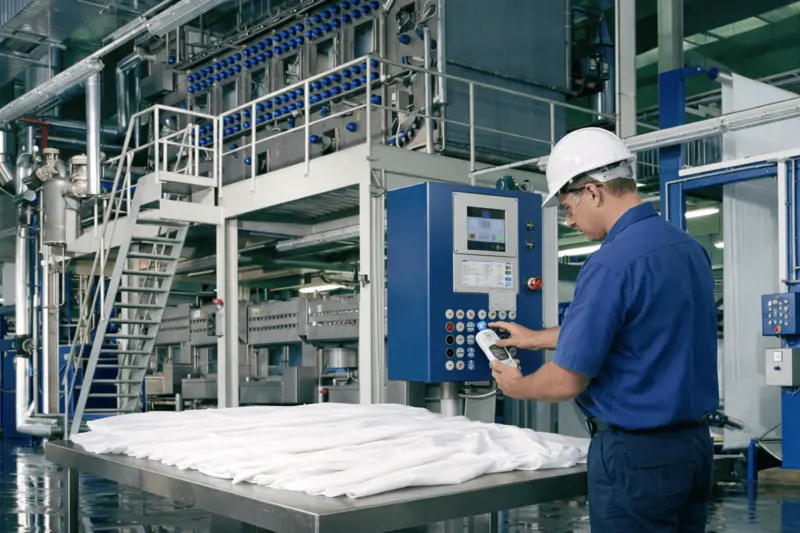
Cotton pretreatment is successful only when the prepared material is clean, uniformly wettable and suitable for the next process without unacceptable loss of strength, weight, handle or dimensional stability. Whiteness alone does not prove that a lot is ready for dyeing.
For right-first-time (RFT) production, the bleaching department and dyehouse should agree a release specification for each product family. That specification may include desizing efficiency, absorbency, extract pH and residual alkalinity, residual peroxide, whiteness or yellowness, cellulose damage, width, grams per square metre (GSM) and visual uniformity. The required limits depend on the substrate, construction, shade, dye class, machinery and buyer requirements.
This is therefore a process-selection and control guide, not a universal recipe. Chemical concentrations, temperature, dwell time, liquor ratio and washing sequence must be validated against the actual cotton, size system, fabric construction, machine, chemical supplier’s technical data sheet and approved mill trial.
What cotton pretreatment must achieve
Greige cotton carries natural impurities such as waxes, pectic substances, proteins, mineral matter and fragments of seed coat. Manufacturing can add size, knitting oil, cone oil, wax, dirt, metal contamination, silicone and machine deposits. These materials do not all respond to the same chemistry.
Pretreatment has five practical objectives:
- Remove the impurities that obstruct wetting, dye penetration or finishing.
- Make absorbency uniform across the width, length and layers of the material.
- Reach only the whiteness needed for the intended shade or white product.
- Remove or neutralize chemicals that can interfere with the next process.
- Preserve fibre strength, fabric structure, handle and dimensional stability.
The balance matters. Under-preparation leaves resist areas and unstable dyeing. Over-preparation consumes unnecessary utilities and can reduce fabric weight or damage cellulose. The correct target is not the maximum possible whiteness; it is a reproducible substrate that meets the next process’s requirements.
Select the route before selecting the recipe
The conventional woven-cotton sequence is often shown as greige inspection, singeing, desizing, scouring, bleaching and optional mercerizing. It is a useful map, but it is not mandatory for every cotton product.
Sized woven cotton
- Preparation need: Inspect, singe where required, desize according to the size chemistry, scour, bleach as needed, then wash and neutralize.
- Main control question: What size and add-on are actually present?
- Avoid: Using an amylase route for a non-starch size system.
Cotton knit
- Preparation need: Remove knitting oils, waxes and natural impurities; bleach according to shade need; use low-tension handling.
- Main control question: Can the route clean the fabric without creasing, abrasion or excessive weight loss?
- Avoid: Copying a woven desizing sequence when no warp size is present.
Cotton-elastane knit or woven
- Preparation need: Use elastane-compatible chemistry, temperature and mechanical handling while controlling dimensional change.
- Main control question: Will the complete process protect stretch recovery and avoid permanent creases?
- Avoid: Treating the blend as 100% cotton.
Cotton yarn or package
- Preparation need: Scour and bleach as required with uniform liquor penetration and effective rinsing.
- Main control question: Are the inner and outer package layers equally prepared?
- Avoid: Passing the lot on an average test while package-to-package variation remains.
Towels and pile fabrics
- Preparation need: Clean oils and natural impurities while protecting loop structure and absorbency.
- Main control question: Is absorbency uniform without harsh handle or excessive weight loss?
- Avoid: Driving whiteness beyond the shade requirement.
Deep reactive shades
- Preparation need: Prioritize cleanliness, uniform absorbency and absence of interfering residues.
- Main control question: Is the bleaching intensity greater than the shade actually needs?
- Avoid: Assuming every dyed lot requires a white-goods bleach.
Pastels, brilliant shades or full white
- Preparation need: Higher and more uniform optical preparation may be required.
- Main control question: Is whiteness achieved without excessive cellulose damage or uncontrolled fluorescence?
- Avoid: Judging the lot visually without instrumental and damage checks.
The route must begin with a greige-material brief. Record fibre composition, cotton source or lot, construction, GSM, elastane content, yarn preparation, size formulation and add-on for wovens, oil or wax system for knits, contamination history, intended shade and downstream dyeing route. If the input is unknown, laboratory identification is more reliable than increasing chemical dosage by guesswork.
1. Greige inspection and lot segregation
Pretreatment cannot make unlike materials identical. Mixing greige lots with different maturity, impurities, size add-on, knitting oil, construction or storage history can create variation even when the machine recipe is stable.
Before processing:
- Inspect for oil, rust, mildew, silicone, dirt, crease, handling and storage marks.
- Confirm fibre blend and elastane content.
- Separate materially different greige lots.
- Obtain the upstream sizing or knitting-lubricant information.
- Check process-water hardness and relevant metal contamination against the mill’s water specification.
- Confirm that the selected machine can wet, circulate, heat, wash and handle the construction uniformly.
This information should travel with the lot. A dyehouse investigating patchiness needs the greige lot, preparation route, machine, recipe version, pickup or liquor ratio, deviations and release-test results – not just the statement “RFD passed.”
2. Singeing: use it for a defined surface requirement
Singeing removes protruding fibres from yarn or fabric by brief, controlled exposure to flame or another heat source. It can improve surface clarity and reduce a frosty appearance after dyeing or printing. Its need and intensity depend on the yarn, construction, weight, desired surface and sensitivity of any blended component.
The critical controls are uniform fabric presentation, burner condition, flame geometry, fabric speed, suction, cooling and immediate extinguishing or quenching arrangements. A fixed speed is not transferable between machines or constructions. The mill should approve singeing through surface appearance, weight-loss or strength checks where relevant, and confirmation that no scorching, streaking or heat damage has been introduced.
Singeing is not automatically required for every knit, yarn or pile fabric. Where the process could damage elastane, pile or a lightweight construction, the surface objective and alternative route should be reviewed before production.
3. Desizing: match the method to the size
Desizing removes the preparation applied mainly to warp yarns for weaving. The first decision is chemical identification, not enzyme dosage.
- Starch and many starch derivatives require degradation into removable, water-soluble fragments. Alpha-amylase is used for starch desizing, but its effective pH, temperature, dwell time, calcium tolerance and auxiliary compatibility depend on the specific product.
- Polyvinyl alcohol (PVA), carboxymethyl cellulose (CMC), polyacrylates and blended size systems have different solubility and washing requirements. Some may be removed mainly by controlled hot washing with suitable auxiliaries; blends may require a combined strategy.
- Knitted cotton normally carries knitting oils and waxes rather than classical warp size. It usually needs de-oiling and scouring, not an automatic woven-fabric desizing step.
The Cotton Incorporated dyeing booklet distinguishes starch removal by alpha-amylase from the washing behaviour of common synthetic sizes. That distinction prevents a frequent failure: a process may show good wetting while still leaving a non-starch film, or an iodine test may show no starch while synthetic size remains.
For starch-sized goods, an iodine-based test can support desizing control, but the mill must define its test method, sampling plan and acceptance level. The result does not by itself quantify PVA, CMC, oil or total extractable residue. Combine the appropriate desizing check with weight change, extractable matter or other validated analysis when the size system demands it.
Desizing is complete only after the degraded or dissolved size is washed away. Enzyme action without adequate washing can merely convert a difficult deposit into smaller residues that remain on the fabric.
4. Scouring: create uniform hydrophilicity
Scouring removes natural cotton impurities and added oils, waxes and dirt. Alkali helps swell cotton and breaks down or solubilizes some impurities. Surfactants wet the structure, emulsify oils and help prevent redeposition. Sequestering or chelating chemistry manages troublesome metal ions. The actual system should be selected for the impurity load, water, substrate and machinery.
CottonWorks’ preparation guidance emphasizes identifying impurities before selecting the route and describes alkali, surfactant and chelation as different functional parts of cotton scouring. Increasing caustic cannot compensate for poor wetting, insufficient circulation or ineffective washing.
Control scouring as a mass-transfer process:
- Can the liquor penetrate the entire fabric or package?
- Are oils and waxes emulsified without redeposition?
- Is pickup uniform on a continuous range?
- Are concentration, temperature and dwell time achieved by the material, not merely displayed by the machine?
- Does washing remove the solubilized material and residual alkali?
- Is the resulting absorbency uniform at multiple positions?
Good average absorbency can hide a side-to-centre, end-to-end or inner-to-outer variation. Sampling must represent the risk pattern of the machine and substrate.
5. Bleaching: reach the required optical target without damaging cellulose
Bleaching destroys or removes natural colouring matter that remains after cleaning. Hydrogen peroxide is widely used for cotton, normally as part of a controlled system containing alkali, stabilizing and metal-control chemistry, wetting or detergent functions and effective washing.
Peroxide performance depends on the complete system. Uncontrolled pH, metal contamination, uneven pickup, poor steam distribution, incorrect dwell, stagnant folds or inadequate stabilisation can create under-bleached areas or local fibre damage. Conversely, a stable bath cannot deliver uniform fabric if the range has poor impregnation or washing.
The product decides the optical target. Deep shades may need clean, uniformly absorbent material without high whiteness. Pastels, brilliant shades and white goods require tighter optical uniformity. Optical brightening agents should be used only where the approved product specification and colour-control method account for fluorescence; they should not be treated as a correction for inadequate cleaning or bleaching.
The European Union’s current textiles best available techniques conclusions describe optimized peroxide bleaching through control of water quality, metal impurities, pH and peroxide concentration. These conclusions are regulatory BAT references for installations within their stated EU scope, not universal recipes or automatic legal requirements for every mill.
6. Mercerizing: optional, product-driven and measurable
Mercerizing exposes cotton to concentrated alkali under controlled conditions and then removes the alkali while controlling fabric dimensions. Depending on whether tension is applied and how the route is engineered, it can change fibre morphology, lustre, dye affinity, dimensional behaviour and handle.
It is not “strongly recommended” for every premium cotton article. The decision should consider the required appearance, shade depth, construction, width control, shrinkage, handle, dye yield, capital route and caustic-recovery opportunity. Slack mercerizing and tension mercerizing do not deliver identical effects.
Do not approve mercerizing only from a nominal caustic concentration. Control liquor strength, temperature, penetration, dwell, tension, width, washing, residual alkali and final dimensional result. AATCC TM89-2025 provides a licensed method for detecting mercerization and indicating completeness through the barium activity number. A universal barium-number target should not be copied between products without an approved specification.
7. Washing, neutralization and peroxide removal
Washing is a process stage, not the space between chemical stages. It must remove solubilized impurities, degraded size, alkali, peroxide and auxiliaries without transferring them to the next compartment or redepositing them on the material.
Check washer loading, water flow, counter-current arrangement where used, mechanical expression between compartments, temperature profile, overflow and contamination of supposedly clean final water. For batch processing, drain-and-fill design, bath exchange and fabric movement influence removal efficiency.
Neutral surface water does not prove that the textile has no residual alkalinity. Use an agreed extraction method. AATCC TM209-2022 covers combined determination of pH and total alkali in wet-processed textiles and explicitly relates these measurements to washing and neutralizing efficiency after processes such as bleaching.
Where peroxide bleaching is followed by a peroxide-sensitive dyeing or enzymatic step, verify the residual using a validated method and an acceptance limit established for that process. If catalase or another approved removal step is used, its dosage and compatibility must follow the supplier’s instructions and mill validation.
Choose batch, semi-continuous or continuous preparation
Batch preparation
- Equipment examples: Kier, winch, jet or soft-flow equipment selected for the material.
- Strong fit: Flexible lots, knits, towels, delicate constructions and varied production.
- Main advantage: Route flexibility and good access for lot-based control.
- Control risks: Liquor circulation, loading, creasing, bath exchange, lot-to-lot repeatability and water use.
Semi-continuous preparation
- Route examples: Pad-batch or pad-roll where controlled impregnation and batching are available.
- Strong fit: Suitable constructions and production plans that can accommodate batching.
- Main advantage: Lower thermal demand for selected stages and flexible continuous-range scheduling.
- Control risks: Pickup uniformity, batching temperature and time, wrapping, edge drying and wash-off.
Continuous open-width preparation
- Strong fit: Long woven lots and stable product programmes.
- Main advantage: High throughput, open-width control and opportunities for counter-current washing and heat integration.
- Control risks: Side-to-centre pickup, seam behaviour, steamer sealing, dwell distribution, washer carry-over and changeover loss.
Do not select the route from throughput alone. Compare achievable uniformity, washing capacity, fabric risk, changeover loss, water and energy per tonne, staffing, maintenance, laboratory control and the actual product mix. For knitted-goods batch equipment, the soft-flow dyeing machine guide provides a separate machinery-selection framework.
Build a cotton pretreatment release specification
A prepared lot should not move to dyeing because it “looks white.” Use a product-family control plan with a defined method, sampling position, test frequency, target, warning limit, action limit and disposition authority.
Desizing efficiency
- Detects: Residual starch or other removable size.
- Control: Use a method matched to the known size system and sample across machine-risk positions.
- Limitation: An iodine test is primarily a starch indicator, not a total-residue test.
Absorbency or wetting
- Detects: Effectiveness and uniformity of cleaning.
- Control: Test several representative specimens using one controlled method.
- Limitation: A fast average result can hide local hydrophobic areas.
Extract pH and total alkali
- Detects: Washing and neutralization effectiveness.
- Control: Use a documented extraction method rather than surface indicator paper alone.
- Limitation: The acceptance limit must suit the next process and buyer requirement.
Residual peroxide
- Detects: Oxidant carry-over into dyeing or enzymes.
- Control: Use a validated quantitative or semi-quantitative method with a process-specific limit.
- Limitation: “No visible colour” is meaningful only for the approved method and detection limit.
Whiteness or yellowness
- Detects: Optical preparation and uniformity.
- Control: Define the instrument, geometry, illuminant, observer, ultraviolet condition, folding and conditioning.
- Limitation: Different formulas or ultraviolet settings are not directly interchangeable.
Fluidity or another cellulose-damage indicator
- Detects: Chemical degradation during preparation.
- Control: Trend against an approved greige or prepared reference and investigate drift.
- Limitation: Do not convert fluidity into a universal degree-of-polymerization claim without a validated relationship.
Strength and weight change
- Detects: The physical consequence of chemical and mechanical treatment.
- Control: Compare against a product-specific baseline and tolerance.
- Limitation: One tensile result may not represent a weak side, crease or local pinhole.
Mercerization completeness
- Detects: Presence and consistency of the mercerizing effect.
- Control: Use the licensed agreed method and correlate the result with appearance, dyeing and dimensions.
- Limitation: A single generic barium-number target is not valid for all products.
Width, GSM and dimensional behaviour
- Detects: Mechanical and dimensional change.
- Control: Measure in the condition defined by the internal or buyer method.
- Limitation: Wet, relaxed, dried and conditioned results can differ materially.
AATCC TM79-2025 covers absorbency for yarns, fabrics and garments. AATCC TM82-2022 covers fluidity of dispersions from bleached cotton as an indicator of cellulose degradation. The editor should verify the current editions and use licensed copies for apparatus, conditioning, procedure, calculations and precision information. This article does not reproduce those methods or set buyer acceptance limits.
When whiteness measurement is part of release, lock the spectrophotometer configuration and specimen presentation. The textile spectrophotometer buying guide explains why geometry, aperture and ultraviolet control matter when comparing textured or fluorescent materials.
Troubleshooting preparation-related failures
Treat a symptom as a hypothesis, not proof of one cause. Contain the lot, compare the failed and conforming material, confirm the defect pattern, then test likely causes.
Cloudy or patchy reactive dyeing
- Possible causes: Uneven scouring, residual size or oil, uneven pickup, pH or peroxide carry-over.
- Check: Absorbency map, residue test, extract pH or alkali, peroxide result, greige lot and machine position.
- Corrective direction: Restore impurity identification, impregnation, washing and release control before changing the dye recipe.
Side-to-centre shade difference
- Possible causes: Uneven pad pressure, liquor distribution, heating, steaming, washing or width tension.
- Check: Left-centre-right pickup and test results, pad-roll condition, temperature and washer profile.
- Corrective direction: Correct the cross-width mechanical or liquor-distribution source.
Poor penetration in yarn packages
- Possible causes: Inadequate flow reversal, excessive package density, channeling or incomplete bath exchange.
- Check: Inner-middle-outer absorbency and pH, package density and pump data.
- Corrective direction: Correct package build, loading and circulation before increasing chemistry.
Residual peroxide at dyeing
- Possible causes: Inadequate washing, bath exchange, neutralization or peroxide-removal step.
- Check: Validated residual test at representative locations.
- Corrective direction: Hold the lot, apply the approved removal or rewash procedure, and investigate washer or batch-exchange efficiency.
Pinholes or strength loss
- Possible causes: Local metal contamination, uncontrolled peroxide decomposition, severe pH, time or temperature exposure, or mechanical damage.
- Check: Water and fabric metal checks, bath trend, fluidity or strength map and microscope review where available.
- Corrective direction: Remove the contamination source and revalidate peroxide control; do not assume every pinhole is iron-related.
Harsh handle or excessive weight loss
- Possible causes: Over-scouring, excessive mechanical action or loss of surface fibre.
- Check: Weight change, strength, handle evaluation and machine history.
- Corrective direction: Reduce severity only after confirming that cleanliness and absorbency remain adequate.
Crease or rope marks
- Possible causes: Overloading, poor fabric transport, stagnant folds, high tension or unsuitable heating and cooling for the construction.
- Check: Defect geometry, load, speed, nozzle or circulation, temperature history and blend composition.
- Corrective direction: Correct mechanical handling and validate the route for the construction, especially elastane blends.
Whiteness variation
- Possible causes: Uneven bleaching, water or metal variation, pickup differences or inconsistent optical-brightener application.
- Check: Instrumental whiteness map with a fixed ultraviolet setting, plus bath and machine-position data.
- Corrective direction: Separate cleaning, bleaching and fluorescence causes before correction.
Recurrent oil or silicone spots
- Possible causes: Greige lubricant, machine contamination, maintenance product or cross-contamination.
- Check: Solvent or extract analysis where available, machine swab and lot history.
- Corrective direction: Eliminate the upstream source and update cleaning verification; stripping is a controlled exception, not the default.
For downstream symptom analysis, continue with the common dyeing defects and root-cause guide. The dyehouse should avoid changing salt, alkali, levelling agent or temperature to mask a lot that failed the preparation release gate.
Improve sustainability without weakening the release gate
Measure the process per tonne of acceptable output, not per machine cycle. A shortened route that increases rewash or re-dyeing can consume more resources overall.
Track at least:
- Water intake and wastewater by stage.
- Steam or thermal energy and electricity.
- Chemical mass by function, including alkali, peroxide, surfactant and sequestrant.
- First-pass preparation release and subsequent dyeing RFT.
- Rewash, correction and downgrade quantity.
- Extracted size or recoverable PVA where applicable.
- Caustic recovery from mercerizing where technically and economically feasible.
- Wastewater mass load and treatment performance, not concentration alone.
The EU textiles BAT conclusions identify options such as online pickup control, automatic shutoff of wash water when equipment stops, counter-current washing, intermediate mechanical dewatering, controlled water reuse, optimized peroxide bleaching and caustic recovery from mercerizing rinse water. Applicability depends on product quality, contamination risk, existing equipment, treatment capacity and local law. Reuse water only after analysis confirms that accumulated hardness, metals, alkali, peroxide, surfactant, colour or organic matter will not destabilize the process.
For mills operating Zero Liquid Discharge, the Textile ZLD cost guide explains why water volume and dissolved or organic load must be considered together.
No pretreatment route is automatically “GOTS compliant” or “ZDHC compliant.” GOTS requires approved chemical inputs for GOTS goods and facility-level controls, including wastewater treatment and certification requirements. GOTS’ chemical-input approval page is the appropriate starting point. The ZDHC Wastewater Guidelines define a wastewater and sludge testing framework. Mills must also meet applicable legal, permit, buyer and certification requirements.
Shift checklist for RFT cotton pretreatment
Before the lot
- Confirm fibre composition, construction, greige lot and intended shade.
- Obtain size chemistry and add-on for woven goods or oil/wax information for knits.
- Check water and machine readiness against the approved control plan.
- Select the route from the substrate requirement, not from the last recipe run.
- Verify chemical identity, storage status, dosing system and approved technical data sheets.
- Confirm the sampling and release plan with the laboratory and dyehouse.
During processing
- Record the actual recipe version and material weight.
- Monitor the variables that determine exposure: concentration, pickup or liquor ratio, pH/alkali, temperature, dwell, circulation and wash exchange.
- Check cross-width or package uniformity at the risk points of the machine.
- Record stops, speed changes, seam problems, foam, dosing interruptions and rethreading.
- Prevent clean-water and final-wash compartments from becoming contaminated by carry-over.
Before release to dyeing or printing
- Complete the specified desizing or residue check.
- Test absorbency at representative positions.
- Verify extract pH and, where specified, total alkali.
- Verify residual peroxide when relevant.
- Measure optical properties using the locked instrumental method.
- Review strength, fluidity, weight change or damage indicators at the defined frequency.
- Confirm width, GSM and visual uniformity for construction-sensitive products.
- Release, hold, rewash or downgrade through an authorized disposition – never by undocumented verbal approval.
Final takeaway
Cotton pretreatment is the controlled conversion of a variable greige substrate into a documented dyeing or printing input. RFT improves when the mill does three things consistently: identifies what must be removed, selects the route for the actual substrate, and releases the lot against measurements that predict the next process.
Do not ask whether the fabric is “white enough” in isolation. Ask whether it is uniformly clean, wettable, chemically compatible with the next operation and free from unacceptable damage. That question turns pretreatment from a recipe tradition into a quality system.