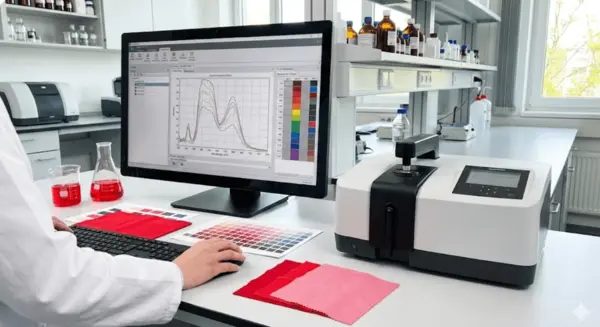
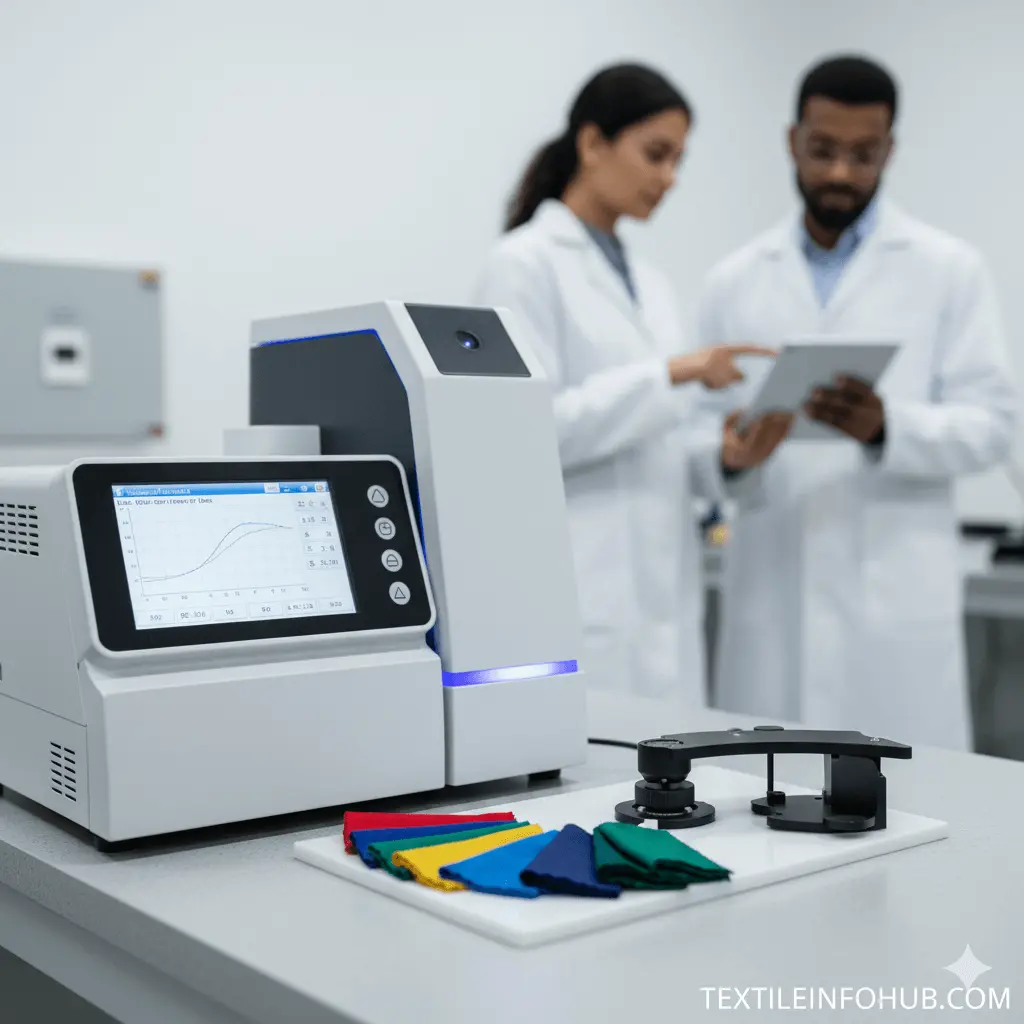
Choosing a spectrophotometer for a textile dye lab is not simply a matter of buying the instrument with the smallest Delta E specification.
The right instrument must measure textured fabrics consistently, control ultraviolet energy when optical brightening agents are present, accommodate different sample sizes and produce data that agrees with instruments used by customers, brands and other laboratories.
For most professional textile dyeing and testing laboratories, a benchtop d/8° sphere spectrophotometer is the appropriate starting point. However, the best model depends on whether the instrument will create master standards, formulate dye recipes, approve production batches or support routine quality control.
Quick answer: The X-Rite Ci7860 and Ci7800 are strong choices for reference-grade color standards and tightly controlled supply chains. The Datacolor Spectro 1000 is the equivalent high-precision choice for laboratories using the Datacolor ecosystem. The Konica Minolta CM-3700A Plus is suited to demanding multi-location color-management programs. For routine formulation and production QC, the X-Rite Ci7600 and Datacolor Spectro 700 UV offer a more practical specification level.
Before comparing individual models, read our textile spectrophotometer buying guide to understand geometry, inter-instrument agreement, repeatability, UV control and aperture selection.
Best Textile Spectrophotometers at a Glance
| Spectrophotometer | Best suited to | Published IIA* | Published repeatability* | Textile-relevant advantage |
|---|---|---|---|---|
| X-Rite Ci7860 / Ci7800 | Master standards and global supply chains | ≤0.06 / ≤0.08 average ΔE* | ≤0.01 ΔE* | Tight agreement, multiple apertures and UV control |
| Datacolor Spectro 1000 | High-precision Datacolor laboratories | 0.08 average, 0.15 maximum ΔE* | 0.01 maximum ΔE* | Automated UV calibration, sample camera and temperature measurement |
| Konica Minolta CM-3700A Plus | Reference laboratories and multi-location programs | ≤0.08 ΔE*ab | SD within 0.005 ΔE*ab on white | Four measurement areas, SCI/SCE measurement and strong legacy compatibility |
| X-Rite Ci7600 | Formulation and production QC | ≤0.15 ΔE* | ≤0.03 ΔE* | Flexible apertures and control of optical brighteners |
| Datacolor Spectro 700 UV | Routine textile QC and growing Datacolor labs | 0.15 average, 0.30 maximum ΔE* | 0.03 maximum ΔE* | Dedicated UV version, three standard apertures and backward compatibility |
*Manufacturer specifications are not always produced under identical test methods or environmental conditions. Use them for initial screening, not as a substitute for an in-lab comparison using your fabrics.
How These Spectrophotometers Were Selected
This shortlist is based on currently published manufacturer specifications and suitability for textile color formulation and quality control. The evaluation considers:
- Diffuse d/8° sphere geometry
- Inter-instrument agreement
- Short-term repeatability
- UV control for fluorescent whites and optical brighteners
- Available measurement apertures
- SCI and SCE measurement capability
- Software and existing-instrument compatibility
- Service, calibration and supply-chain support
- Current product availability
No instrument is universally “best.” A lower-specification instrument that matches a customer’s established fleet may be a safer investment than a reference-grade instrument from an incompatible ecosystem.
1. X-Rite Ci7860 and Ci7800
Best for: Creating digital master standards and managing color across tightly controlled global supply chains.
The X-Rite Ci7860 is the highest-precision model in the Ci7000 benchtop family. X-Rite publishes inter-instrument agreement of no more than 0.06 average ΔE* and repeatability of no more than 0.01 ΔE*. The Ci7800 offers the same published repeatability with inter-instrument agreement of no more than 0.08 average ΔE*.
Both models use d/8° sphere geometry and are intended for applications requiring close color tolerances. They can capture specular-included and specular-excluded measurements, work with multiple sample apertures and integrate with X-Rite software such as Color iMatch, Color iQC and NetProfiler.
The Ci7860 is the stronger candidate when a laboratory must create or maintain highly accurate master standards. The Ci7800 is a practical alternative when reference-grade performance is needed but the Ci7860’s tighter IIA is not contractually necessary.
Why it works well for textile laboratories
Textile supply chains frequently exchange digital color data between brands, mills, dye houses and testing laboratories. Small differences between instruments can cause one location to approve a shade while another rejects it.
The Ci7860’s principal advantage is its tight published inter-instrument agreement. This becomes valuable when the same standard must be reproduced across several instruments or countries.
The system also supports different reflectance apertures, which is important when a laboratory must measure large fabric swatches, narrow trims, yarns or small printed areas. Its UV-control capabilities make it suitable for textiles containing fluorescent whitening agents, provided the laboratory follows the correct UV-calibration procedure.
Main advantages
- Reference-grade published inter-instrument agreement
- High repeatability for creating and maintaining standards
- Simultaneous specular-included and specular-excluded measurements
- Multiple measurement apertures
- UV control for optically brightened materials
- Integration with X-Rite formulation and QC software
- Suitable for multi-site digital color programs
Limitations
- A reference-grade instrument can be unnecessarily expensive for routine pass/fail QC
- The full workflow may require additional software, accessories, service and training
- Maximum performance depends on sample preparation, conditioning and operator discipline
- Existing Datacolor or Konica Minolta data workflows may make migration more complex
Who should choose it?
Choose the Ci7860 or Ci7800 when your laboratory creates master standards, works with demanding brands or must maintain very close agreement across multiple locations.
For routine production QC with wider tolerances, the X-Rite Ci7600 may provide a better balance.
Manufacturer information: X-Rite Ci7000 benchtop family.
2. Datacolor Spectro 1000
Best for: High-precision textile laboratories already using Datacolor instruments and software.
The Datacolor Spectro 1000 is the company’s high-precision benchtop instrument for formulation and quality control. It uses diffuse illumination with 8° viewing, a pulsed xenon source and a 152 mm integrating sphere.
Datacolor publishes repeatability of 0.01 maximum ΔE* and inter-instrument agreement of 0.08 average and 0.15 maximum ΔE* under its specified conditions.
The standard instrument includes Large Area View, Small Area View and Ultra-Small Area View apertures. Medium and extra-small options are also available for specialized samples.
Why it works well for textile laboratories
One of the strongest reasons to select the Spectro 1000 is compatibility with an existing Datacolor workflow. A laboratory already using Datacolor formulation software, historical standards or older Datacolor benchtop instruments may reduce implementation risk by remaining in the same ecosystem.
The instrument includes automated, adjustable UV calibration and UV cut-off options. These functions are particularly important when measuring whites, pastel shades or materials treated with optical brightening agents.
A positioning camera helps reduce sample-placement errors, while sample-temperature measurement can identify situations in which a hot or insufficiently conditioned specimen may produce misleading results.
Main advantages
- High published repeatability and inter-instrument agreement
- Automated and adjustable UV calibration
- Three standard aperture sizes
- Sample-positioning camera
- Sample-temperature measurement
- Backward compatibility with other Datacolor benchtop instruments
- Available in different orientations and configurations
Limitations
- Published wavelength range is 360–700 nm, which should be evaluated against customer requirements
- Software, accessories and service should be included in the total-cost calculation
- Purchasing a reference-grade instrument is difficult to justify if the laboratory only performs routine internal QC
Who should choose it?
Choose the Spectro 1000 when your company operates a Datacolor-based formulation or supply-chain program and requires high agreement between instruments.
It is also a strong candidate for a new laboratory that expects to distribute digital standards across several manufacturing sites.
Manufacturer information: Datacolor Spectro 1000 family.
3. Konica Minolta CM-3700A Plus
Best for: Reference laboratories requiring high accuracy, multiple measurement areas and continuity with existing Konica Minolta data.
The CM-3700A Plus is the current successor to the CM-3700A. The older CM-3700A is officially discontinued, so new buyers should evaluate the Plus model rather than specifying the legacy instrument.
Konica Minolta publishes inter-instrument agreement within 0.08 ΔEab, based on the average of 12 BCRA Series II tiles under LAV/SCI conditions. Its stated repeatability on white is a standard deviation within 0.005 ΔEab.
The instrument provides concurrent SCI and SCE measurement, a wavelength range of 360–740 nm and four reflectance measurement areas. It also includes a camera viewfinder, environmental temperature and humidity monitoring, and sample-surface temperature measurement.
Why it works well for textile laboratories
The CM-3700A Plus is attractive where high-precision reference work must be performed across multiple instruments or locations.
Its four measurement areas provide useful flexibility for fabrics, yarns, trims and smaller specimens. The instrument also supports adjustment of the UV cut-off filter, which matters when measuring samples containing optical whitening agents.
Compatibility with historical CM-3700A data may be especially important for organizations that have built long-term color databases around the previous model.
Main advantages
- High published inter-instrument agreement
- Strong repeatability, including improved performance on dark samples
- Four reflectance measurement areas
- Concurrent SCI and SCE measurement
- Camera-assisted sample positioning
- Sample and environmental temperature monitoring
- Compatibility with legacy CM-3700A data
- Integration with SpectraMagic NX2 software
Limitations
- The instrument is not a low-cost choice for routine QC
- UV adjustment, software configuration and customer-data compatibility should be demonstrated before purchase
- Laboratories using X-Rite or Datacolor ecosystems must evaluate the practical implications of adding another platform
Who should choose it?
Choose the CM-3700A Plus when your company already uses Konica Minolta instruments, needs continuity with CM-3700A data or wants a high-precision reference instrument with flexible sample handling.
Manufacturer information: Konica Minolta CM-3700A Plus.
4. X-Rite Ci7600
Best for: Textile formulation, laboratory quality control and production environments that do not require reference-grade IIA.
The X-Rite Ci7600 is a mid-range d/8° sphere spectrophotometer designed for formulation and QC. X-Rite publishes inter-instrument agreement of no more than 0.15 ΔE* and repeatability of no more than 0.03 ΔE*.
It supports simultaneous SCI and SCE measurement and offers several reflectance apertures. Optional transmission capability is available for laboratories that also need to measure transparent or translucent materials.
The instrument can use UV filters to control optical brighteners, making it relevant for textile whites and fluorescent materials.
Why it works well for textile laboratories
Many dye houses do not need the specification level required for creating global master standards. Their priority is dependable recipe formulation, lab-dip evaluation and production pass/fail control.
For those applications, the Ci7600 can provide the necessary sphere geometry, aperture flexibility and X-Rite software integration without moving to the highest reference tier.
It is particularly logical for a mill whose customers already use X-Rite instruments or exchange data through X-Rite-compatible workflows.
Main advantages
- Appropriate specification level for formulation and QC
- d/8° sphere geometry
- Simultaneous SCI and SCE measurement
- Multiple reflectance apertures
- UV-filter options for optical brighteners
- Integration with Color iMatch, Color iQC and NetProfiler
- Optional transmission capability
Limitations
- IIA and repeatability are not as tight as the Ci7800 or Ci7860
- Some apertures, UV filters or transmission accessories may be optional
- Not the preferred choice for creating the most demanding master standards
Who should choose it?
Choose the Ci7600 when you need a capable X-Rite benchtop instrument for formulation and production QC but cannot justify reference-grade specifications.
Manufacturer information: X-Rite Ci7600.
5. Datacolor Spectro 700 UV
Best for: Routine textile formulation and QC in growing laboratories that need a Datacolor workflow and UV capability.
The Datacolor Spectro 700 family uses diffuse illumination with 8° viewing and a pulsed xenon source. Datacolor publishes repeatability of 0.03 maximum ΔE* and inter-instrument agreement of 0.15 average and 0.30 maximum ΔE* under its stated conditions.
The family includes a Spectro 700 UV configuration for optically brightened whites and fluorescent materials. This distinction matters: buyers working with OBAs should confirm that the quotation is specifically for the UV-capable configuration rather than assuming every Spectro 700 has identical UV functionality.
Three apertures—LAV, SAV and USAV—are included as standard, with additional aperture options available.
Why it works well for textile laboratories
The Spectro 700 UV covers the practical requirements of many dye houses: sphere geometry, several sample sizes, support for optically brightened materials and compatibility with Datacolor workflows.
It is best viewed as a routine formulation and QC instrument rather than a master-standard instrument. For a laboratory that needs tighter cross-location agreement, the Spectro 1000 is the stronger option.
Main advantages
- UV-specific version for brightened whites and fluorescent materials
- Three standard apertures
- Sample-temperature measurement
- Compatibility with Datacolor benchtop workflows
- Suitable for routine formulation and quality control
- Different physical configurations are available
Limitations
- Looser published IIA than the Spectro 1000
- The standard and UV models must not be confused during quotation
- Not intended to replace a high-precision master instrument in a tightly controlled global program
Who should choose it?
Choose the Spectro 700 UV when your laboratory performs routine textile formulation and QC, needs to control optical brighteners and prefers the Datacolor ecosystem.
Manufacturer information: Datacolor Spectro 700 family.
Which Textile Spectrophotometer Should You Buy?
Use the following decision sequence.
1. Start with the customer’s instrument fleet
If a major customer, brand or buying house specifies an approved model, follow that requirement before comparing prices or convenience features.
A technically superior instrument does not automatically guarantee acceptable agreement with a different instrument family.
2. Define the instrument’s role
For creating master standards and supporting very tight multi-location tolerances, shortlist:
- X-Rite Ci7860 or Ci7800
- Datacolor Spectro 1000
- Konica Minolta CM-3700A Plus
For routine formulation and production QC, shortlist:
- X-Rite Ci7600
- Datacolor Spectro 700 UV
3. Confirm your UV requirement
If the laboratory measures fluorescent whites, pastel shades or textiles containing OBAs, require the supplier to demonstrate:
- UV calibration
- UV-included and UV-controlled measurements
- Repeatability on your brightened fabrics
- Compatibility with customer measurement conditions
- Availability of textile UV reference standards
AATCC provides a Textile UV Calibration Standard specifically for spectrophotometers used with textiles. UV performance should therefore be treated as a controlled measurement requirement, not a marketing feature. See AATCC spectrophotometer UV calibration.
4. Match apertures to actual samples
A large aperture is useful for averaging fabric texture and construction variation. Smaller apertures may be needed for yarns, narrow trims, prints, mélange effects or accessories.
Do not select the instrument from a brochure alone. Ask the supplier to measure the smallest, largest and most difficult samples handled by your laboratory.
5. Calculate total ownership cost
The quotation should separate:
- Instrument
- Formulation software
- Quality-control software
- Computer and database requirements
- Aperture plates
- Yarn, fabric or compression holders
- UV standards
- Installation
- Operator training
- Calibration and annual maintenance
- Extended warranty
- Travel charges for service
- Data migration
- Additional-user or network licenses
A less expensive instrument can become the more expensive system if essential software, service and accessories are excluded.
Spectrophotometer Demo Checklist
Do not approve a purchase after measuring only a white tile. Give every shortlisted supplier the same test set.
Include:
- A dark navy or black fabric
- A fluorescent white fabric
- A pastel shade containing OBA
- A highly textured knit
- A woven fabric with visible directionality
- A glossy synthetic fabric
- A mélange or heather sample
- A yarn or narrow trim
- A shade close to your normal pass/fail tolerance
- A customer-approved physical standard
During the demonstration:
- Condition all specimens under the same laboratory conditions.
- Measure each specimen at least five times without moving it.
- Remove and reposition it between another five readings.
- Rotate directional fabrics and record the effect.
- Compare LAV and SAV results where relevant.
- Compare two separate units of the same model.
- Exchange data with the customer’s instrument or software.
- Test UV-controlled measurements on fluorescent whites.
- Confirm how the system records operator, aperture, UV condition and measurement mode.
- Request a written service and calibration proposal.
The most useful demo result is not a perfect reading on a calibration tile. It is stable, transferable data on your most difficult production materials.
Questions to Ask the Supplier
Before issuing a purchase order, ask:
- Is the published IIA an average or maximum value?
- Under which aperture, measurement mode and tile set was it tested?
- Which UV features are standard and which are optional?
- Is the quoted model suitable for optical brighteners?
- Which apertures are included?
- Can it measure yarns and small printed areas?
- Which software licenses are mandatory?
- Can existing historical standards be migrated?
- Can the data be exchanged with customer systems?
- What is the local calibration and service turnaround time?
- Are loan instruments available during repair?
- What is the warranty period?
- Which annual parts or standards must be replaced?
- Can the supplier demonstrate two instruments reading the same textile samples?
Frequently Asked Questions
What type of spectrophotometer is best for textile dyeing?
A benchtop d/8° integrating-sphere spectrophotometer is generally the most suitable choice for professional textile formulation and QC. Diffuse illumination helps manage the effects of fabric texture and direction better than directional geometry in many common textile applications.
The final choice must still follow the measurement method, customer requirements and product type.
Is a portable spectrophotometer enough for a textile dye lab?
A portable instrument can be useful for production-floor checks, troubleshooting and measurements that cannot be brought to the laboratory. However, a benchtop instrument is normally preferred for recipe formulation, master standards and tight-tolerance supply-chain communication.
Portable and benchtop instruments should not be assumed to produce interchangeable data.
What is inter-instrument agreement?
Inter-instrument agreement describes how closely different units of the same model measure the same standards.
This matters when a brand, supplier and dye house each use separate instruments. Better IIA reduces disagreement caused by the instruments themselves, although it cannot eliminate errors from sample preparation, temperature, humidity, orientation or measurement procedure.
Why is UV control important for white textiles?
Optical brightening agents absorb ultraviolet energy and emit visible light. A change in the instrument’s UV content can therefore change the measured whiteness and color values.
Without controlled UV calibration, two laboratories may disagree even when measuring the same brightened fabric.
Should I buy the same instrument brand as my customer?
Usually, compatibility with the customer’s established fleet should receive significant weight. Ask the customer which model, aperture, measurement mode, illuminant, observer and UV condition they use.
Matching only the brand name is not enough; different models and procedures can still produce differences.
How often should a spectrophotometer be calibrated?
Follow the manufacturer’s procedure and your laboratory SOP. Calibration is commonly performed at the start of a shift, before critical measurement work or whenever the instrument requests it.
Annual manufacturer calibration does not replace routine user calibration and performance verification.
Final Verdict
There is no single textile spectrophotometer that is correct for every dye house.
The X-Rite Ci7860 and Ci7800 are strong candidates for master standards and demanding global supply chains. The Datacolor Spectro 1000 offers a high-precision alternative for organizations built around Datacolor software and data. The Konica Minolta CM-3700A Plus is a capable reference instrument, particularly where compatibility with earlier Konica Minolta data matters.
For routine formulation and production quality control, the X-Rite Ci7600 and Datacolor Spectro 700 UV offer more practical specification levels.
The final decision should be based on customer compatibility, actual fabric trials, UV requirements, local service and the complete cost of the measurement system—not on the instrument specification sheet alone.
Last specification review: July 2026.
Manufacturer Sources
- X-Rite Ci7000 family
- X-Rite Ci7600
- Datacolor Spectro 1000
- Datacolor Spectro 700
- Konica Minolta CM-3700A Plus
- AATCC Textile UV Calibration Standard