
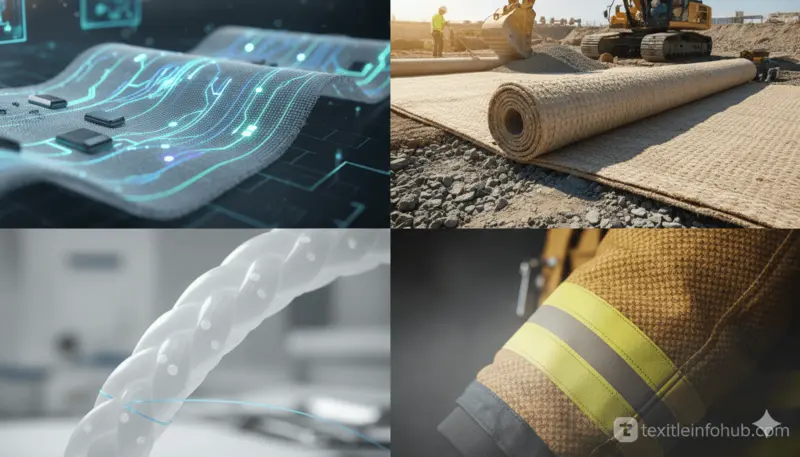
If you think the textile industry is just about T-shirts and towels, you’re missing the $250 billion story. This is a professional guide to technical textiles—what they are, why they’re the highest-value part of the industry, and a breakdown of the 12 ‘Techs’ (Medtech, Geotech, Protech, etc.).
Introduction: The “Hidden” Multi-Billion Dollar Textile Industry
When most people hear “textiles,” they think of apparel or home furnishings. But this is just the tip of the iceberg.
Beneath that visible market lies a massive, high-growth, and incredibly profitable industry known as Technical Textiles.
These are materials that are engineered for function, not for fashion. They are valued for what they do, not for how they look. They are the hidden fibers that stop bullets, filter viruses, build roads, and make airplanes lighter.
For professionals, engineers, and students, this is the most exciting and fastest-growing part of the industry. This guide will provide a practical, holistic overview of what these materials are, how they’re categorized, and the real-world problems they solve.
What Is a Technical Textile? (Function > Fashion)
A technical textile is a textile product manufactured for its technical performance and functional properties rather than for its aesthetic or decorative characteristics.
- A conventional textile (like a cotton shirt) is chosen for its aesthetics (color, print) and comfort (hand-feel, breathability).
- A technical textile (like an aramid fiber vest) is chosen for its function (ballistic resistance, tensile strength).
These materials are often non-woven, or made from advanced polymers and fibers like aramids (Kevlar), carbon, or glass. They are the engine of innovation in the industry.
And it’s a massive engine. The global technical textiles market was valued at over USD 250 billion in 2023 and is projected to grow to well over USD 330 billion by 2030, according to reports from Grand View Research and Fortune Business Insights. This is not a niche; it’s the future.
How Are Technical Textiles Made? (The 3 Platforms)
A common mistake is to think of technical textiles as one industry. In reality, they are built on three distinct manufacturing platforms. The “process” is what defines the final product.
Platform 1: Nonwovens (The “Engineered Sheet”)
This is the largest and most common platform. Nonwovens are engineered fabrics made directly from fibers, which are bonded together by heat, chemicals, or mechanical force (no spinning or weaving needed).
- Common Processes:
- Meltblowing: A fine stream of molten polymer (like Polypropylene) is blasted with hot air to create a web of microfibers. This is the critical filter layer in N95 masks and surgical gowns.
- Spunbond: Molten polymer is extruded through a spinneret and laid down in a web, then bonded. This provides strength. (Most masks are an “SMS” sandwich: Spunbond-Meltblown-Spunbond).
- Needle-punching: A web of staple fibers is mechanically tangled together with thousands of barbed needles. This is the process used to create heavy-duty Geotextiles and industrial felts.
Platform 2: Advanced Weaving
This platform is used when high tensile strength, low stretch, and maximum stability are required. The process uses specialized looms to create structures from high-performance yarns.
- Common Processes:
- 2D Weaving: Standard over-under weaving, but with extreme materials. This is used for Airbags (Nylon 6,6) and Ballistic Vests (Aramid fibers).
- 3D Weaving: A highly advanced process that weaves a 3D structure, not a flat cloth. This is used to create “preforms” for advanced carbon-fiber composites in aerospace and automotive applications.
Platform 3: Technical Knitting
This platform is used when complex 3D shapes, high flexibility, or open-mesh structures are needed.
- Common Processes:
- Warp Knitting (Raschel): This high-speed knitting process is used to create high-strength, stable mesh structures like Agrotech (shade nets) and Geotech (reinforcement grids).
- Weft Knitting (3D & Seamless): Modern 3D knitting machines can create complex, seamless shapes, which is critical for Medtech (e.g., seamless vascular grafts, compression sleeves) and Clothtech (e.g., 3D-knitted shoe uppers).
The “Conceptual” Process Flow
While there is no single manufacturing path, there is a conceptual flow that all technical textiles share:
Problem Definition : We need a material that stops a 9mm bullet
- Polymer & Fiber Selection (e.g., “Para-Aramid fiber is required for its high tensile strength”)
- Manufacturing Platform (e.g., “Advanced Weaving” is chosen for stability)
- Finishing & Coating (e.g., “Water-repellent coating is applied”)
- Performance Testing (e.g., “Passes Ballistic Test Standard XXX”)
The 12 “Techs”: A Breakdown of the Core Applications
The industry is best understood by its 12 primary application categories, often used by the international trade show Techtextil.
1. Agrotech (Agriculture)
Textiles used in agriculture, horticulture, and forestry to protect crops, improve yields, and manage resources.
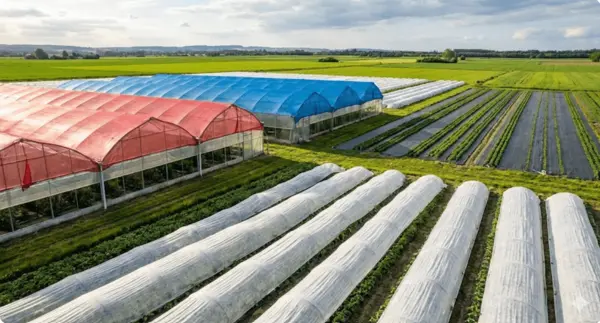
- Examples: Shade nets (for UV protection), anti-hail nets, crop covers, weed control fabrics, and irrigation-integrated geotextiles.
- Key Properties: UV stability, weather resistance, biodegradability (in some cases).
- Materials Used: Primarily Polypropylene (PP) and Polyester (PET) for their high UV stability and moisture resistance. HDPE (High-Density Polyethylene) is also common for nets. For biodegradable applications, Jute or PLA (Polylactic Acid) are used.
2. Buildtech (Construction)
Textiles used in the construction of buildings, dams, bridges, and roads.
- Examples: Architectural membranes (like stadium roofs), concrete reinforcement (textile-reinforced concrete), acoustic insulation, and vapor barriers.
- Key Properties: High tensile strength, structural integrity, durability.
- Materials Used: High-tenacity Polyester (PET), Polypropylene (PP), Glass Fibers, and Aramid fibers. These are chosen for their immense strength and resistance to degradation.
3. Clothtech (Clothing Components)
The “hidden” functional components of a garment. This does not include the main fashion fabric.
- Examples: Interlinings (to give a collar stiffness), seam tapes (for waterproofing), wadding, and advanced insulation (like Thinsulate™ or PrimaLoft®).
- Key Properties: Insulation, breathability, elasticity, shape retention.
- Materials Used: Polyester (PET) (for insulation wadding and interlinings), Nylon (for durable interlinings), and Elastane (Spandex/Lycra) for elastic tapes.
4. Geotech (Geotextiles)
One of the largest sectors. These are textiles used in civil engineering, in contact with soil and rock, to solve geotechnical problems.
- Examples: Geotextiles for roadbed stabilization, landfill liners, erosion control systems, drainage channels, and soil reinforcement.
- Key Properties: High durability, permeability, tensile strength, and resistance to biodegradation.
- Materials Used: Overwhelmingly Polypropylene (PP) (for its chemical inertness and stability) and High-Tenacity Polyester (PET) (for its high strength).
5. Hometech (Household)
Technical components of home furnishings, distinct from purely decorative fabrics.
- Examples: Fire-retardant (FR) fibers in upholstery, carpet backings, mattress components (like FR barriers), and advanced filter materials for vacuums.
- Key Properties: Flame retardancy, durability, acoustic properties, filtration.
- Materials Used: Flame-Retardant (FR) Polyester, Nylon (for carpet durability), and Polypropylene (for carpet backings).
6. Indutech (Industrial)
The “workhorse” textiles used in general industrial manufacturing and processes.
- Examples: Industrial air and liquid filters, conveyor belts, high-temperature insulation, abrasive backings, and cleaning wipes.
- Key Properties: High-temperature resistance, chemical resistance, high strength, filtration efficiency.
- Materials Used: A wide range of high-performance fibers, including Polyester (PET), Nylon, Aramid (e.g., Kevlar®, Nomex®), Glass Fibers, and PTFE (Teflon) for extreme chemical and temperature resistance.
7. Medtech (Medical & Hygiene)
A high-value, highly regulated sector for health and hygiene.
- Examples:
- Non-implantable: High-tech wound dressings, antibacterial bandages, surgical gowns, and face masks (like N95/FFP2 meltblown nonwovens).
- Implantable: Artificial ligaments, cardiovascular grafts (artificial veins), and dissolvable sutures.
- Key Properties: Biocompatibility, sterility, absorbency, antibacterial properties.
- Materials Used: Polypropylene (PP) (for nonwoven disposable gowns and masks), Polyester (PET) (for sutures and grafts), Cotton (for traditional bandages), and biocompatible/bioresorbable polymers like PGA (Polyglycolic Acid) and PLA for dissolvable sutures.
8. Mobiltech (Automotive & Aerospace)
Textiles used in the construction and furnishing of all types of vehicles.
- Examples: Airbags (a masterpiece of textile engineering), car seats, seatbelts, tire cord (for reinforcement), cabin air filters, and lightweight carbon-fiber composites for airplane bodies.
- Key Properties: High tensile strength, UV resistance, flame retardancy, low weight.
- Materials Used: High-tenacity Polyester (PET) (for seatbelts, upholstery), Nylon 6,6 (critical for airbags due to its specific strength and melting point), and Carbon Fiber and Aramid for lightweight composites.
9. Oekotech (Environmental Protection)
Textiles used specifically for environmental protection and waste management. (Note: This is often grouped with Indutech or Geotech).
- Examples: Landfill liners, erosion control, textiles for oil spill cleanup (sorbents), and flue gas filtration for smokestacks.
- Key Properties: Impermeability, chemical resistance, filtration.
- Materials Used: Polypropylene (PP) and Polyester (PET) for their durability and chemical inertness. Also, specific nonwovens designed for high filtration efficiency.
10. Packtech (Packaging)
Textiles used for packaging, containment, and transportation.
- Examples: FIBCs (Flexible Intermediate Bulk Containers or “bulk bags” for grain/chemicals), tea bags (wet-laid nonwovens), and agricultural produce sacks.
- Key Properties: High strength-to-weight ratio, tear resistance.
- Materials Used: Polypropylene (PP) (for FIBCs/bulk bags and sacks), Polyester (PET) (for strapping), and natural fibers like Jute (for traditional sacks).
11. Protech (Protective Clothing)
High-performance textiles designed to protect people from extreme dangers.
- Examples: Firefighter turnout gear (using aramid fibers like Nomex®), ballistic vests (using para-aramids like Kevlar®), cut-resistant gloves (HPPE), and chemical-resistant suits.
- Key Properties: Extreme thermal resistance, cut/abrasion resistance, ballistic resistance.
- Materials Used: Aramid fibers are dominant here. This includes Meta-Aramids (e.g., Nomex®) for heat/flame resistance and Para-Aramids (e.g., Kevlar®, Twaron®) for ballistic/cut resistance.
12. Sporttech (Sports & Recreation)
Textiles used in active sports and leisure, where performance is the primary driver.
- Examples: Carbon fiber composites (for tennis rackets, bicycle frames), high-performance running shoes, moisture-wicking activewear, paraglider sails, and artificial turf.
- Key Properties: Low weight, high strength, moisture management, durability.
- Materials Used: Carbon Fiber (for composites), Elastane (Spandex) (for stretch/compression), Polyester (for moisture-wicking), and Nylon (for durability in packs and outerwear).
Conclusion: The Future is Functional
As you can see, the textile industry is far more than just fashion. The most profound innovations—and highest profit margins—are in these 12 functional categories.
These materials are solving critical problems in medicine, construction, transportation, and safety. For any textile professional, student, or B2B leader, understanding the “techs” is no longer optional; it’s the key to understanding the future of the industry.
3 thoughts on “What Are Technical Textiles? A Guide to the 12 Tech”
Comments are closed.