
The Investment Logic: Why “Cheap” is Expensive
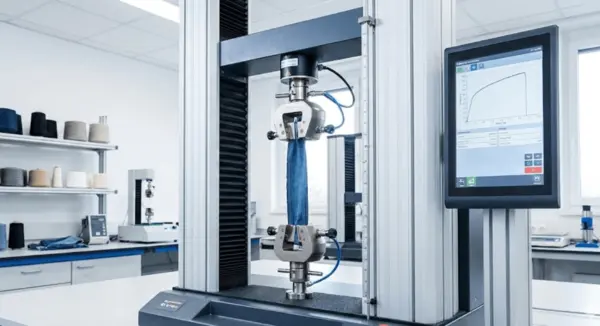
Buying a tensile testing machine is a Capital Expenditure (CapEx) decision that will define your quality control capability for the next decade. This is not a consumable item; it is a long-term asset. The most common mistake mill owners make is viewing this purchase solely as a “box-ticking exercise” to satisfy a buyer’s audit requirement.
This mindset is dangerous. A machine with poor frame rigidity or low-quality load cells can suffer from “calibration drift.” The result? You might be rejecting perfectly good production batches (internal loss) or, worse, shipping defective fabric that passed in your lab but fails in the buyer’s lab (external liability).
If your internal lab data cannot be trusted by your customers, the machine is effectively a paperweight. The goal of this guide is to help you procure an instrument that offers repeatability, reproducibility, and audit-proof data integrity.
Define Your “Force Range” : The 80% Rule
Before you talk to any supplier, you must define the physical limits of what you are testing. The most common procurement error is “Oversizing”—buying a high-capacity machine thinking it covers all bases. It does not.
Tensile testers rely on Load Cells to measure force. A load cell is most accurate between 2% and 100% of its rated capacity (depending on the ISO 7500-1 accuracy class). If you buy a 50 kN (5,000 kg) machine to test delicate 10 Newton yarns, the machine’s “noise floor” will likely drown out your actual data, leading to wildly inaccurate results.
The “Form Factor” Decision:
- Single Column Machines (The Lab Saver): These are compact, desktop units designed for lower force applications, typically rated up to 2.5 kN or 5 kN (approx. 500 kg).
- Ideal for: Yarns, knits, lightweight apparel fabrics, and single-fiber testing.
- Advantage: Small footprint and lower cost.
- Dual Column Machines (The Industrial Standard): These feature two vertical pillars for structural rigidity. They are required when testing forces exceed 5 kN, as the frame must not bend under high loads. Typical ratings range from 10 kN to 50 kN.
- Ideal for: Heavy denim, canvas, webbing, industrial slings, and geotextiles.
- Advantage: Zero frame deflection ensures the movement recorded is the fabric stretching, not the machine bending.
The Procurement Rule: Aim for a machine capacity where your most frequent tests fall at 50–80% of the maximum load. This “sweet spot” ensures maximum sensor longevity and data precision.
Technology Standard : CRE is King
Once you have determined the size, you must specify the working principle. In the world of textile physics, how the machine pulls the fabric dictates whether your data is valid or void.
There are two main technologies you will encounter, but only one is acceptable for modern compliance.
1. The Legacy Trap: CRT (Constant Rate of Traverse)
- Mechanism: Often uses a weighted pendulum or an inclined plane to measure load. As the sample stretches, the pulling clamp moves at a constant speed, but the rate of load application varies due to the swinging pendulum’s inertia.
- The Problem: Inertia creates momentum errors. If you are testing a high-stretch fabric (like Spandex), a CRT machine will give significantly different results compared to modern labs.
- Verdict: Obsolete. Do not buy this technology unless you are replicating data from 1980s specifications.
2. The Modern Standard: CRE (Constant Rate of Extension)
- Mechanism: Driven by precision servo-motors and ball screws. The moving crosshead travels at a perfectly constant speed (e.g., 300mm/min) regardless of how much force the fabric resists with. The load is measured by a stationary electronic load cell, not a moving pendulum.
- The Advantage: It eliminates inertia errors. This provides the “Time-to-Break” accuracy required by ISO 13934 and ASTM D5034.
The Procurement Rule: When requesting quotes, explicitly state: “Machine must operate on the Constant Rate of Extension (CRE) principle.” If a supplier tries to sell you a “mechanical pendulum” tester at a discount, walk away. It is not audit-compliant.
The Critical Accessories :Grips & Jaws
You can buy the most precise CRE machine on the market, but if you skimp on the gripping mechanism, your investment is wasted. The interface between the machine and your fabric—the “Jaws” or “Grips”—is where 90% of testing errors occur.
The most common failure mode is “Slippage”. If the fabric slips inside the jaws during the pull, the machine records “fake elongation,” ruining your data. Conversely, if the jaws are too tight or sharp, they cause a “Jaw Break” (where the fabric snaps at the grip line rather than in the center), which renders the test invalid according to ISO and ASTM standards.
1. Manual (Mechanical) Grips
- Mechanism: The operator tightens the jaws using a screw knob or lever.
- The Risk: The clamping force depends entirely on the operator’s physical strength. Operator A might tighten it firmly, while Operator B leaves it loose. This introduces “human variable” into your data.
- Best For: Heavy, textured fabrics (canvas, denim) that have high friction and don’t slip easily. Budget-sensitive setups.
2. Pneumatic Grips (The Recommended Choice)
- Mechanism: Compressed air controls the clamping. You set the pressure (e.g., 80 psi) once, and the grips close with the exact same force every single time.
- The Advantage: Consistency. It creates a “follow-up” effect—as the sample thins out while stretching, the pneumatic pressure automatically compensates to keep the grip tight.
- Best For: Synthetics, silky fabrics, and slippery linings where manual grips fail.
The Hidden Detail: Jaw Faces The “Face” is the actual surface touching the fabric. Do not accept a “one size fits all” face.
- Rubber Coated: For delicate yarns or fabrics that damage easily.
- Serrated (Pyramid): For standard wovens.
- Wave/Line Contact: For extremely slippery high-tenacity nylons.
The Procurement Rule: For any lab seeking accreditation (ISO 17025), Pneumatic Grips are strongly recommended to demonstrate repeatability. If buying manual grips, ensure the supplier includes multiple “Jaw Face” options (Rubber + Serrated) in the package.
Software & Compliance
You are not just buying a machine; you are buying a data generator. In the age of digital compliance, the software interface is often the weak link where audits fail. A machine that pulls perfectly but exports data in a proprietary, unreadable format is a liability.
1. The “Library” Requirement Textile testing standards are complex. ASTM D5034 alone has specific pre-tension requirements and gauge lengths.
- The Must-Have: Ensure the software comes with a Pre-Loaded Standards Library. Your operators should not be manually programming the speed and formula for every test. They should be able to select “ISO 13934-1” from a dropdown menu, and the machine should auto-configure the parameters (e.g., 100mm/min or 20mm/min depending on the standard).
2. Data Integrity & Exporting Auditors (like SGS, Intertek, or brand compliance officers) love raw data.
- The Red Flag: Software that only lets you print a PDF report.
- The Requirement: The software must allow CSV / Excel export of the raw data points. This allows for advanced statistical analysis (Standard Deviation, CV%) and proves you aren’t hiding outliers.
3. Anti-Tampering Features Can an operator delete a “bad test” to improve the batch statistics?
- The Audit Shield: Look for software with User Hierarchy (Admin vs. Operator). The Operator should be able to run tests but not delete results or modify the test parameters. This “Read-Only” protection is critical for maintaining a credible lab.
4. Future-Proofing Ask the supplier: * “Is the software license perpetual, or is it a subscription?”* and “Will this software run on Windows 11/12?” Many mills are stuck with perfectly good 10-year-old machines that cannot run because the software requires Windows XP.
The RFQ ( Request for Quotation) Checklist
Don’t just ask “How much?” Send this technical query to vendors to filter out the noise.
Subject: RFQ for Textile Tensile Tester – [Company Name]
- Principle: Confirm the machine uses CRE (Constant Rate of Extension) technology driven by servo motors.
- Capacity: We require a machine capacity of [Insert Force, e.g., 5kN].
- Accuracy: State the accuracy class of the load cell (ISO 7500-1 Class 0.5 or Class 1).
- Grips: Quote for Pneumatic Grips compatible with [Insert Fabric Type, e.g., Denim/Nylon]. Include face type (Serrated/Rubber).
- Standards: Is the software pre-loaded with ASTM D5034, ISO 13934, and ASTM D5035?
- Data: Does the software export raw data points to .CSV/Excel?
- Calibration: Do you provide NABL/ISO 17025 accredited calibration certificates upon installation?
- Warranty: Define the warranty on the Load Cell specifically (often different from the main machine).
Final Takeaway
Your tensile testing machine is the “Gatekeeper” of your mill. It is the only thing standing between a profitable shipment and a disastrous claim.
When you buy this machine, you are not buying a motor and a screw; you are buying reputation. If you buy a cheap machine that gives false passes, you will eventually ship bad fabric. The cost of that single claim—air freighting replacement goods, penalties, and lost trust—will be ten times the price difference between a cheap machine and a good one.
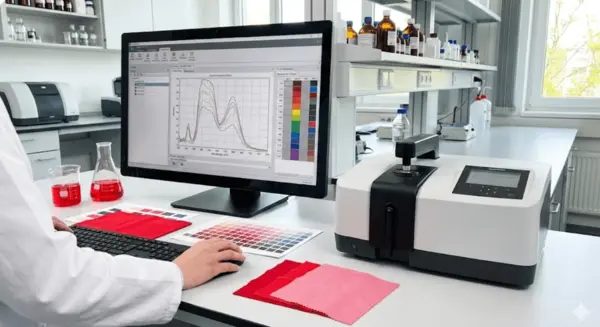
Ultimately, a world-class lab requires total instrument integrity—whether you are stress-testing fabric with a tensile machine or managing shade consistency with a spectrophotometer. Choose wisely. Calibrate often. Trust your data.
One thought on “Tensile Testing Machines: Buying Guide for Textile Mills”
Comments are closed.