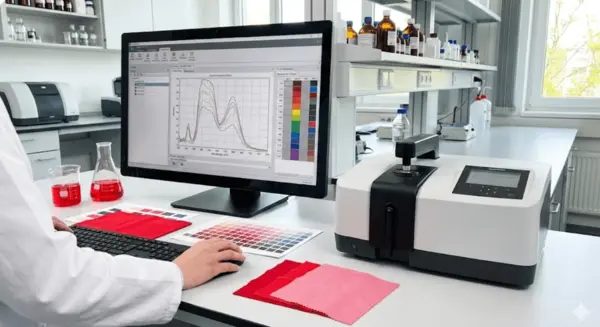
A spectrophotometer can be precise on its calibration tile and still be the wrong purchase for a textile dyeing laboratory. If its geometry, ultraviolet (UV) condition, aperture, software or file format does not match the customer’s measurement procedure, the mill can continue to face pass-at-mill and fail-at-buyer disputes.
For many professional dye-lab formulation and quality-control tasks, a benchtop diffuse/8° integrating-sphere spectrophotometer is a practical starting point. It is not a universal rule. The correct instrument is the one that reproduces the required method on your fabrics, exchanges usable data with customers and remains supportable throughout its working life.
This guide explains how to specify that system, compare quotations and conduct a textile-based acceptance trial before purchase.
Quick answer: Do not begin with brand, price or the smallest published Delta E value. Begin with the customer’s measurement condition, your instrument’s job, your most difficult specimens and the data workflow. Then require every shortlisted supplier to measure the same conditioned sample set using the same documented procedure.
First decide what the instrument must do
“Measure colour” is not a sufficiently precise requirement for an RFQ. Recipe formulation, master-standard creation, routine batch approval and production-floor troubleshooting place different demands on an instrument.
| Primary job | Usual starting point | What the supplier must demonstrate |
|---|---|---|
| Dye-recipe formulation | Benchtop spectrophotometer integrated with formulation software | Spectral-data capture, database compatibility, stable measurement of substrates used in calibration dyeings and correct handling of UV where relevant |
| Creation or transfer of digital standards | Higher-agreement benchtop system | Agreement between separate units, compatible measurement conditions and reliable exchange of spectral data with customer systems |
| Routine lab-dip and batch approval | Benchtop spectrophotometer with suitable apertures | Repeatable results after the sample is removed, repositioned and remeasured; fast pass/fail workflow and audit-ready records |
| Production-floor investigation | Portable spectrophotometer, normally as a secondary instrument | Correlation with the laboratory method on actual production fabrics, rugged sample positioning and controlled transfer of results |
| Fluorescent whites or textiles containing optical brightening agents | System with controllable and calibratable UV energy | Repeatability on the mill’s brightened materials and compatibility with the customer’s specified UV condition |
| Prints, lace, heather effects or very small colour areas | Suitable small-area or imaging system | Correct targeting of the colour area without contamination from adjacent colours, backing or an undersized specimen |
A low-cost colorimeter may be adequate for limited internal checks on stable, uniform products. It should not be assumed to replace a spectrophotometer when the job requires spectral data, recipe formulation, metamerism assessment or digital colour communication.
Collect the customer’s method before asking for quotations
The most expensive mistake is purchasing an instrument and only later asking how a major customer measures the same standard. Obtain a written measurement specification from the customer, brand or buying office wherever possible.
Record:
- instrument maker and model used by the customer;
- optical geometry and specular condition;
- measurement aperture;
- UV included, UV excluded or UV-calibrated condition;
- illuminant and standard observer used for calculation;
- colour-difference equation and any weighting factors;
- backing, number of folds, specimen orientation and number of readings;
- conditioning requirement;
- tolerance and whether component limits such as Delta L, Delta a and Delta b* also apply;
- digital file format and software version; and
- whether the mill will create standards or only measure against customer-issued standards.
The International Organization for Standardization’s ISO 10617:2010 catalogue entry confirms that spectral data exchange between instruments and calculation software is an important textile application. A compatible file is useful only when the associated measurement conditions and metadata are also controlled.
If a customer cannot provide a method, document the mill’s proposed method and obtain written acceptance before building a colour database around it.
Nine specifications that matter in a textile dye lab
1. Optical geometry: match the method, not a slogan
The two common families are directional geometries such as 45°/0° and sphere geometries such as diffuse/8° (d/8°). They illuminate and view the specimen differently, so they can produce different results on the same material. Konica Minolta’s instrument-geometry explainer describes this distinction and notes that geometry affects where a colour falls in colour space.
Sphere instruments are widely used for textile formulation and for rough, textured or irregular specimens because diffuse illumination reduces sensitivity to direction compared with a single directional path. “Reduces” is important: a sphere does not make fabric structure, pile, lustre, stretch or presentation irrelevant.
Do not automatically reject a 45°/0° instrument, and do not automatically buy a d/8° instrument. Use the geometry required by the customer’s procedure and prove performance on the product. Data from different geometries should not be treated as interchangeable.
2. SCI and SCE: keep the setting consistent
Many sphere instruments offer specular component included (SCI) and specular component excluded (SCE) modes. These configurations treat surface reflection differently. Neither is a universal “correct” mode for every textile decision.
The method should state the mode, and standards and batches must be measured consistently. Ask the supplier whether the instrument measures SCI and SCE simultaneously or requires separate measurements, and confirm how the setting is stored in the result record.
3. UV control: essential for some workloads, unnecessary for others
Optical brightening agents absorb ultraviolet energy and emit part of it in the visible region. The UV content presented to the specimen can therefore change the measured result on fluorescent whites and brightened pastel shades.
AATCC maintains a Textile UV Calibration Standard programme for textile spectrophotometers and explains that UV output changes with lamp use. If the mill measures optically brightened products, require the supplier to demonstrate the complete UV-calibration procedure, reference-standard handling, replacement cycle and agreement with the customer’s UV condition.
Do not infer UV performance only from the published wavelength range. Ask what is controlled, how it is calibrated, which accessories or reference materials are required and whether those items are included in the quotation.
If the lab never handles fluorescent materials, document that fact. A more complex UV system may add cost without improving the defined job.
4. Aperture and sample presentation: buy for the real specimen
A large measurement area usually represents more yarns, loops or weave repeats and can improve repeatability on non-uniform fabric. A smaller area may be necessary for yarns, narrow trims, small print motifs and limited sample sizes.
Ask the supplier to state both the illuminated and measured area for every aperture; marketing names such as LAV, MAV or SAV are not reliable dimensions across brands. Confirm which apertures, plates, yarn holders and fabric-compression accessories are included.
During the trial, check whether the sample:
- fully covers the port;
- is opaque at the chosen number of folds;
- can be presented without stretching or crushing the structure;
- can be rotated and repositioned consistently;
- remains flat at the port; and
- can be held safely without operator fingers entering the measurement area.
Datacolor’s textile sample-measurement guidance recommends using the largest aperture the specimen can support and highlights opacity, rotation, texture and consistent geometry as practical controls. Treat this as manufacturer guidance and validate the final procedure for your own products and customer requirements.
5. Repeatability and inter-instrument agreement: read the conditions
Repeatability describes how closely one instrument repeats a measurement under stated conditions. Inter-instrument agreement describes how closely separate instruments—normally units of the same model—measure a defined set of standards under stated conditions.
Both matter, but published values are easy to miscompare. One datasheet may report an average while another reports a maximum. Tile sets, colour-difference equations, apertures, modes, environmental conditions and statistical treatment may differ.
For every figure, ask:
- Is it an average, maximum, range or standard deviation?
- Which tiles or reference materials were used?
- Which aperture, geometry, specular condition, UV setting, illuminant and observer were used?
- How many readings and instruments were included?
- Does the value apply to a white tile only, or to a chromatic tile set?
- Can the supplier repeat the comparison on two saleable units and on our fabrics?
Do not create a universal pass/fail threshold from unrelated datasheets. The purchase criterion should be tight enough that instrument variation does not consume an unacceptable portion of the mill’s customer tolerance, and it must be proven under a common trial procedure.
6. Spectral range, interval and optical design: require fitness for the workflow
The original version of this article prescribed one wavelength range and one interval for every dye house. That is too absolute. Current textile benchtop systems publish different ranges while serving formulation and quality-control applications.
Specify the range and data interval required by the customer method, formulation software, UV workflow and legacy database. Confirm whether the exported file contains the spectral data needed by the receiving system. For fluorescent work, verify calibrated UV performance separately rather than using a start wavelength as a proxy.
7. Software and data ownership: evaluate the system, not the box
The instrument may be unusable for its intended job without formulation or quality-control software. Ask the supplier to demonstrate the complete workflow from measuring a standard to approving a batch, exporting data, recovering a database and auditing a changed tolerance.
The quotation should identify:
- formulation and quality-control modules;
- perpetual, subscription, network and additional-user licences;
- compatible operating systems and computer requirements;
- supported colour-difference equations, illuminants and observers;
- import and export formats;
- access to raw spectral data and result metadata;
- user permissions, audit trail and approval controls;
- backup and recovery method;
- migration of historical standards, dyes and recipes; and
- compatibility with customer portals or fleet-monitoring systems.
Require a successful test migration before purchase when the lab has a valuable legacy database. “Compatible” should mean that the required records and metadata survive the move, not merely that the new software opens one sample file.
8. Calibration, verification and service: plan for the day after installation
Routine user calibration, intermediate performance verification and periodic manufacturer service are different activities. Ask the supplier to separate them in the proposal.
Confirm:
- the routine calibration procedure and required tiles or traps;
- how reference materials are identified, cleaned, stored and replaced;
- available diagnostic or performance-verification tools;
- recommended service interval;
- local engineer location and typical response process;
- calibration traceability and certificate scope;
- warranty exclusions and travel charges;
- expected lamp or component life and replacement cost; and
- availability of a loan instrument during extended repair.
Follow the manufacturer’s current manual, the customer method and the laboratory’s approved standard operating procedure. Do not copy a calibration frequency from another model.
9. Benchtop versus portable: decide whether you need one system or two
A portable instrument is useful when the specimen cannot be brought to the lab, for example during floor investigation or inspection of large assemblies. It also introduces more opportunity for uncontrolled positioning, ambient contamination and differences from the laboratory master method.
For recipe formulation, master standards and tight supply-chain communication, a benchtop system is normally the safer starting point. If a portable unit is also required, define it as a secondary method until correlation with the benchtop system has been established across the mill’s product range. Datacolor’s portable-versus-benchtop overview similarly distinguishes mobile spot checks from controlled laboratory work; final suitability still requires an in-mill trial.
Copy-ready RFQ checklist
Send the same requirement table to every shortlisted supplier. Replace the bracketed fields before issue.
| RFQ item | Requirement to state | Evidence required with offer or demo |
|---|---|---|
| Instrument role | [Formulation / master standards / routine QC / portable investigation] | Proposed configuration and explanation of suitability |
| Customer compatibility | [Customer model, geometry, modes and file workflow] | Data-exchange and cross-instrument trial |
| Geometry and modes | [Required geometry; SCI/SCE condition] | Datasheet, software screenshot and measurement record |
| UV requirement | [None / included / excluded / calibrated to specified method] | Live calibration and measurement of mill fluorescent specimens |
| Apertures | [List actual specimen sizes] | Illuminated and measured dimensions; included plates and holders |
| Performance | [Mill acceptance limits under common trial] | Repeatability, repositioning and two-unit comparison results |
| Spectral data | [Required range, interval and export format] | Exported sample file opened in receiving software |
| Software | [Formulation, QC, licences, users and audit needs] | End-to-end workflow demonstration |
| Legacy migration | [Databases, standards, recipes and history] | Trial migration report and exclusions |
| Installation and validation | [Site readiness, training, protocol and documents] | Scope, schedule and responsibility matrix |
| Service | [Location, response process, calibration and loan-unit need] | Written support plan and itemised annual cost |
| Commercial scope | [Five-year cost schedule] | Itemised instrument, options, licences, service and consumables |
Run a textile-based demonstration before purchase
A white calibration tile is necessary for instrument control, but it is not a buying trial. Give each supplier the same coded, conditioned specimen set and the same written procedure.
Include difficult materials from the mill’s normal workload, such as:
- a dark navy or black;
- a fluorescent white and a brightened pastel, if relevant;
- a textured knit, pile or rib;
- a directional woven fabric;
- a lustrous synthetic;
- a heather, mélange, print or narrow trim;
- a sample close to the mill’s normal acceptance boundary; and
- a customer-approved physical standard.
Then test in this sequence:
- Freeze the method. Record conditioning, backing, folds, orientation, aperture, geometry, specular condition, UV mode, illuminant, observer and colour-difference equation.
- Measure without moving the specimen. This isolates short-term instrument variation under the trial condition.
- Remove and reposition the specimen. This captures the combined effect of instrument, presentation and material non-uniformity.
- Rotate directional materials. Quantify whether the proposed SOP adequately controls orientation.
- Compare apertures where needed. Select the aperture that represents the product and can be used consistently on both standard and batch.
- Compare two separate units of the proposed model. Use instruments that could actually be supplied, not only a demonstration reference unit.
- Exchange data. Open the result in the customer or receiving system and confirm that measurement conditions and metadata remain intact.
- Test UV control. On fluorescent specimens, perform the proposed UV calibration and repeat the measurement after recalibration.
- Test the operator workflow. Have a normal lab user create a standard, measure a batch, apply the tolerance, add a comment and retrieve the result.
- Document exceptions. Record samples the instrument cannot hold, measure or classify reliably.
Set the number of readings and acceptance limits in the approved trial protocol. They should reflect customer tolerances, product variability and the mill’s measurement-system risk. Do not invent them during the demonstration or accept a supplier’s preferred metric without checking the calculation conditions.
Compare five-year total cost, not only purchase price
Use this procurement calculation:
Five-year total ownership cost = instrument + required software + accessories + installation and training + validation + service and calibration + reference materials and consumables + expected downtime and data migration cost − residual value
This is a planning formula, not a claim about any vendor’s cost. Use dated written quotations and a consistent tax and currency basis.
| Cost line | Supplier A | Supplier B | Supplier C |
|---|---|---|---|
| Instrument and required options | |||
| Formulation and QC software | |||
| Computer, network and database | |||
| Apertures and specimen holders | |||
| UV standards and other reference materials | |||
| Installation, training and validation | |||
| Five years of licences and support | |||
| Five years of service and calibration | |||
| Estimated downtime or loan-unit cover | |||
| Data migration | |||
| Less estimated residual value | |||
| Five-year total |
Use a weighted decision score only after the trial
The following weights are an editorial starting point, not an industry standard. Change them to reflect the mill’s customer exposure and workload.
| Criterion | Example weight |
|---|---|
| Customer and method compatibility | 30% |
| Performance on actual mill specimens | 25% |
| Software, data exchange and migration | 15% |
| UV, aperture and sample-handling fit | 10% |
| Local service and lifecycle support | 10% |
| Five-year total ownership cost | 10% |
| Total | 100% |
Score each supplier from 1 to 5 only after reviewing the evidence. Calculate the weighted score as:
Weighted score = sum of (criterion score ÷ 5 × criterion weight)
Keep the raw trial data beside the score. A neat total should never hide a failed customer-compatibility test or an unsupported service promise.
Warning signs in a spectrophotometer quotation
Pause the purchase if the supplier:
- demonstrates only ceramic tiles and refuses to test production fabrics;
- quotes repeatability or inter-instrument agreement without the test conditions;
- will not compare two units of the proposed model;
- describes a UV lamp as equivalent to calibrated UV control;
- omits mandatory software, apertures or licences from the base price;
- cannot complete a sample data exchange or trial migration;
- gives only a verbal service commitment;
- proposes a different geometry without addressing the customer’s method;
- claims that one Delta E number guarantees visual acceptance; or
- pressures the mill to approve before a written acceptance report is complete.
Frequently asked questions
What type of spectrophotometer is best for textile dyeing?
For many professional dye-lab formulation and quality-control tasks, a benchtop diffuse/8° integrating-sphere spectrophotometer is a sensible starting point because it can handle textured materials and controlled colour-data workflows. The final choice must match the customer’s geometry, UV condition, specimen procedure, software and acceptance method.
Is 45°/0° geometry unsuitable for every textile?
No. Geometry changes the measurement and directional geometry can be more sensitive to surface and orientation effects, but the correct choice is the geometry required by the application or customer method. Never assume data from 45°/0° and d/8° systems are interchangeable.
Can a portable spectrophotometer replace the lab instrument?
Not automatically. Portable instruments are valuable for floor checks and large specimens, while a benchtop system normally offers a more controlled platform for formulation, master standards and close supply-chain communication. Validate correlation before using the portable result for the same pass/fail decision.
Why is UV calibration important for white textiles?
Optical brighteners respond to UV energy. If the instrument’s UV condition is uncontrolled or differs from the customer’s condition, two labs can report different values on the same brightened specimen. Use the specified UV method and current reference materials.
Should the mill buy the same brand as its main customer?
Customer compatibility deserves substantial weight, but brand alone is not enough. Confirm the model, geometry, aperture, UV condition, software and file workflow, then run a cross-instrument comparison on shared textile specimens.
How often should a textile spectrophotometer be calibrated?
Follow the current manufacturer procedure, customer requirement and laboratory SOP for that model and workload. Routine user calibration, performance verification and periodic service are separate controls; a service certificate does not replace day-to-day instrument control.
Final buying rule
Buy the measurement system that survives the mill’s test, not the instrument that wins the brochure comparison.
Define the method first. Test the hardest fabrics. Compare two units. Exchange real data. Price every required licence, accessory and service year. When the shortlist is technically qualified, use the separate comparison of current textile spectrophotometer models to investigate specific configurations without turning model popularity into the selection criterion.
A disciplined purchase will not eliminate shade variation; the instrument cannot correct poor sampling, conditioning, dyeing or visual assessment. It can, however, make the measurement contribution controlled, traceable and far easier to defend when the mill and customer disagree.